Best global wealth manager: JPMorgan Private Bank
|
Also shortlisted: UBS BNP Paribas Wealth Management |
| View more 2014 awards |
This year JPMorgan Private Bank passed the $1 trillion mark in private client assets. While the firm has long been a wealth manager of choice for ultra-high-net worth clients in North America, over the last few years, it has succeeded in spreading this reputation beyond the US to become a global force in wealth management and wins the award this year for Best Global Wealth Manager.
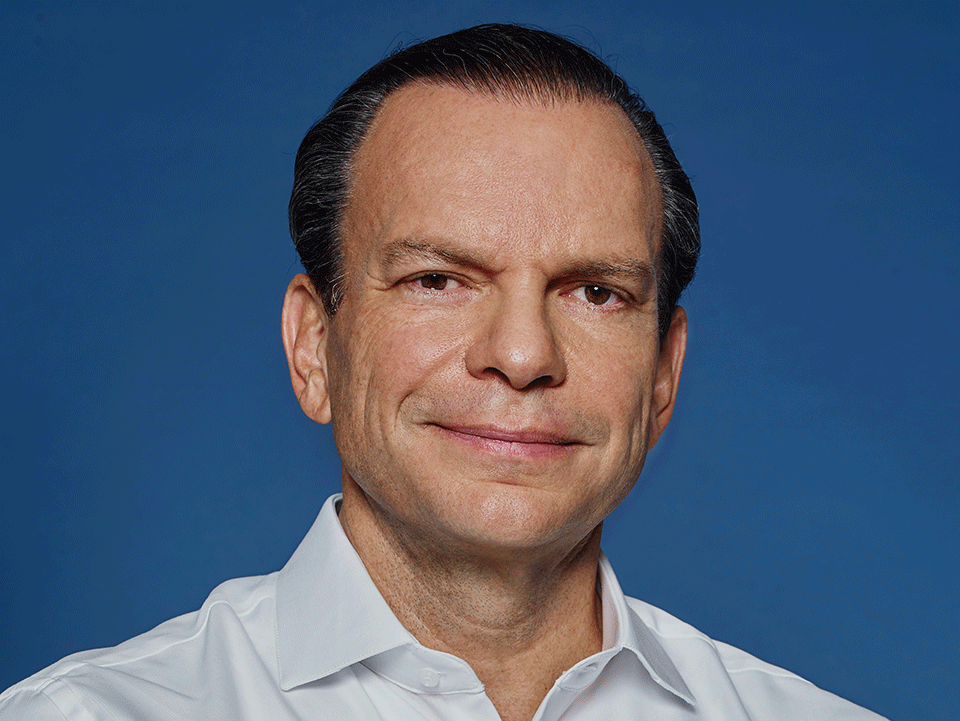
Since the end of 2010 the private bank has added around $270 billion in assets. “Ten to 15 years ago, our business was 65% US and only 35% international – now we’re an even balance by people and real estate,” says Phil Di Iorio, chief executive of global wealth management at JPMorgan. Di Iorio says that being global has its advantages for clients, but that being on the ground and offering local solutions is imperative – particularly as the bank moves down the client wealth spectrum from ultra-high-net-worth to those with between $5 million and $30 million, as it is doing in Asia, Brazil and Mexico. “That wealth remains onshore and needs local products and solutions,” he says.
|

Di Iorio says the bank experienced its greatest market share gains in Europe. “As many of the European banks are restructuring themselves we have managed to get new clients and assets at a very fast pace and our market share has increased – particularly in France and Italy. The benefit we have is a strong and global balance sheet so we can take the place where traditional European lenders were.”
On its own shores, JPMorgan has to compete with Bank of America Merrill Lynch, Citi, Goldman Sachs, Morgan Stanley and a resurgent UBS. It has been strategic in where it adds offices and applies focus. The population drift to low tax states has meant that many of the country’s wealthy are moving to Florida where JPMorgan Private Bank has been adding advisors. In Silicon Valley where the wealth is growing at a fast pace the bank now has an office and has been making hires. “We also have verticals in New York to focus on Silicon Alley where we are trying to bridge private banking and investment banking opportunities,” says Di Iorio.
JPMorgan Private Bank has always been more focused on managing wealth through products and advice than collecting assets however. Over 2013 and the first half of this year, the private bank launched over 30 thematic investment solutions to take advantage of the European recovery, the housing recovering in the US, and trends in energy, technology and healthcare. One theme was the accelerating economic growth, favourable demographic trends and improving macroeconomic and political stability in sub Saharan Africa. There the firm accessed the opportunity for its clients through targeted private equity investing.
Many of the themes are driven by the firm’s CIO and regional CIO group. Over the last few years, wealth managers have adopted the role of a global CIO for their private banks. However, for JPMorgan it has been entrenched in its client proposition since the 1990s. In June 2013, the private bank launched a new global weekly e-newsletter for clients entitled, “CIO View” which shares the firm’s thoughts on the macro-economy, market movements around the world, and portfolio positioning. It is an increasingly demanded proposition. Clients want to know what is behind their wealth managers’ choices in investments and the days of the discretionary manager are long gone.
While performance is a key factor in the management of wealth, advice around lifestyle, succession planning and philanthropy are seen as of equal, if not greater, in importance for many private clients. JPMorgan does advice very well on topics that other banks may deem too niche. For example, in the wake of the US Supreme Court’s repeal of Defense of Marriage Act (DOMA), JPMorgan launched a series of regional roundtables and thought-pieces on considerations for same-sex wealth and estate planning in America. In August the firm formed the Goals-Based Planning Center, an interdisciplinary group of wealth strategists that combined financial and investment planning, such as goal-based investing and estate planning, to help clients map assets to reach specific goals, such as retirement, wealth transfer to heirs and philanthropy.
Philanthropy has always been the feather in JPMorgan’s hat. It has a close relationship with the Bill and Melinda Gates’ Foundation. Last year it partnered with the foundation to develop an exclusive Global Health Investment Fund that helps finance late-stage health technologies that have the potential to save millions of lives in low-income countries. The bank also runs regular family office and next generation thought leadership programs around the world.
While the bank is considered a traditional wealth manager, it is also an innovator.
JPMorgan’s mobile app, released in 2010 and the first of its kind in private banking, allows clients to review all of their banking and investment accounts; perform transactional services including person-to-person payments, check deposits, wire transfers, and bill payments; access content from investment and wealth advisory teams; view TV clips of the firm’s strategists on leading networks around the world; and an allows clients to interact with advisors in real-time. In 2013 the app was amended to include secured prospective investor videos from leading private equity and real estate managers.