 |
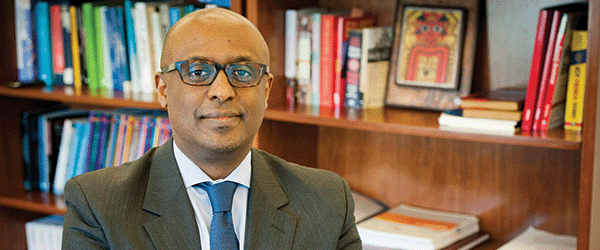
| Abebe Aemro Selassie, deputy director, IMF’s African Department |
 What is the biggest economic challenge facing SSA? What is the biggest economic challenge facing SSA?
|

This is a huge region we are talking about, with an extremely diverse group of countries and circumstances. The region has been doing very well in the last 10 to 15 years. But the single most-important challenge is to sustain the growth we have seen since 2000. We’ve seen average economic growth increase sharply.
About two-thirds of the countries in the region have enjoyed 10 or more years of uninterrupted economic growth. In a quarter of the countries, that period is coming close to 20 years. In the likes of Rwanda, Senegal, Mozambique, Uganda and Tanzania, we have seen very sustained periods of economic growth.
This growth has been built with a backdrop of very sound macroeconomic policies and stability addressing the health and education investment needs that these countries have. So sustaining those sound policies is paramount – that’s really fundamental.
There is a lot of poverty and inequality in the region, but for the vast majority of countries we see a positive future. Sustaining growth is contingent on macroeconomic stability being sustained. We see a few countries where fiscal deficits have drifted to very wide levels, which heightens vulnerabilities, so addressing those is very important. There is lots of fine tuning that needs to take place in terms of macroeconomic management.
|
Which countries are holding the region back?
|
There are some very clear cases where conflict is a major issue. The Central African Republic and South Sudan have severe problems, of course.
And in the last few months the impact of the Ebola virus is having on places like Guinea, Sierra Leone and Liberia is going to affect economic activity.
These are shocks and all countries are susceptible to them. Overcoming these challenges and addressing them quickly is crucial. Particularly for the fragile countries of the region, those with weaker institutions, their susceptibility to shocks is very high. These countries have a lot more to do to make sure that they have more robust institutions to deal with shocks.
| Background |
|
In the 2014 Regional Economic Outlook for sub-Saharan Africa (SSA), the IMF struck a positive tone. Predicting a pick-up in economic growth, the report also said inflation looks set to remain contained in most countries, while fiscal balances, on current policies and prospects, are generally projected to improve in 2014. However, challenges remain and Abebe Aemro Selassie, as deputy director of the IMF’s African department, is well-versed on them. From 2006 to 2009, he was the IMF’s resident representative in Uganda. Before joining the IMF, he worked for the government of Ethiopia. His deep understanding of the problems, policy challenges and economic opportunities facing the SSA region are first-rate. Here he shares his views on what’s working and what’s not. |
Aside from exogenous shocks or weak institutions, there are problems in terms of policy challenges. In a few cases fiscal deficits have widened to levels that cannot be justified by economic conditions and in those cases reducing the deficit is important – Ghana is one example of that. The high level of the fiscal deficit in Ghana has been cause for concern and there are several other countries where fiscal policy is not as counter-cyclical as it needs to be.
With the advent of the global financial crisis, countries that had been pursuing sound policies were able to expand their deficits and provide some support to economic activity. But many countries have remained in that expansionary vein for five years, beyond what is considered the end of the financial crisis. There is a need to revisit those wider deficits in some cases.

This relationship is tremendously important. China has, over the last 10 to 15 years, become a very important trading partner for the region. It’s on a par with traditional partners like Europe now. It varies from country to country, but China’s role as an export destination is generally vital.
The impact of China has also been felt via the import channel, though. China on the global stage has emerged as a major manufacturing power. Its ability to provide goods at very competitive prices has been a boom to the SSA region.
When it comes to Africa, people tend to only look at the export channel and ignore the import side, which has been arguably as important, perhaps more important, than exporting. It’s kept import prices low and given African countries and companies the opportunity to buy manufactured goods at reasonable prices, which helps these countries. I really cannot stress enough how important this channel is. When it comes to Africa, everybody jumps on commodities, but there are other important trade relationships.
A slowdown in China will clearly impact commodity exports in particular, both through lower prices and lower volumes.
On the other hand, China remains a powerhouse. The slowdown has not been as rapid or abrupt as was previously feared. The drag on the SSA region so far has been limited. Yes, Africa’s fate is closely interlinked with China’s, but the reason behind that is that SSA is becoming increasingly integrated into the global economy. With that integration you get the lows as well as the highs, so when the global economy does well, so does SSA. When the global economy is not doing well, then because you are more integrated, you will suffer too.
Of course. Companies in many cases face very high interest rates and borrowing costs because of limited levels of domestic saving, meaning they are trying to tap markets abroad. Or they are trying to acquire foreign currency through import. That’s always going to be a challenge. Most countries in the region tend to have significant current-account deficits.
Over and above that, there are some places where foreign-exchange regulations are cause for concern. From the government side there are various reasons why access to foreign exchange is limited. One is to try to save scarce foreign-exchange resources for the import of goods and items that are seen as more critical. Another is wanting to minimize vulnerability to shocks and keep reserves at adequate levels.
There are some macroeconomic reasons for putting these regulations in place. It’s a difficult balancing act for governments to not stifle business.
The story from the company side is always going to be they need better access to cheaper financing. But from the policymaker side, I think more important is having sound monetary policy and banking sectors. There will always be the short-term urge to try to facilitate access to credit for companies, but it’s not always clear-cut how directly the government can and should intervene.
I urge policymakers to take the longer-term view. The focus has to be on making sure the banking system is robust, where banks are sound, well-capitalized and regulated. Governments also need to make sure there isn’t too much pressure from high fiscal deficits, as this can crowd out the private sector from being able to borrow from banks. There is always going to be a limited amount of credit growth in each country in a given year and if the deficit is excessive that could limit the credit available to the private sector.
Businesses are really booming in this region. The reason we have seen a lot of the growth we have is because businesses have not been throttled in the vast majority of cases – there is a positive dynamic in the private sector. This growth period has not been government-driven in most countries. The point more is continuing to strive to sustain the balance where fiscal policy isn’t excessively loose or where other policy mistakes are made that will throttle the fledgling access that companies currently have to credit. Maintaining that balance is important.
Firms are always going to say it could be better. I’m better placed to focus on the policy side of this discussion. One good thing about the policy attitudes of policymakers in recent years has been focusing more on putting in place the policies and frameworks to allow the private sector to flourish rather than being directly involved in the provision of goods and services themselves.
This also applies to capital markets. We have seen evidence of governments putting in place the regulatory infrastructure and supervisory frameworks that you need for capital markets. In the medium-to-long term, that is going to be the best investment that governments make. And all of this is with a view to, of course, making sure companies, instead of just relying on bank loans for external financing, in due course can look at domestic bonds for funding.
It is always positive to see domestic bonds being issued. These are welcomed developments. Companies need to have the option of alternative forms of financing and the nice thing about being able to issue bonds is it puts competition on banks to provide more attractive loan rates. It all goes towards making sure you have as competitive a market as possible in all areas of economic activity.
It depends on the type of activity companies are engaged in. If your main activity is selling to local markets, producing and distributing locally, then the attractiveness of taking foreign-currency loans diminishes.
On the other hand, if you are an exporting enterprise and have access to foreign currency then that provides you a natural hedge for any foreign-currency risk that might come, to some degree.
Of course, you have to also be wary of the foreign-exchange risk that arises when you borrow in another currency but your revenue sources are denominated in local currency. If you are primarily engaged in importing into the domestic market or your activities are otherwise heavily domestically focused, then of course it pays to stick to local currency. Essentially you want to borrow in the currency you are doing business in.
Foreign currency in many countries is a scarce commodity. As is credit. It is a cause for concern, but I’ve never known any companies in Africa or elsewhere that say they have adequate access to finance. The glass is always half-empty for them.
What we’ve seen so far is a limited impact. This is best exemplified by looking at the ability of sovereigns to continue issuing bonds, like Kenya has done recently. Access to capital markets has not yet been constrained, despite clear signalling that global financial conditions will tighten in a couple of years.
Nonetheless, we also saw at the first sign of discussion of US policy tapering the turmoil that created and at least temporarily the sharp rise in spreads that these countries were facing. It was a warning about what might be coming down the pipe in terms of higher borrowing costs and reduced appetite for funding markets in SSA going forward.
This is a difficult one. Broadly, underpinning the growth record in SSA over the last eight to 10 years has been improving political risk and the reduction in the number of conflicts. There has been a big trend of diminished conflict in the region.
The perception of the political risks being high is an interesting data point for this survey, but overall we have seen reduced conflict. Perhaps they were thinking about not having developed court systems that will allow them to have quicker, stronger contract enforcement.
It’s always pertinent to look at the short- and more medium-term challenges in this region. In the medium-to-long term, our view is that the outlook is favourable and there are several reasons for this. One is that there are tremendous catch-up growth possibilities. In the past, economic growth was hindered by large macroeconomic imbalances, weak and problematic institutions and poor governance, and now we have seen improvements in all of these dimensions. There are still issues, but they are certainly not a barrier to growth like they used to be.
We are also right now seeing the tendency for economic growth to beget more economic growth. As countries grow, they see more investment opportunities and that leads to more growth – it’s a nice, virtuous cycle. But the medium-term positivity will only come to fruition if the shorter-term challenges are promptly addressed.