Best bank in Central & Eastern Europe
Early signs of recovery in the eurozone brought relief to struggling economies across emerging Europe last year but the picture remained very mixed. Countries such as Turkey, Romania and Hungary had a substantial pick-up in growth, but the core central European markets of Poland and Czech Republic were slower to recover from their respective slowdowns. Meanwhile Croatia remained mired in recession, and Russia and Ukraine showed every sign of emulating it even, before the outbreak of the Crimean crisis.
The banking landscape across the region was equally diverse. The relatively mature markets of Czech Republic and Poland again produced healthy returns despite record low interest rates, but elsewhere the latter took a further bite out of already meagre profits. What may prove to be the last hurrah of Russia’s long consumer boom ensured that the market remained a big generator of growth and profits in 2013, but very high levels of non-performing loans continued to bedevil the banking sectors of southeastern Europe and Hungarian lenders had to deal with another year of hefty government depredations. As if that were not enough, the big regional banks also faced the challenge of cleaning and shoring up their balance sheets ahead of the European Central Bank’s asset quality review later this year.
The regional dynamics in the awards period therefore favoured banks with balanced coverage and a big presence in at least one of the most profitable and fastest-growing markets. The winner, however, also needed to demonstrate an ability to protect its bottom line through a credible damage limitation strategy for more challenging environments, as well as a strong balance sheet.
The contest was very close. UniCredit, Société Générale and Erste all scored highly on a number of metrics – however, the group that most closely matched the awards criteria was Raiffeisen Bank International (RBI). With a presence in 15 countries, RBI’s regional network is the largest of any western European group and includes a Russian subsidiary that accounts for a big chunk of last year’s growth and profits. The Austrian group is also expanding in the key Polish market and by March was close to completing the complex integration of Polbank, which it acquired from EFG Eurobank in 2011.
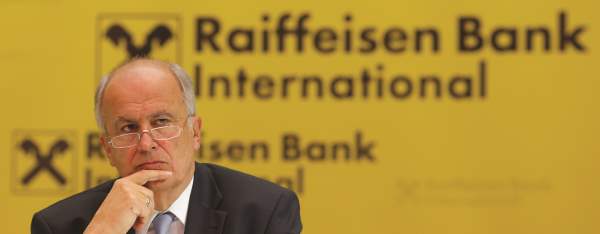 |
| New kid on the bloc. CEO Karl Sevelda wants RBI to target Russia, Romania, Poland, Czech Republic and Slovakia for growth |
Across the rest of its network, RBI had already been pursuing a selective strategy of focusing on its most profitable subsidiaries before the departure in May of chief executive Herbert Stepic. This was further refined by incoming CEO Karl Sevelda, however, who named five markets – Russia, Romania, Poland, Czech Republic and Slovakia – as key to the group’s growth.
This increasingly targeted approach has resulted in deleveraging across a number of RBI’s underperforming operations, which in turn has provided valuable protection to the group’s profitability. Adjusting for a one-off gain from the sale of a large securities portfolio in 2012, the group’s pre-tax profit remained roughly stable last year at €835 million. By contrast, Erste endured a substantial reduction in profits from its CEE network last year, as did UniCredit, after adjusting for one-off boosts from the sale of stakes in Moscow Exchange and Yapi Kredi Sigorta.
Sevelda also oversaw RBI’s long-awaited €2.8 billion capital raise in January, which successfully boosted the group’s core tier-1 capital ratio to 10.1%. That is comfortably above the new Basle III regulatory requirements and should ensure RBI is well positioned ahead of the AQR.
That is not to say that RBI will not face other challenges this year. Slowing growth in Russia and the failure to find a buyer for Ukrainian subsidiary Raiffeisen Bank Aval before the Crimean crisis will almost certainly affect the group’s full-year results and could yet undo some of Sevelda’s good work, although the Russian operation’s corporate focus should help cushion it from the decline in consumer demand. For the period covered by this year’s awards, however, RBI is a worthy winner.
Despite tapering fears and the Ukrainian crisis, debt remained the dominant asset class in central and eastern Europe (CEE) in the 12 months to March. Bond issuance of $113 billion from the region was second only to the record $137 billion in the last awards period, whereas equity primary market and M&A activity was lacklustre even by post-2008 standards.
Best investment bank in Central & Eastern Europe
This weighting is reflected in the choice of Citi, the region’s leading debt capital markets house this year, as the winner of the regional investment banking award. Not only did it succeed in regaining the top spot in the CEE bond league tables from US rival JPMorgan, it was also one of only two houses in the top 10, along with BNP Paribas, to post a year-on-year increase in total allocated volume. Table-topping performances in the key markets of Turkey and Poland were key to this result, as was a very strong showing in Russia, but Citi also demonstrated impressive regional coverage with deals from jurisdictions as diverse as Bulgaria, Azerbaijan, Serbia and Ukraine.
Citi’s investment banking achievements last year were not, however, confined to the bond markets. The US house was also second only to Russian specialist VTB Capital in the equity capital markets rankings, notching $2.24 billion of league table credit from seven transactions. Its role as one of only two leads on VTB Bank’s $3.3 billion capital raise (Euromoney’s deal of the year for 2013) accounted for a big part of the total. Citi also acted on the $527 billion IPO of Polish utility Energa, however, as well as secondary offerings from other companies including Russia’s PhosAgro, Turkey’s Erdemir and Polish bank Alior.
M&A was Citi’s weaker spot but even here the bank took part in some of the year’s biggest deals, including Rosneft’s $1.8 billion acquisition of a 40% stake in Arctic Russia from Italy’s Enel and KKR’s €1 billion purchase of leading Balkan pay-TV and broadband provider SBB/Telemach. Other highlights included advising Allianz on the €684 million acquisition of Yapi Kredi Sigorta and 80% of Yapi Kredi Emeklilik, as a result of which the German group became Turkey’s largest insurer; and acting for Greek telecom incumbent OTE on the €717 million sale of its Bulgarian subsidiary Globul to Telenor.
Best debt house in Central & Eastern Europe
 |
|
William Weaver, EMEA head of EM DCM at Citi |
Key to Citi’s number one ranking in emerging European DCM in the awards period were the extent of its franchise and the balanced nature of its coverage. Borrowers from 12 countries across central Europe, the Balkans and the CIS contributed to the bank’s total allocated deal volume of $13.3 billion, while by issuer type the breakdown was 52% sovereign, 29% corporate and 19% financial institutions. As well as topping the league tables in Turkey and Poland, and coming a creditable third in the Rus sian rankings, Citi also headed the board in Romania thanks to mandates on all three of the sovereign’s transactions in the period.
League table credit, however, was not Citi’s only claim to bond market pre-eminence. The bank also scored highly on qualitative measures, winning mandates on many of the year’s landmark deals across the credit spectrum. In sovereign deals, these included Azerbaijan’s long-awaited dollar debut, Latvia’s first euro-denominated bond since joining the single currency, Hungary’s $3 billion dual-tranche in March, and the largest ever transaction from Turkey, a $2.5 billion 10-year that was launched in January.
Notable investment grade corporate transactions included debuts from Turkish conglomerate Koc Holding, Slovak power distributor ZSE and its gas counterpart Eustream, as well as Lukoil’s $3 billion market return in April 2013. Citi also acted on the inaugural dollar issues of double-B names Bulgarian Energy Holding and Turkish glass producer Sisecam, and picked up a clutch of other high-yield mandates for borrowers including Ukraine’s Mriya Agro Holding, Kazakhstan’s Nostrum Oil and Gas, and Czech Republic’s CE Energy. Overall, sub-investment grade issuance – which also included dollar bonds from Russian financials Nomos Bank and Home Credit and Finance Bank – accounted for 28% of Citi’s allocated volume in the 12 months to March.
Best equity house
In another year of muted primary equity activity in CEE, just $17.9 billion worth of deals emerged from the region, a decline of more than 20% on the previous awards period. There was, however, enough deal flow to produce a clear winner. While only fourth in the overall league tables, Goldman Sachs’ tally of global coordinator mandates on three of the year’s eight IPOs was unmatched by any of its rivals. The trio of deals also spoke to the US house’s breadth of coverage, comprising the market debut of Russia’s Tinkoff Credit Systems, as well as the privatizations of Polish freight operator PKP Cargo and Romania’s Romgaz. The latter, a dual Bucharest-London listing, was not only the largest ever Romanian IPO but also the first to include an international component. Goldman Sachs also acted as global coordinator on Russian diamond miner Alrosa’s $1.2 billion fully marketed secondary offering, which set a new record for listing size on the Moscow Exchange. Other mandates won in the awards period by the bank’s EMEA emerging markets ECM department, headed by Richard Cormack, included a $600 million convertible bond and an accelerated bookbuild of secondary shares for Russian internet search firm Yandex, on both of which Goldman Sachs was sole lead, as well as a $149 million placement for oil and gas field services firm CAT Oil.
Best M&A house
As the go-to investment bank in CEE’s most active M&A market, state-owned Russian house VTB Capital unsurprisingly topped the regional advisory league tables last year. Its reach, however, remained limited to its home market and a couple of CIS neighbours – in striking contrast to second-placed Deutsche Bank, which once again demonstrated impressive breadth of coverage with 16 deals across a wide range of markets and sectors. These included several of the largest transactions in the awards period. The German house acted for Russia’s Alfa Group on its $7.1 billion purchase of RWE’s oil and gas exploration unit, for Rosneft on the $4.7 billion absorption of the remainder of TNK-BP, and for local conglomerate PPF Group on the $5.8 billion purchase of Telefonica’s Czech unit. In the latter deal Deutsche Bank also underwrote a highly structured holdco financing package for PPF, demonstrating its ability to stand behind a complete transaction.Other central European mandates included advising Mid Europa on the $800 million sale of a 39% stake in T-Mobile Czech Republic to Deutsche Telekom, acting for the latter in its $730 million acquisition of GTS Central Europe and advising EVO Payments on its $114 million purchase of a 66% stake in eService from leading Polish bank PKO BP. Deutsche also advised on a Turkish payment processing deal, acting for private equity firm Turkven, but its biggest achievement in the market was as advisor to Yapi Kredi Sigorta on the €814 million sale of its insurance business to Allianz, the largest ever deal in the sector in Turkey.
Best flow house
The true test of a flow house is its ability to continue providing liquidity at times of market stress, and the Crimean crisis proved that Deutsche Bank was more than equal to the task. Not only was the German house one of the few firms to offer prices on the hryvnia and Ukrainian bonds in size even at the height of the political turmoil, it also topped the tables of international market makers in both Russian equities and government bond futures in March.
A similarly strong performance in foreign exchange in Russia, combined with notable gains in other key jurisdictions such as Turkey and outstanding regional coverage, also ensured that Deutsche Bank retained the top spot by overall market share for CEE in Euromoney’s foreign exchange survey for 2014 by a wide margin. The bank’s tally of 18.7% was more than seven percentage points ahead of that of closest rival Citi. Deutsche Bank also took steps to ensure further flow growth across all asset classes in the core Polish market, merging its retail and investment banking operations and expanding its on-the-ground trading staff, while the addition of the Autobahn Corporate Treasury platform to the bank’s electronic trading offering should boost volumes across the region.
Best risk adviser
Risk advisory skills were more than ever in demand in CEE last year as volatility returned with the taper tantrum and then the Ukrainian crisis. Here again Deutsche Bank excelled, devising a range of innovative solutions to help clients protect against market upheavals. In Russia, the bank was the number one provider of corporate foreign exchange hedging in 2013, using lightly structured solutions to obtain better terms for clients than in the plain vanilla markets. Tailor-made knock out and capped swaps provided substantial protection for Russian importers against the decline of the rouble from mid-2013, while the use of target profit forwards – including the first ever conditional TPF – allowed the country’s exporters to both protect against currency appreciation and register a gain on the rouble’s fall. Deutsche Bank was also one of the most active providers of credit default swap protection in the region last year, doubling traded volumes as institutions sought to protect their cash positions, and enhanced its reputation for frontier market innovation with transactions such as the largest-ever cross-currency swap in Kazakh tenge and the first outright forward in Moldovan leu.
Best transaction services house
Few global banks can match the presence of Citi across the CEE region – nine countries, 200 proprietary branches, 6,000 employees covering 10,000 clients – and even fewer can boast a similar financial performance to its transaction services business.
Revenues from this business in the region hit $628.1 million in 2013, generating net income of $280.5 million, with average liabilities of close to $25 billion and assets of $12 billion.
It is this regional strength and capability that distinguishes Citi from other global banks in the region, and it is this combined with its ability to innovate for clients that helps set it apart from regional transaction banks. Citi, as a result, takes the award this year.
The US bank has consistently delivered innovative solutions around cash management, treasury and trade that meet clients’ needs locally, regionally and globally.
In Romania, for example, Citi rolled out its FX Pulse Single Sign on, an end-to-end web-based FX solution that integrates CitiFX, its FX platform, with the multi-currency payment capabilities of CitiDirect BE, enabling clients to buy foreign currency and meet their domestic- and foreign-currency cash management needs.
In Russia, Citi launched its CitiDirect BE tablet application, extending CitiDirect BE functionality to tablet users and designed to provide clients with an intuitive data visualization of their global account balances along with transaction management capabilities. Citi also launched Global Platform for corporate cards in Russia, and introduced a new electronic banking platform for its corporate customers.
The bank was also one of the main advisors in the development and adaptation of an ISO 20022 XML format for rouble payments, allowing corporate customers to use host-to-host payments via a single standardized messaging format across the country in all the banks. This has further helped to integrate rouble payments into customer’s shared service centres and payment factories.