| Best bank in western Europe | Santander |
| Best investment bank in western Europe | Deutsche Bank |
| Best debt house in western Europe | HSBC |
| Best equity house in western Europe | Goldman Sachs |
| Best M&A house in western Europe | Goldman Sachs |
| Best risk adviser in western Europe | HSBC |
| Best transaction services house in western Europe |
Deutsche Bank |
| Best flow house in western Europe | BNP Paribas |
| Country Awards for Excellence 2014: western Europe | |
| Awards for Excellence 2014: Results index | |
Best bank in western Europe
After five years of balkanization of the European banking system, with many national champions abandoning international ambitions, selling out of positions that commanded little share in foreign markets to repatriate capital that domestic regulators have pressured them to conserve close to home, there are hardly any European banks left worthy of the name.
It’s slightly odd that one of the last standing should come from a peripheral eurozone country, Spain, and be perhaps best known for its international diversification into Latin America.
But Santander is an unusual bank: unique in having a credit rating higher than its domestic sovereign and with few peers in having built a diversification of group exposures and earnings through a network of separately capitalized subsidiaries, several publicly quoted on stock markets outside Spain.
It has large retail banking and consumer financing businesses in continental Europe that produce a large share of group earnings. Spain accounted for 7% of group profit for 2013, the UK contributed 17%, Germany 6%, Portugal 2%. While it does not neatly fit Euromoney’s geographic boundary for western Europe, Poland contributes 6% of group earnings with what Santander terms ‘other Europe’ bringing in 5%.
 |
|
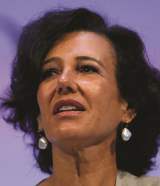
Santander UK chief executive Ana Botín |
Santander has more than six million customers in Germany, where it is the consumer finance leader with a market share of 14.4%. It is the leading car-finance institution in Germany and number one in durables financing, cooperating with more than 21,000 car dealers and more than 27,000 durables dealers in Germany.
In Portugal, Santander Totta boasted the highest profits among the big five Portuguese banks last year, partly boosted as a safe haven for depositors by a credit rating higher than the sovereign’s from Moody’s and Fitch.
Santander UK under chief executive Ana Botín has finally made progress turning round historically poor retail customer satisfaction ratings and welcomed more current account switchers than any other bank last year for a net gain of 11% in current accounts as the UK government moved to increase portability. Amid continuing government concern over weak lending to SMEs, Santander UK increased its lending to the sector by 13% in 2013, the fourth year in a row of double-digit lending growth.
Best investment bank in western Europe
Deutsche Bank is the best investment bank in Europe. Its capital raising, announced in May after the awards review period, shows that, unlike many of its European competitors, it is in no mood to throw in the towel in investment banking. While narrowly beaten into second place in the European ECM bookrunner rankings by Goldman Sachs and into second in DCM bookrunner rankings by HSBC, neither of those rivals offer the same strength across capital markets as Deutsche, which adds to that a respectable fourth place in the M&A adviser rankings.
In choosing a best investment bank, Euromoney typically keeps a close eye on which firm other banks turn to, as they are often the largest, most discerning and financially sophisticated consumers of investment banking services. Deutsche Bank raised more equity capital for western European banks in the period under review than any other firm, €24 billion, helping those banks to strengthen ratios ahead of new regulations and stress tests,
These were not simply easy deals for national champions in core Europe. Deutsche was global coordinator on the recapitalization of Piraeus Bank via a €6.9 billion rights issue.
In the debt capital markets, Deutsche boasts a string of high profile successes. It also provided vital leadership during the difficult period in 2013 from May to September, when the then Federal Reserve chairman Ben Bernanke sparked market jitters with his comments on tapering quantitative easing.
Many deals were under-subscribed but Deutsche re-established the fair clearing level for example for SSA bonds with a deal for the EIB. Unlike many rivals that were over-optimistic about their ability to execute and brought unwise deals to market that then had to be pulled, Deutsche advised many issuers to delay until conditions improved, such as Yorkshire Building Society whose UK RMBS deal in September eventually generated the largest order book of the year.
Telecoms was the most active sector in M&A, accounting for over 20% of volume in the period under review, and Deutsche was closely involved in the stand-out deals: Ono’s sale to Vodafone and Numericable’s acquisition of SFR. It was also active in pharmaceuticals, advising Bayer on its €1.9 billion acquisition of Algeta. It played a key role on the largest deal of the year, coming in the mining sector: advising Xstrata on its merger with Glencore, which closed in May 2013.
Best debt house in western Europe
HSBC had another very strong year in western European DCM, cementing its position at the top of the rankings with $127 billion-worth of business contracted over the awards period for a 6.94% market share. Number two-ranked Deutsche Bank is, however, only a whisker behind on 6.9%. The breadth of HSBC’s franchise has been particularly apparent this year, with the bank among the top three providers in SSA, investment-grade corporates and FIG across the region. In SSA, in addition to healthy benchmark business, HSBC was also behind the Republic of Portugal’s first syndicated new line since its economic adjustment plan in May 2011. It also brought innovation to this market with the inaugural combined benchmark Bund-Laender-Anleihe from Germany’s government and the federal states.
The corporate market has not been short of innovation over the last 12 months either. HSBC has played its role both in bringing new issuers and tapping new investor bases. It was behind the University of Manchester’s first deal in the sterling market and Centrica’s first ever US dollar issue. In high yield it successfully tapped into investor appetite for fallen angels to bring the first German unrated bond in 2014 for Durr and the first Italian unrated bond in 2013 for Indesit. Its £1.35 billion sterling century bond for EdF was the first of its kind, and while there was some criticism in the market over pricing, it demonstrates the bank’s ability to tap into new pockets of investor appetite. The reach for yield by investors has also enabled it to bring a series of issuers to corporate hybrids.
Bank capital trades have been the overriding theme in FIG this year and this is another sector in which HSBC has played its part. It was co-structurer on Italy’s first CRD IV-compliant AT1 deal for UniCredit and brought the first tier-2 transaction from a Spanish bank in 2014 for BBVA. Its £750 million tier-2 deal for BPCE was the issuer’s inaugural sterling deal and the largest sterling tier 2 from a French bank.
HSBC’s focus on non-benchmark funding via medium-term notes and private placements has also been an important part of its DCM offering this year as has its CNH business, in which it has a 32% share in the fledgling market.
Goldman Sachs’ ECM business in western Europe remains the one to beat. In terms of sheer numbers it has a 13.2% market share, was bookrunner on seven of the 15 largest offerings during the awards review period and managed three of the five largest sole bookrunner trades. The bank is always on the ticket for the highest profile deals, and while last year that may sometimes have been a mixed blessing (see Royal Mail) the strength of the franchise is hard to dispute.
Best equity house in western Europe
Europe’s equity markets benefited from a transformation in investor appetite over the review period and Goldman Sachs took advantage of this to re-open several markets – a notable example being Piraeus Bank in Greece which sold €1.75 billion shares in March. The surge in European IPO activity was one of the most dramatic developments in the capital markets this year, with private equity sponsors in particular taking advantage of the long-awaited return of this exit route from their investments. Goldman Sachs has played an important role in helping repair relations between institutional investors and private equity over the year – a product of its strong relationships on both sides of the table. The bank managed seven sponsor IPOs in western Europe last year, including Merlin, Pets at Home, Kion and Moncler. While the Royal Mail IPO has subsequently attracted a raft of negative publicity for both Goldman and the other houses on the deal, it was the result of 11 months of investor education and communication by the US bank before the sale.
The surge in IPO activity and appetite left plenty of room for innovation, and Goldman was at the forefront of this as well. It was behind the landmark EADS accelerated bookbuild offering and cash-settled contract – the largest ABO in Germany since 2005 and arranged KPN’s equity equivalent capital raise. It has also been at the forefront of complicated and confidential transactions, a prime example being the Adecco ABO, which was the third largest ABO this decade behind Volvo and Continental, both of which Goldman solely led.
Best M&A house in western Europe
The boom in European cross-border mergers and acquisitions in the past 12 months was captured best by the investment bank that has corporate dealmaking at its heart – Goldman Sachs.
The US investment bank notched up 94 advisory roles on deals worth a combined $236 billion, over $50 billion more than its nearest competitor JPMorgan, handing it a staggering 34% market share.
Goldman was also the number-one adviser across industry sectors – natural resources, technology, media and telecoms, financial institutions and healthcare – and lead advised on nine out of the top 15 completed M&A transactions this year, worth a combined total of $133 billion.
A selection of those complex and jumbo deals included acting as lead financial adviser to: Xstrata on its $45.5 billion mega merger with Glencore; Virgin Media on its $24.1 billion sale to Liberty Global; and Vodafone on its $11.4 billion acquisition of Kabel Deutschland.
Indeed, executing large complex deals is something Goldman thrives on.
It advised the Spanish government on the $14 billion recapitalization of Banco Financiero y de Ahorros in May last year, the largest recap of a financial institution in Spain, which involved the issue of contingent convertible bonds by Bankia, subscribed by BFA and subsequently converted into shares. The deal ultimately returned Bankia to solvency.
The success of the turnaround – Bankia reported an after-tax profit of €818 million for 2013, compared with a loss of €21.2 billion in 2012 – enabled Goldman this year to pick up a role advising Spain’s rescue fund (Fondo de reestructuración ordenada bancaria) on Bankia’s privatization.
In addition to that, Goldman lead advised: Warner Chilcott on its $8.5 billion sale to Actavis; DE Master Blenders on its $8.4 billion sale to a Joh A Benckiser-led investor group; and Repsol on the $6 billion sale of its liquefied natural gas assets to Royal Dutch Shell in January.
Best risk adviser in western Europe
Western European institutional investors and companies across industries continue to face a multitude of risk management challenges as a result of the ever-changing global financial landscape.
The bank that arguably did more than any other to address these challenges by developing new markets, originating workable funding and risk management solutions, analysing the impact of market changes and identifying opportunities to hedge and increase returns is HSBC.
It executed six landmark transactions for investor and issuer clients over the past year, one of the most important being its role as joint lead manager and sole duration manager on the UK DMO’s £5 billion 2068 index-linked bond. The issue not only extended the index-linked gilt curve by six years, but was also the longest dated sovereign bond, and is the largest single duration event in the global bond markets to date.
Other landmark transactions include: the largest ever renminbi denominated interest rate swap (Rmb900 million ($144 million)) to hedge an intercompany loan for a European multinational; sole counterparty on a €780 million interest-rate swap hedging financing on the largest acquisition in European real estate in 2014; and executing a €1.1 billion swap as a pre-new issue hedge, enabling the first public euro issue of commercial mortgage-backed securities since the financial crisis.
Away from landmark transactions, HSBC helped its clients navigate moves in interest rates, identifying relative value strategies to risk manage the exposure. The bank also helped European insurers address the challenge of depressed rates and credit spreads to improve returns. In March, for example, HSBC self issued a €50 million 15-year VariCap note for a French insurer in response to growing interest in yield-enhancement structured products that addressed low rates. The note was the first traded in the euro market since 2008.
The bank that has not only been at the forefront of helping European treasurers navigate and adapt to regulatory change but broadened its client offering and delivered innovative solutions is Deutsche Bank.
Regulatory change, not least the Single Euro Payments Area directive, has been top of treasurers’ minds, and Deutsche has been the ‘go-to’ bank for advice and technical expertise.
Its experience as a leading processor of Sepa credit transfers and direct debits has meant it is well-positioned to support corporate clients in complying with the directive, while investment in a high-tech Sepa processing engine has helped the flow of payments at a time of acute need for companies.
The bank also led the way in announcing domestic pricing for all bulk cross-border transactions within the Sepa area, and introduced an accounts receivable manager for Sepa, streamlining and simplifying the complexities of the reconciliation process, and reducing administrative costs as a result.
In addition, Deutsche launched its ‘Payments and collections on behalf of’ programme for corporate clients to help them optimize their treasury operations, as well as making a substantial investment in the cash and trade business by creating a global solutions unit for large corporate clients across target industries and geographies.
Best transaction services house in western Europe
Technological innovation has been a hallmark of Deutsche’s global transaction banking business in recent years – launching the Autobahn app market is a case in point – and in the past year it continued to develop and launch new products. For example, its partnership with Xchanging, the business technology services provider, led to the launch of Netsett, a central accounting and net settlement clearing services platform for the global open-market insurance industry.
Deutsche’s trade finance business also had a strong year, and at the end of 2013 it had documentary credit, collections and guarantees worth more than €70 billion on its books. Indeed, across the board, Deutsche’s performance in west Europe has been impressive, leading to it be recognized again as the region’s best cash manager in Euromoney’s 2013 cash management survey.
Best flow house in western Europe
The future of the big European flow houses has been the subject of much conjecture. US competitors jibe that they face a huge challenge to their model in a new era when leverage ratios hit hard. Of the traditional big two in the region Barclays has announced its intention to retreat from some capital intensive businesses. Deutsche Bank, on the other hand, intends to cement its position as the only European flow monster.
Amid all this noise, one regional firm continues to get on with its business quietly and to good effect. BNP Paribas remains committed to flow markets across all asset classes. The French bank punches its weight in areas such as credit, rates and foreign exchange. It continues to be the competitor to beat in equity derivatives, but over the past year has enhanced its offering to clients providing extensive market access to clients and a range of tailor-made products to investors who are looking to manage and mitigate risks.
BNPP has also boosted its prime brokerage services model. Investment in multiple margin methodologies means that clients can optimize capital usage and increase leverage, also providing big reductions in financing costs for alternative money managers. Leveraging its historical derivatives expertise, BNPP supports cross margining of global equities, American Depositary Receipts, exchange-traded funds, certificates, warrants, bonds, global portfolio swaps, listed futures and options and OTC derivatives.
As both cash and derivatives flow business migrate to e-trading, BNPP has invested in its electronic offerings. It believes that its Cortex e-FX platform, which integrates products and customizes services to give clients full control of how they use the platform front-to-back on more than 150 currency pairs, will allow the bank to gain market share from rivals in the foreign exchange market.