 |
|
| Best bank in Africa | Guaranty Trust Bank |
| Best investment bank in Africa | Barclays |
| Best debt house in Africa | Citi |
|
Best equity house in Africa |
Citi |
| Best M&A house in Africa | Barclays |
| Best risk adviser in Africa | Standard Chartered |
| Best flow house in Africa |
Standard Chartered |
| Best transaction services house in Africa | Standard Chartered |
| Country Awards for Excellence 2014: Africa | |
| Awards for Excellence 2014: Results index | |
Best bank in Africa
This year, Euromoney’s best bank in Africa is Nigerian player Guaranty Trust Bank (GTBank). It stands out not only because of its stellar performance in its home country, but precisely because the bank represents a new standard of local expertise in Nigeria and is successfully delivering on its regional ambitions.
Since the Nigerian banking crisis, which came to a head in 2009, and following a period of consolidation in the sector, a number of Nigerian banks have emerged as important regional players. Nigeria’s policy makers and bankers should be applauded for their efforts to clean up the troubled banking sector, which is now picking itself up.
Intervention by the Asset Management Corporation of Nigeria (Amcon), the bad bank used to mop up bad debt in Nigeria, helped to reduce the banking industry’s NPL ratio to an average of 5% in 2013 from over 30% three years earlier.
Moreover, the long-overdue rebasing exercise completed in April 2014 also illustrates the country’s true strength and size, firmly outpacing South Africa as the continent’s largest and most important economy.
Meanwhile, South Africa is lagging behind its African neighbours. Subdued economic growth and an impending recession, a contracting mining sector and interest rate hikes have put pressure on South African banks’ asset quality and inhibited business development.
As a result, the likes of UBA and Ecobank, along with GTBank, are doing well and are beginning to follow in the footsteps of traditional leaders Standard Bank and Standard Chartered, albeit on a much smaller scale to date, to broaden their footprints and become regional banking players.
GTBank has made one of the most interesting acquisitions over the period under review. In February it bought a 70% stake in East Africa’s Fina Bank Group for $100 million, gaining entry into the burgeoning markets of Rwanda, Kenya and Uganda.
With the acquisition, GTBank now has operations in nine African countries, including Cote d’Ivoire, Gambia, Ghana, Liberia and Sierra Leone, as well as a presence in the UK.
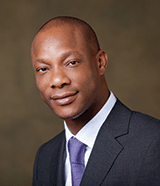
The already strong and efficient leadership in GTBank has been able to leverage off successful policy implementation and the economy’s growth. Segun Agbaje, chief executive of GTBank in Nigeria, is one of the most respected and trusted bankers in the region, with a strong track record of leading the bank’s development.
 |
|
Segun Agbaje, GTBank. The bank now has operations in nine African countries |
Under Agbaje’s leadership, GTBank issued a five-year $400 million Eurobond with a coupon of 6%, one of the lowest for any Nigerian company, highlighting the bank’s global appeal. Gross earnings for the bank reached N242.67 billion ($1.49 billion) at the end of 2013, up from N223.07 billion in 2012. Profit before tax at the end of 2013 was N107.09 billion.
During the year under review, GTBank adopted a three-tiered “know your client” programme, which uses flexible account opening requirements to allow socially and financially disadvantaged people to gain access to the bank’s products and services. This was complimented by the introduction of agent banking services, creating wider access to the bank’s products and services.
The bank continues to show its dedication to gender equality and female empowerment – an issue pertinent to African countries. As of December 2013, 44% of the bank’s staff and 30% of senior management were female.
GTBank stands out as Euromoney’s best bank in Africa for its ability to adapt to local situations while maintaining international standards of best practice.
Best investment bank in Africa
This year, Barclays has succeeded as best investment bank in Africa due to the breadth of debt, equity and M&A deals that it has worked on across the continent.
In Kenya, Barclays worked on the local currency issue for East African Breweries, a subsidiary of the Diageo Group, to raise KSh3.97 billion. Barclays led the extensive capital structure advisory exercise to ensure the successful issue of Diageo Group’s first debt capital market issuance in Kenya and sub-Saharan Africa.
Offshore, Barclays, along with Citi, led Ghana’s 10-year $750 million Eurobond in July 2013 with a yield of 8%. And Barclays, with Deutsche Bank and Standard Chartered, has been chosen again to work on Ghana’s third Eurobond, planned for later this year. The repeat mandate highlights the bank’s track record of successful debt issues in Africa.
In equity, Barclays worked on the listing of one of the world’s largest natural resources companies, Glencore Xstrata, on the Johannesburg Stock Exchange in November 2013 – the largest listing on the exchange for 10 years.
The listing makes investment in Glencore easily accessible to South African investors through its new classification as a domestic equity and the JSE listed shares are fully interchangeable with those listed in London and Hong Kong.
In project finance, an important yet notoriously difficult sector in Africa, Barclays has been able to do several high profile deals in South Africa.
South Africa has been one of the only countries in the continent to develop a number of long-term renewable energy projects through fully fledged independent power producer (IPP) procurement programmes and Barclays has been at the forefront of these deals.
In November 2013, Barclays won mandates to provide R10.8 billion ($1.02 billion) of debt funding in South Africa to a total of six renewable energy projects under the government’s third IPP round.
The bank acted as the mandated lead arranger for two of the largest deals including the R3 billion, 17-year concentrated solar power project in Bokpoort in the Northern Cape. The greenfield project will have a net generation capacity of 50 megawatts with 9 hours of thermal energy storage and once completed it will be the concentrated solar power plant with the longest amount of thermal storage in the world.
Barclays also arranged R8.3 billion in debt for the Department of Energy’s Peakers Project, involving the construction of two open cycle gas turbine peaking power plants at Avon in KwaZulu-Natal and Dedisa in the Eastern Cape. The project will provide energy to the grid at peak times, and will be Africa’s first greenfield thermal power project to be delivered by an independent producer.
Both projects, as well as the others that Barclays has worked on, will do a great deal to supply sustainable energy to a country which is making a great effort to tackle remaining energy bottlenecks.
Best debt house in Africa
Debt capital markets in Africa have been driven over the last 12 months by Eurobonds, which have gathered momentum as investors search for yield and African sovereigns and companies require additional funding for infrastructure and development.
Citi, under William Weaver, the bank’s head of emerging market DCM, has firmly positioned itself as the go-to bank for debt capital markets in Africa, working on many of the continent’s first Eurobonds. The bank has raised over $9 billion in the primary market for issuers from the region accounting for around 71% of the total volume during the period under review.
Last year, Citi worked on Rwanda’s debut $400 million Eurobond, the first from an East African country. In Morocco, Citi led BMCE’s $300 million debut bond, the first non-sovereign issuer out of Morocco.
In Nigeria, Citi has helped the likes of Diamond Bank and Zenith Bank tap the debt market for the first time, allowing both banks to raise necessary funding for the burgeoning oil and gas sector in the country.
In South Africa, Citi continues to dominate, having worked on all investment grade dollar corporate bonds in the country including Eskom’s $1 billion 10-year bond, AngloGold Ashanti’s $1.25 billion bond and Naspers’ $750 million seven-year bond issue.
Best equity house in Africa
Citi has also outperformed its peers in the equity capital markets in Africa. Headed by Miguel Azevedo, head of investment banking, Citi has raised $1.7 billion in equity for its clients in Africa over the last 12 months, more than any other bank, having led three large international transactions in the region.
Most notably, Citi acted as the sole adviser to Atlas Mara, an Africa-focused investment vehicle managed by former Barclays chief executive Bob Diamond and Ugandan entrepreneur Ashish Thakkar. The vehicle, the first of its kind, raised $325 million through a London IPO.
In November 2013, Citi acted as joint bookrunner for pharmaceutical company Aspen’s $696 million accelerated equity offering (AEO) when GlaxoSmithKline decided to sell its stake in the company. It was the largest AEO since September 2010 and the largest South African equity transaction since March 2012.
More recently, Citi acted as joint bookrunner for furniture and household goods company Steinhoff International Holdings in January to raise $630 million via a seven-year convertible bond, representing the lowest coupon (0.4%) ever achieved in the public bond market in South Africa and the highest conversion price to date.
Best M&A house in Africa
In M&A, Barclays leads the league tables this year, with 10 deals completed worth $2.9 billion, a market share of more than 12%, according to Dealogic, after leveraging on cross-border opportunities through the most developed financial market, South Africa.
In October, Barclays advised Metair Investments, an automotive parts manufacturer in its acquisition of Mutlu Aku, a Turkish acid battery manufacturer and distributor for $276 million, which was the largest ever South African investment into Turkey.
Barclays also acted as the buy-side adviser to a Chinese consortium to acquire Palabora Mining Company from Rio Tinto Group and Anglo American, one of China’s most complicated cross-border investments into Africa.
Barclays has also made an important move with the strategic combination of its African business with Absa Group under the new name of Barclays Africa Group.
Best risk adviser in Africa
Under the leadership of Rajat Kumar, Africa’s head of fixed income, Standard Chartered beats Standard Bank to be named best risk adviser in Africa this year. The bank, supported by its regional presence in 15 African markets, and over 170 branches in sub-Saharan Africa, has safely steered its clients through an environment of heightened volatility in the foreign exchange and interest rate markets across Africa.
Since Standard Chartered introduced local currency bond trading, it has developed cross-currency swap and interest-rate swap curves to expand and improve risk management and liquidity for hedging solutions to clients.
Between April 2013 and March 2014, Standard Chartered completed derivative trades of over $4.4 billion and the bank has the largest market share in interest rate derivatives in Ghana, Zambia, Nigeria, and Tanzania.
Best flow house in Africa
Standard Chartered also stands out as the best flow house in the region, especially as the bank is able to leverage its international network and client flows from offshore hubs in London, New York, Singapore and Dubai into Africa. The bank benefits from coordination between onshore and offshore sales and trading teams.
Due to the bank’s strong international presence, it can contribute to Africa’s financial development: local bankers often attend international training programmes in Standard Chartered’s other offices to get exposure to more established markets, developing personal expertise and deepening the markets in Africa itself.
Standard Chartered is the leader in FX, making markets in more than 30 currencies in spot, forwards and non-deliverable forwards. Clients also have 24-hour access to FX liquidity through the bank’s global e-commerce platform, which trades 25 African currencies and crosses.
Best transaction services house in Africa
For its impressive range of innovative solutions for corporate clients across the entire spectrum of supply chain, trade finance, liquidity, collections and payments, Standard Chartered also wins the award for best transaction services house this year.
Across transaction banking business lines, Standard Chartered has supported its clients in adapting to new opportunities and has continued to develop its technology to suit client’s changing needs.
In receivables and reconciliation, the bank launched its Virtual Account solution in South Africa and added more channels to the existing capability in Kenya, Uganda, Nigeria and Ghana. It also launched its mobile payments platform in Kenya and Nigeria, enabling clients to upload a payment file for direct credit to mobile wallets. Roll out of this to Uganda, Tanzania, Zambia and Ghana is happening this year.
Standard Chartered has also led the way in Africa on bank payment obligations and has been there for clients on the supply chain and financing side too. In the past year it has structured innovative structured commodity finance facilities, import finance facilities and host-to-host, collections and electronic letters of credit.
It’s a strong performance across the board that helped boost its Africa ranking in Euromoney’s 2013 cash management to third from fifth the year before.