|
Australia
|
 |
| Michael Smith, ANZ. Healthy growth puts the bank in the lead |
ANZ wins best bank in Australia as it grew assets at a healthy lick during the awards period and posted an impressive return on equity. ANZ is also the most valuable banking brand in Australia, according to a recent survey. Last year, it posted a fourth straight year of record annual profit, this time with an 11% rise year-on-year to $6.3 billion.
ANZ is now the third-largest banking group in Australia behind National Australia Bank and Commonwealth Bank. It is expected to make its plans for the rest of Asia clearer in the coming weeks amid reports that it may be forced to reconsider its stakes in several smaller regional lenders.
But as it stands, outside of Australia, ANZ is the most active of the Australian banks and has targeted up to 30% of earnings from outside Australia and New Zealand inside the next three years. ANZ recently appointed Farhan Faruqui, former head of corporate and investment banking at Citi as its new head of international banking. Faruqui will look to expand ANZ’s reach in corporate and investment banking.
In doing so he will be chasing the acknowledged market leader and winner of the award for best investment bank in Australia (and the award for best equity house) once again, UBS.
With a market share of 32% in equity raising, UBS is the undisputed market leader in Australia and has been for the best part of 10 years. During the awards period it arranged almost three times the amount of equity capital raising as its nearest competitor. In block trading, UBS is still more dominant, with a 47% market share, making it an obvious choice also for the award of best equity house. It also leads the field in DCM in Australia and is always top three in M&A, making the investment banking award an easy decision.
In M&A Macquarie worked on the most deals during the awards period, advising on 37 transactions. Goldman Sachs advised on 31 and UBS on 36 over the same period. But it is not just volume that wins Macquarie the best M&A house award. It also advised on some of the most important deals. For example it served as joint financial adviser to State Grid International Development – the world’s largest utility company and a subsidiary of State Grid Corporation of China – on the acquisitions of 60% of the shares in SPI (Australia) and 19.9% of the stapled securities in SP AusNet, from Singapore Power International. This was the largest Australian M&A transaction in 2013.
In the debt house category, Westpac, last year’s winner of the overall best bank award, takes the spoils. It worked on 69 deals during the awards period worth a combined total of $22.2 billion, narrowly missing out to ANZ in the league tables overall.
But the growth in the business is what made it most impressive. Westpac made a coup last year when it hired John Chauvel, former head of the financial institutions group at ANZ, as head of debt capital markets, underlining its ambition to expand still further in the sector. While the bank has always been strong in Aussie and Kiwi dollar debt, it is starting to have greater impact in foreign currency bonds.
 |
Bangladesh
|
During a period of political and economic instability, City Bank of Bangladesh thrived and wins a new award this year as the best bank in Bangladesh.
As of the end of last year, City Bank’s capital adequacy ratio, under Basle II, was 11.7%. Deposits grew by Tk13.4 billion ($172 million) in 2013.
Across a range of businesses, the bank embraced change in a way that its rivals struggled to match. The bank was joint arranger with two partner banks for a $66 million commercial loan backed by a sovereign guarantee as part of a deal worth $351 million to finance the delivery of two Boeing 777 commercial aircraft for the national carrier Biman.
In internet banking, City Bank introduced Citytouch, an innovative platform in a market where the use of internet banking is very limited. It also looked to break into the growing market serving high net-worth individuals in Bangladesh, launching a dedicated boutique private bank called Citygem.
Traditionally, the investment banking industry in Bangladesh has been quite limited in scope, focusing mainly on IPOs, pre-IPO placements and extending margin loan facilities.
As a result, the Bangladeshi capital market has not seen many other capital market instruments such as bonds, quasi-equity instruments, convertible securities and derivatives. But NDB Capital has been foremost among institutions in Bangladesh in terms of introducing new instruments that are starting to help Bangladeshi businesses to raise funds at competitive rates, as well as providing investors with a wide choice of investments.
NDB Capital has also played an important role in creating awareness amongst institutional investors such as banks, insurance companies and mutual funds about new investment opportunities. For this it is our choice as the best investment bank in Bangladesh.
 |
Cambodia
|
ABA Bank wins the inaugural award for the best bank in Cambodia. Earnings per share at the bank grew by almost a fifth while total revenues rose by a quarter. Operating profit was up 40% and profit before tax 28%.
The Cambodian market remains underbanked because of political unrest and the civil war. There are 35 commercial banks vying to sign up more customers.
ABA has worked to upgrade several of its branches in Phnom Penh and the provinces and is also embracing technology, redesigning its website and improving cardholder security, cash deposit machines and other factors that will be important in taking banking in Cambodia to the next level. For its role in leading these efforts, ABA Bank wins the award.
 |
China
|
China was one of the stories of the review period. The new administration took over amid high hopes that this would help restore growth and that China would again become the undisputed driver of growth for businesses in the wider region.
The early signs are good. Market reforms are being pressed through at a dizzying pace. If the authorities stick to their ambitious plans, then the new mood of optimism should not be misplaced. As the government seeks to broaden its horizons by encouraging more inbound and outbound businesses, the banks that also embrace such an approach are likely to prosper. So far, instances of Chinese banks having a lasting impact beyond China’s borders are rare. But one bank, China Development Bank, is showing the way. Having started life as one of the mainland’s three policy lenders, it is now the world’s largest provider of overseas loans, ahead of Asia Development Bank and the World Bank. It has capitalized on the retrenchment by several leading banks, particularly large US lenders, in the wake of the financial crisis to forge ahead and it now exerts a growing influence on the international stage. Increasingly it is one of the most important tools in China’s foreign policy kit.
Evidence of its fresh approach came when it signed an agreement with the African Development Bank to co-found a $2 billion fund. This fund is expected to start financing projects quickly in Africa and follows Chinese premier Li Keqiang’s first visit to the continent. It is also in a group of institutions that will assist Pakistan with infrastructure development projects and recently agreed to deepen its ties with the UAE, among a host of measures designed to broaden its overseas portfolio. For being the best example of a Chinese bank exerting that country’s considerable power overseas, China Development Bank is this year’s best bank in China.
In investment banking ICBC continues to set the standard. It is the Chinese bank that foreign banks active in Asia most often cite as getting it right. Income from investment banking services at ICBC, including M&A and reorganization, rose by 43% due to a surge in demand from enterprises involved in restructuring; income from physical precious metals, pension and private banking grew by more than 70%.
Goldman Sachs tops the league table for ECM in China for the awards period with an almost 10% market share, making it an easy choice for the best equity house award. It worked on 34 deals with a combined deal value of more than $9 billion.
In M&A, Morgan Stanley is just ahead of Goldman Sachs, which in turn is just ahead of CICC and UBS. Deal flow was slow, and while Morgan Stanley did not work on as many deals as several of its leading competitors, it worked on the ones that mattered and built up a market share of almost 9% through the 15 deals it advised on, which together were worth $22.3 billion.
In debt capital markets, the Chinese banks naturally come to the fore, with UBS the only foreign institution sneaking into the top 10 ranking table, and then only at number 10. China Development Corp is top of the pile according to Dealogic but China Construction Bank, one of the ‘big four’ lenders, is Euromoney’s choice as best debt house in China due to the scale of its DCM franchise, working on 142 deals, with a combined value of $23.5 billion, during the review period.
 |
Hong Kong
|
The awards for Hong Kong are seldom too difficult to decide and this year was no different. HSBC wins best bank and investment bank. The awards are recognition of its achievement on many fronts serving clients in Hong Kong.
It continues to be the dominant debt house, if anything building its lead over its closest rivals still further. It is the only bond house to be ranked number one in the G3 league table for Hong Kong issuers, G3 bonds for Chinese issuers, US dollar bonds for Chinese high yield issuers, as well as HK dollar bonds and offshore RMB bonds.
HSBC also led all benchmark (deal size above $200 million-equivalent) G3 transactions for Hong Kong borrowers during the awards period, representing a 100% hit rate, a feat that no bank has achieved for the last 10 award periods.
Its dominance in the HK dollar bond market was further cemented with the bank seizing the number-one spot in the HK dollar bond league table once again, executing more than half the deals priced with a market share of almost 55%.
HSBC also led the way in equity and equity-linked issuance. It was ranked number one in Hong Kong IPOs, number one in Hong Kong rights issues and number one in Hong Kong equity-linked offerings. HSBC’s ambition is to expand the equity platform to become a leading player across Asia-Pacific and the signs are encouraging that this ambition will be achieved sooner rather than later.
In global trade and receivables finance, the bank introduced a new supply chain financing platform and in cash management it launched an Asia-Pacific same-day remittance service that enables fund transfers between HSBC accounts in Hong Kong and those in eight of the most important Asia-Pacific markets for renminbi, US dollars and HK dollars. In commercial banking, loans and advances to customers reached $84 billion at the end of 2013, up 17% year-on-year.
In investment banking, its plan to be a one-stop shop, providing advisory services and financing to a diverse range of customers is beginning to look like it is working, and Hong Kong is a microcosm of Asia-Pacific in this respect.
Its deep roots with Hong Kong corporates are undeniable and HSBC remains the go-to bank for most of them.
 |
India
|
Last year was a waiting game for most banks in India. With the recent election by a landslide of Narendra Modi of the BJP, it looks like good times for India could be coming soon.
In the banking world, none of India’s domestic banks particularly distinguished themselves over the awards period.
Taking this into account, the award of best bank and best investment bank both go to a foreigner – a coup for Citi.
The bank added more than 2,500 employees in the past year, bringing the total number to more than 9,500, with Citi India reporting an increase of 39% in pre-tax profits for the financial year ending March 2013.
Citi’s consumer banking business grew in terms of new client acquisition, volume, market and wallet share.
Servicing 41,000 commercial banking clients across small and mid-sized Indian corporates, Citi remained the top foreign bank in India in terms of revenue, earnings and assets.
It continued to have the highest revenue per branch and the highest spend per credit card, and it remained the country’s top distributor of mutual funds.
In its corporate and investment banking business, during the review period, Citi helped clients to raise over $10 billion of debt and equity capital amidst challenging market conditions pre-election.
Citi was ranked first in equity and equity-linked issuances and was the leading arranger in dollar bonds.
It was also ranked first in the league tables for announced and completed M&A transactions.
Citi is the leading foreign bank in local electronic payments with a 5.7% market share of India’s domestic payment flows, and it has an 8.7% market share of India’s trade flows.
Citi is also custodian to 50% of Indian asset managers.
 |
Indonesia
|
PT Bank Central Asia wins the award for best bank in Indonesia, pipping last year’s winner Bank Mandiri because, in a challenging macroeconomic environment, its was able to sustain positive growth in both lending and funding, maintain asset quality, improve profitability and deliver decent returns to shareholders.
Transaction banking remains at the core of its business, providing a solid platform from transaction accounts and allowing the bank to maintain stable, cost-effective funding.
BCA also impressed with its pursuit of new areas of business. These include vehicle financing, insurance, Sharia banking and securities trading.
In investment banking, Credit Suisse remains the benchmark in Indonesia and retains the title it won last year, although it faces increasingly stiff competition, particularly from Deutsche Bank. It is the only bank in the top five for all the main investment banking businesses.
During the period under review, Credit Suisse worked on 27 deals with a combined deal value of $3.9 billion and took a leading role on almost all of the defining transactions of the review period, including the $225 million global bonds for PT Japfa Comfeed, the $113 million acquisitions of PT Medco Energi Internasional shares and treasury shares and the $246 million treasury share placement for PT Telekommunikasi Indonesia.
 |
Japan
|
Sumitomo Mitsui Banking Corporation is our choice as the best bank in Japan this year. Financial performance from the group and in particular from some of its largest subsidiaries was once again strong.
Consolidated gross profit for the fiscal year ended March 31 was ¥2,898.2 billion ($28.5 billion), ¥105.3 billion higher than the previous fiscal year.
This was largely due to an increase in profits at SMBC Nikko Securities, which in turn was driven by a surge in equity commissions from improved market conditions and steady results of other subsidiaries such as Cedyna and Sumitomo Mitsui Finance and Leasing.
Ordinary profit increased by ¥358.6 billion year-on-year to ¥1,432.3 billion.
In investment banking, Morgan Stanley retains the award it won last year as it advised on nine out of the top 10 Japan-related M&A deals announced and completed during the awards period. It is also at or close to the top of the league table in the rest of the main investment banking businesses.
In DCM it worked on the $4 billion senior notes from Bank of Tokyo Mitsubishi, the first 30-year US dollar tranche by a Japanese issuer and the largest yankee FIG deal in the US dollar market since the 2008 crisis.
 |
Korea
|
In Korea, Hana Bank retains the award it won last year, coming through a difficult period for the Korean economy well. Pre-tax profit rose 18.3% year-on-year reaching W800 billion ($791 million). Hana Bank’s NPL ratio also remained low, reflecting a conservative approach to risk management that is becoming its hallmark. The merger with KEB proved to be a saga for the firm, taking more than a year to receive regulatory approval amid fierce opposition from KEB’s union. But the bank will now hope to put such travails behind it, focusing instead on the positive impact the purchase of KEB should have.
Hana Bank’s parent company acquired KEB, which specialises in FX and corporate finance business, in 2012. Hana had previously been known primarily for its retail and private banking capabilities. The merged group is expanding its sales force and has broadened its overseas network to cover 24 countries.
For Korean banks, there are some clouds on the horizon after the Korean Financial Supervisory Service issued warnings to Hana, Shinhan and Korea Exchange for failing to attract sufficient deposits. The banks, which were given the warnings after the end of the Euromoney review period have said they will comply with directives from the regulator, although all could struggle to attract cash with interest rates at record lows. But for now Hana has displayed the right mix of ambition and caution to merit this year’s award.
In Korea, Deutsche Bank was the leading M&A house, just pipping Morgan Stanley and Citi in the total value of deals it advised on. And it wins the award for the best investment bank in Korea because it is also top five in ECM and DCM. Citi runs it close for overall performance, but on balance, Deutsche worked on the most meaningful transactions and continues to underline its commitment to the Korean market. Notable transactions include three bond deals for the Export-Import Bank of Korea, a $1 billion deal for the sovereign, and a $750 million SEC registered deal for Korea Development Bank.
 |
Malaysia
|
Ask any banker in Asia-Pacific which local Asian players are the best and the name CIMB Bank almost always comes up. This year, in recognition of this and a track record of sustained performance, it wins the award for best bank in Malaysia. It posted strong growth in loans, deposits, and fee-based products such as wealth management, remittances, and payment products despite challenging market conditions.
The bank achieved double digit growth in retail loans, auto loans and 42% growth in enterprise banking loans. It is now the number three provider of credit cards in Malaysia. In commercial banking, CIMB enjoyed a third consecutive year of loans growth, posting a rise of 9% year on year.
In investment banking, it was another busy year for CIMB. It completed the integration of investment banking assets acquired from Royal Bank of Scotland in Taiwan, Korea and India. During the awards period, the bank was involved in eight out of the 10 largest Malaysian ECM deals. CIMB successfully raised a total of $1.6 billion during the period, accounting for 62.9% of the total funds raised through IPOs. CIMB was also at the top of the secondary offerings league table with completed deals valued at $3.1 billion or 71.9% of the total funds raised through secondary offerings in the period under review. Notable transactions included UMW Oil & Gas Corporation’s $860 million IPO on which CIMB served as joint global coordinator. It also served as JGC on AirAsia’s $330 million IPO. In debt, CIMB continued to impress, with a market share of 29.2% of the Malaysian private debt securities market, and the highest number of bond issues managed with a combined total of $6.9 billion, according to Dealogic.
It also more than held its own in M&A, advising on several of the largest deals for Malaysian companies. CIMB has successfully turned itself into a bank of real clout in the region and it can only be a matter of time before it makes its presence felt further afield.
 |
Mongolia
|
Khan Bank wins the award for the best bank in Mongolia this year as it remained solid and secure in a difficult market environment. The Mongolian economy slowed down, with GDP growth dropping to 11.7% from 12.4% in 2012 due to a sharp decrease in coal exports and mine development and foreign direct investment, the main drivers of growth in recent years.
Among business developments that caught the eye, Khan Bank introduced a bancassurance service for the first time in Mongolia through its 524 branches across the country. Through collaboration with a range of Mongolian insurance companies, Khan Bank can now provide six different varieties of insurance. It also introduced contactless payment for the first time in the Mongolian market and was the second Mongolian bank to launch a smart-phone app, overtaking closest rival Golomt Bank in terms of the download rate of the app. Khan Bank also distinguished itself from the crowd by embracing corporate and social responsibility in a number of ways and taking a more stringent approach to risk management than some of its more cavalier peers.
 |
Myanmar
|
KBZ is the largest privately owned bank in Myanmar and, in our reckoning, the best. It is by some way the most profitable bank in the country and has been the largest tax payer in Myanmar for the past two years. According to figures from the central bank, KBZ is now the largest lender in the country, providing 35% of all loans. Its standing in the country is no accident. The bank has been active in developing itself on all fronts, including expanding its branch network, rolling out mini-branches, improving mobile and correspondent banking and offering new products in trade financing, cash management, workers’ remittance and treasury and foreign currency trading.
The bank also seems to understand the importance of customer service. Indeed in a report entitled ‘Banking in Myanmar – the final frontier’ from consultant McKinsey in December 2012, KBZ was named the market leader in customer service. For its progress on several fronts and for explosive growth in deposits, loans and fee income, KBZ is our bank of the year.
 |
New Zealand
|
ASB traces its roots in New Zealand back to 1847 when it launched as Auckland Savings Bank with the pledge to ‘serve the community, to grow and to help Kiwis grow’. While the tagline might sound a bit corny nearly 170 years later, the bank continues to thrive and is our choice this year as best bank in New Zealand.
ASB is owned by Commonwealth Bank of Australia and has gained a reputation for embracing new technology early, probably the most important way in which banks differentiate themselves from one another in the eyes of customers wherever they are in the world. For example it has begun offering a limited service for smartwatches on which users will be able to receive information on deposits into their accounts in real time. ASB provides a range of financial services, including business, rural and institutional banking.
Some worry that New Zealand’s relatively small population is already overbanked. With consolidation appearing inevitable, ASB is among the best positioned to continue to prosper and grow as market forces whittle down the number of banks active in New Zealand.
The establishment of Deutsche Craigs in October 2013, combining the investment banking teams of Deutsche Bank and Craigs Investment Partners, marked the culmination of a close alliance over the past three years. And it looks like it is starting to pay off.
The combined group was, for the awards period, ranked third in ECM and number one in DCM, also advising on some of the most important M&A transactions. Among notable trades, Deutsche Craigs served as joint lead manager on the IPO of Meridian Energy, the largest IPO ever in New Zealand, which featured an innovative structure with instalment receipts and a retail price cap. It also served as joint lead manager on a $365 million block trade in Air NZ, the second largest block trade in 2013.
In DCM, it was the only bank to feature on all three syndications done by the New Zealand Debt Management Office. It was also structuring adviser and joint arranger on Genesis Energy’s subordinated capital bonds restructure.
On the advisory side, it took the role as sole financial adviser to Transpacific Industries on the $950 million divestment of its New Zealand business to Beijing Capital Group.
 |
Pakistan
|
HBL Pakistan, formerly known as Habib Bank, has been a constant presence in Pakistan since the formation of the country in 1947, having been established some years before as a means of providing commercial banking services to India’s Muslim community. It now has more than 1,500 branches and 100 ATMs across Pakistan and 55 branches beyond Pakistan’s borders. While the country continues to be ravaged by political and civil unrest, HBL continues to dominate the domestic banking business, with a market share of more than 40% and is our choice for best bank in Pakistan.
In investment banking, Allied Bank, the fifth largest private commercial bank in Pakistan, has taken the lead. Less than 10 years after being established, the investment banking team at Allied has worked on several leading transactions in an advisory role and arranged funding of more than $15 billion.
The last few years have obviously been challenging for Pakistan’s economy. The banking sector continues to grapple with rising non-performing loans and due to the crowding-out effect of government borrowing, private-sector appetite for capital remains subdued. Banks are also averse to taking further risks and their focus remains on restructuring struggling borrowers. Restructurings remains the favourite option as the inefficiencies in the judicial system compel the banks to look beyond security enforcement for recovery of their loans.
For navigating adverse market conditions with aplomb, Allied is our choice as the best investment bank in Pakistan.
 |
Philippines
|
BDO Unibank still leads the way in the Philippines, posting a record net income of P22.6 billion ($518 million) in 2013, which not only surpassed the P14.5 billion profit in 2012 by 56% but also exceeded earnings guidance for the year. Indeed the bank’s profit in 2013 was the highest in BDO’s history and among Philippine banks. It achieved a good balance of businesses, with robust lending operations combined with steady fee-based revenue generators and exceptional trading gains.
During the review period, the bank targeted retail clients through aggressive marketing programmes and competitive pricing. It also extended its banking hours at many branches.
BDO is strong in corporate lending and in project finance to support the government’s infrastructure development thrust. It also continues to strengthen its international lending desks to service the banking needs of foreign commercial interests in the country. These desks are manned by officers, advisers and consultants fluent in the language of the target markets and familiar with international banking practices.
Implementing these strategies resulted in the bank frequently outpacing the industry in terms of loan growth, with BDO’s at 19% versus the industry’s 16% for 2013. It also results in it being Euromoney’s pick as the best bank in the Philippines.
In investment banking, Deutsche Bank stands out, topping the league table for DCM with a 12.7% market share, ahead of leading rival HSBC. These two are well clear of Goldman Sachs, Morgan Stanley and Standard Chartered. The undisputed market leader in equities for the Philippines, as in so many markets across Asia, is UBS. But Deutsche builds its investment banking case by taking second place, working on deals with a combined deal value of $580 million for a 11% market share.
 |
Singapore
|
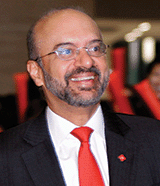 |
| Piyush Gupta. DBS is synonymous with Singapore |
In Singapore, a year has made little difference. DBS, led by Piyush Gupta, retains the award as best bank. Last year we said no other regional bank was as synonymous with its home market – that holds true this year too.
DBS posted record-breaking earnings of S$3.5 billion ($2.8 billion) in 2013 and of S$1 billion in the first quarter of this year.
Despite the continued low interest-rate environment, DBS outperformed peers in Singapore by most measures. Total income rose 9% to a record high of S$5.42 billion from higher loan volumes and broad-based non-interest income growth. Full-year net profit rose 9% to S$2.26 billion.
The consumer banking group recorded another strong year as total income rose 10% to S$2.54 billion, reaching a new post-2009 high. DBS is the largest consumer bank in Singapore, serving over 4.6 million retail customers with more than 2,300 distribution points. It has the largest internet banking and mobile banking customer base in Singapore, with about 2.4 million online and 800,000 mobile users respectively.
The institutional banking group also had a stellar year. Total income grew 13% to a record high of S$4.68 billion from strong asset growth and improved cross-selling. Customer loans grew 20% to S$179 billion, and deposits grew by S$24 billion.
DBS also wins the best debt house award. As the leading bond and debt house in Singapore, it has consistently been ranked as the top bookrunner for Singapore issuers and has maintained its leadership position in Singapore league tables across the awards period.
In investment banking too, not much changed in terms of the leading players and Credit Suisse retains its award with some ease. It advised on the two largest acquisitions of Singapore listed companies during the awards period, including CapitaLand’s $2.5 billion proposed acquisition of a 34.7% stake in CapitaMalls. This was a landmark strategic transaction, which strengthens Credit Suisse’s long-standing relationship with the CapitaLand Group and is the 11th transaction on which Credit Suisse has acted as financial adviser or bookrunner for the CapitaLand Group since 2003.
In M&A it continues to work on many of the largest deals involving Temasek, advising it for the seventh time since 2008 on an M&A transaction, this time the announced $2.5 billion acquisition of Olam in March 2014.
Credit Suisse also takes the spoils as the best equity house. It was the top bookrunner, working on deals worth more than double that of its closest rival, Bank of America.
Morgan Stanley scoops the award for best M&A house in Singapore after topping the league table for deal value by a considerable margin with a total volume of $8.9 billion. Morgan Stanley’s highlights include acting as advisor to Fraser and Neave (F&N) in the $4 billion demerger of its real estate business, Frasers Centrepoint (FCL), from its food and beverage business. The deal involved the listing of FCL on the SGX and it was completed in January, 2014.
 |
Sri Lanka
|
Sampath Bank is this year’s best bank in Sri Lanka. Total revenue rose by almost a fifth, mainly due to credit growth of 25.2% – not only far in excess of the industry growth of 8.8% but also the highest among all private sector banks in 2013. Sampath also achieved the highest growth rates among these banks in deposits and total assets.
In investment banking NDB posted robust performance despite moderate market sentiment, seldom a recipe for much other than maintaining, rather than growing, a business. But in this environment, NDB successfully managed to underline its credentials in important areas such as debentures, securitizations, advisory services and M&A.
Total funds generated in 2013 reached a record $323 million while the revenue from fee-based activities touched $2.5 million. Among deals that caught the eye, NDB advised the national airline Sri Lankan Airlines on the proposed setting up of a maintenance, rehabilitation and overhaul operation at the newly constructed Mattala International Airport.
 |
Taiwan
|
Taiwan is one of Citi’s priority markets and it remains the most profitable foreign bank in the country. Citi Taiwan is the strongest and best capitalized bank on the island, with return on assets and return on equity at 1.45% and 11.68%, while the market averages were 0.68% and 10.26% respectively.
The local franchise of Citi continues to be Taiwan Inc’s preferred banker, helping raise more than $1.13 billion from the domestic and international capital markets. During the review period, Citi advised on three M&A transactions, closed six capital market deals and completed four syndicated loans.
Citi continues to invest in its consumer banking franchise by launching up to 500 new products spanning currency deposits, mutual funds, structured notes, stocks, bonds and insurance products during the past year.
Backed by about 4,500 employees across 60 branches in the island, Citi is also involved in the development of the Taiwanese community through its citizenship programmes where more than $3.1 million has been contributed to improve the financial literacy and discipline of more than 520,000 Taiwanese people. Its 19-year old Citibank-United Way Taiwan fundraising programme has raised about $46 million since 1995, touching over 8,100 projects involving over 400 local NGOs.
In markets, Citi completed the first cross-border renminbi settlement in Taiwan for a renowned local electronics manufacturer and the first renminbi currency exchange for a Taiwanese technology company. In consumer banking, Citi continued to take a leading position in the credit card market in Taiwan and in 2013 it introduced two new credit card products targeting the affluent market.
Yuanta Securities is our pick as the best investment bank in Taiwan this year. In equity underwriting in Taiwan, Yuanta accounted for 12.34% of the overall market share.
There were a total of 74 IPOs listed in 2013, including 36 on the Taiwan Stock Exchange and 38 on the GreTai Securities Market (the over-the-counter market). During the assessment period, Yuanta was the lead underwriter for seven IPOs, including five on the main board and two on the OTC market. Tokyo-based Auto Server was a particularly good win for Yuanta because it was the first Japanese company to list in Taiwan (on the OTC market) and may well be the template for more Japanese companies to follow. Yuanta is the market leader in corporate bond and financial debenture underwriting.
In the review period, Yuanta underwrote a 103 corporate bond and financial debenture issues and accounted for NT$87.88 billion ($2.9 billion) in volume. In fixed income it had the leading market share of 19.1%.
 |
Thailand
|
In Thailand, Siam Commercial Bank and its subsidiaries are the local force to be reckoned with. For example its SCB Securities subsidiary, established in 1995, operates a securities business and is one of the leading brokers in Thailand with a Fitch credit rating of AA-.
SCBS’s equity market share increased from 2.78% to 3.51% in 2013, the highest growth among the 33 brokers in Thailand, playing a big part in the overall success of the group.
The bank also posted impressive growth in its brokerage arm’s retail share of wallet from 2.5% to 3.2% in 2013. Accounts grew by 53% to 48,598 by the end of 2013. Earnings per share at the group level rose 14.8%, outperforming the peer group and earning it the best bank in Thailand award.
 |
Vietnam
|
Vietnam was a tougher market to call than in previous years with some relatively unheralded names on the rise.
But Euromoney chose Eximbank for best bank as it continues to expand its branch network apace. It also shows a level of ambition that sets it apart from many of its Vietnamese peers. An example from the review period is the agreement it signed with Cedyna Financial, a member of the Sumitomo Mitsui Group of companies, though which Cedyna will assist Eximbank in establishing modern evaluation processes and standards for the auto loan business. At the same time, Cedyna will support Eximbank in syndicated lending with leading automobile brands in Japan, creating the ground for sustainable development.
Credit Suisse scooped the best investment bank award, topping the league tables for both mergers and acquisitions and share of wallet, while tying for top spot in debt capital markets with ING and Deutsche Bank.
Credit Suisse clocked up a total deal value of $1.2 billion over the awards period. Around half of that cash – $667.7 million – came from M&A, 23.8% of the total market. The bank had 39.7% of share of wallet out of a deal value of $12.4 million and a third of the deal value in DCM, which amounts to $66.1 million.
The bank’s deal highlights in Vietnam include advising on a $200 million investment by the Warburg Pincus consortium into Vincom back in May 2013. Credit Suisse also invested $50 million in this transaction. It was involved in several other deals involving Vingroup throughout the review period across both debt and equity markets.
Further deals included a $90 million liability management exercise to swap bonds into shares for Hoang Anh Gia Lai and over $100 million of repo financing transactions with Lien Viet Post Bank, helping the bank generate liquidity from credit-linked notes.