|
Bahrain
|
The Bahrain award is one of the easier ones in the region to decide upon; Ahli United is the leader on almost any metric. Its $579.4 million net profit for the 2013 financial year ($366.5 million after allowing for a one-off exceptional gain) was a record and a 25.7% improvement on the previous year, as well as being the biggest profit in the country’s banking industry. Total assets grew 9.3% to $32.65 billion; loans, 8.3%; customer deposits, 17.4%. NPLs are a healthy 2.4% and total provisions for those NPLs 149.4%, while the bank’s capital adequacy ratio now stands at 16.2%. Most of these metrics lead the industry.
Ahli United puts its recent success – good numbers, prudently achieved – down to focused liability management, cost discipline, and improved productivity.
An interesting illustration of confidence came with a decision by the International Finance Corporation, which had invested $125 million in new equity in the bank in April 2011 through mandatorily convertible preference shares, to accelerate that conversion into common shares two years early in 2013, giving the IFC a 2.9% shareholding in the bank. AUB also stands out in having a higher credit rating than the sovereign, something that rating agency rules generally don’t permit; S&P, which has AUB at BBB+ when Bahrain itself is BBB, apparently granted the rating in recognition of the bank’s regional diversified business model.
Ahli United was also a strong candidate for the regional best bank award, with the majority of its earnings coming from outside Bahrain and with a clear focus on cross-border work.
 |
Egypt
|
Times have obviously been very difficult in Egypt, but Commercial International Bank has continued to grow consistently over the past three years – to grow impressively, in fact. Consolidated net income grew 35% year on year to E£3 billion ($420 million); revenue, at E£6.98 billion, was up 31%; customer deposits climbed 23% to E£78 billion; and the bank logged return on average assets of 26.5%. Also, it’s not as if all of these were simply rebounds from a conflict-deflated low base: most of those numbers went up impressively in 2012 too.
Deciding upon the best bank in Egypt first requires a comparison of public-sector and private-sector banks, and although CIB from the private sector wins the award, the public sector is not without merit: Banque du Caire in particular enjoyed an impressive year. But CIB, much the biggest and most profitable of the private-sector banks, is the one that demonstrates not only growth but also innovation and strategy. Growth numbers like CIB’s might raise red flags, but there is evidence of prudent risk management too: NPLs at 3.96% are hardly the best in the region, but for a post-revolutionary nation still finding its feet as a young and turbulent democracy it’s really not bad at all. There is evidence of smart provisioning too, with loan-loss provisions covering NPLs 1.6 times at the end of 2013 and a loan-loss provision expense of E£915 million taken during the year in case recovery in Egypt’s battered economy takes longer still to come.
At the same time, though, the bank has sought to look to a better future, opening 17 new branches in 2013 and renovating others. In truth, despite its growth in consumer banking, it is better known as a corporate bank, and the counterparty of choice for most of Egypt’s biggest corporations through its history. An important initiative in 2013 was an expansion of the bank’s global transaction services platform; now 89% of the bank’s trade services transactions take place online. Another new initiative was the establishment of a dedicated sustainability development department, designed with growing environmental awareness in Egypt in mind.
 |
Iran
|
Iran’s banking sector is positioning itself for a brighter future when sanctions are removed and banks can once again engage more freely with the rest of the world. There are plenty of them ready to do so: several big state-owned houses and at least 17 private banks.
We opted for one of the private houses for this award, since they tend to bring a more entrepreneurial, risk-aware approach to banking. Parsian Bank is pretty much the biggest of them. Almost all of its key indicators are strong and moving very much in the right direction: net profit was up 24% year on year, while deposits and loans also grew encouragingly. As of December 2013, the bank boasted return on equity of 20.17%, return on assets of 1.29%, and a tier 1 ratio of 12.19%.
The number that is missing is NPLs, and this is the blight on the Iranian banking system: officially more than 15% of all assets, and possibly as much as 40%. Nobody is immune and it’s unlikely Parsian is either, given its connections with the troubled automotive industry. The best clue comes from its 2013 annual report, which showed provision for doubtful debts of $145.3 million; pre-tax profit, by comparison, was $736.5 million (incidentally, both of these numbers are, in dollar terms, probably out of date, pre-dating a considerable devaluation in the Iranian rial since; nevertheless, they’re in proportion.)
Still, Parsian shows a model and vigour that can grow it out of whatever those bad loans are, with the largest private-sector banking share of customer deposits and a sense of momentum and innovation across business lines. From creating the first interactive voice-response phone banking system with Persian speech recognition in Iran, to revamping credit approval systems and rolling out a loyalty programme, there is a feeling of progress here that will stand it in good stead when Iran is welcomed back to the world investment community.
 |
Israel
|
Bank Hapoalim remains the clear leader in Israeli banking, and it has stayed there in part through a concentration on going back to basics. It does the simple things well and dominates the market in each of them: 33% of Israel’s retail customers, 36% of its corporate lending volumes, 48% of its credit cards and 33% of its loans to SMEs. Thanks to this dominance, it is also the most profitable bank in Israel, logging NIS2.58 billion ($741.4 million) in 2013 with a 9.3% return on equity.
A new three-year plan kicked off in 2013, and one of the key priorities was a focus on the small-business segment. The SME market share is the one that has grown most dramatically in recent years: Hapoalim controlled 26% of that market in 2009, 33% today. Alongside this, the bank continues to launch new offerings in retail banking, such as a new personal financial planning service last year, and the broader corporate division, which has been working on improving the quality of the credit portfolio.
Israeli Arabs; ultra-orthodox individuals; technology companies; small businesses – they seem unlikely bedfellows, but each has been an area of focus at Hapoalim over the past year, showing the bank’s ability to spot a clear, if sometimes niche, opportunity.
Debt deals from Israel during our review period were dominated by Israel Electric Corp, which raised $1.1 billion in a dual-tranche bond in June and then tapped another $300 million from it in July; and the State of Israel, which raised an upsized €1.5 billion deal in January. Barclays and Citi were the names in common on all three deals.
Both banks also appeared on the most important equity deals in Israel during the year: Barclays on the $195.8 million CaesarStone follow-on, and smaller deals for Magic Software Enterprises, Mazor Robotics and Sapiens International; and Citi on raisings for Israel Discount Bank and Protalix BioTherapeutics.
The clincher, then, is M&A, where Barclays was an adviser to the target on two of the three biggest deals in the country during our review period: the takeover of Cial Industries, a manufacturing and high technology group, by Access Industries from the US; and the purchase of Given Imaging, a company that has developed a wireless imaging system for the gastrointestinal tract, by Covidien.
 |
Jordan
|
There is far more to Arab Bank than its home base, but no matter how much it has grown internationally – and these days more than 75% of revenues come from abroad, leveraging 600 branches in 30 countries, making it arguably the one truly regional homegrown bank – it has not neglected Jordan itself.
Among banks operating in Jordan, Arab Bank is the biggest in terms of total assets (21% of the market), deposits (21.5%) and direct credit facilities (15.8%). Quite apart from size, its financial performance has been consistently impressive. Although this is only reported at a group level, net profit was $501.9 million at the end of 2013, an extraordinary 43% growth. Shareholders are among the happiest at this performance, with dividends hitting 37% in 2013. And this has been achieved with a capital adequacy ratio of a healthy 15.15%.
Alongside more mainstream areas of banking, Arab Bank is impressive in project finance, including the recent financing of the 117MW Tafliah Wind Farm project in Jordan alongside the International Finance Corporation. It is helping the Ministry of Energy and Mineral Resources to develop solar energy plants in Jordan, and working with multilaterals to promote sustainable energy use – a position fostering corporate social responsibility that is also good business.
In core businesses, consumer banking is growing, with a revamp of the Elite programme for high-net-worth customers in Jordan this year, alongside the Arabi Premium programme for mid-income executives and entrepreneurs, an initiative that was developed in Jordan and has since been rolled out across the Middle East. In corporate banking, progress has been made on an e-banking offering to integrate cash management and trade-finance platforms.
 |
Kuwait
|
National Bank of Kuwait has lost its crown as the best bank in the Middle East, but it is still the clear leader in Kuwait itself, despite growing competition. It is the biggest bank both by assets and market cap; it has the largest market share in most disciplines of banking; it is the most profitable, often accounting for half of the entire banking sector profitability in Kuwait; and it also leads in asset quality. Net profits hit $844 million in 2013, and total assets $66 billion.
In corporate banking, NBK accounts for about a quarter of the market, and although there have been few headline deals in a recovering Kuwaiti economy lately, it consistently appears on the most important transactions. Examples include a financing agreement for the expansion of the Al Amiri Hospital, funding for a gas turbine project at the Al-Zour Power Station, and Kuwait’s Boat Harbor Project. Other important transactions over the past year include financing for Jazeera Airways’ fleet expansion, a role as the only local bank on the IWPP project, the first ever PPP project in Kuwait, and a coordinator and MLA role on the $300 million VIVA deal. NBK also leads the market in trade finance and stands to benefit from Kuwait’s development plan, a four-year programme expected to lead to many projects.
On the consumer side, NBK has 40% of the market through 64 branches and, like most successful banks in the region, is focusing increasingly on higher-wealth clients. NBK Private Banking grew assets under management steadily through 2013.
Markaz, an investment banking and asset management group, looks very different to most other financial institutions in Kuwait. Its research is among the best in the region, and although there have been slim pickings for financing in Kuwait this year, the firm has managed to involve itself in a range of transactions.
Examples in capital markets advisory have included capital raisings and a listing; restructuring advisory roles have covered real estate companies and local creditors; transaction advisories have covered foreign companies working on projects in Kuwait and credit groups enforcing debt in the country, as well as a disposal of assets for a regional real estate company and an advisory role on the sale of a hospital project; and valuation and strategy advisory positions for companies including Agility Warehousing Company, several real estate groups and one of Kuwait’s leading insurers.
 |
Lebanon
|
There are two obvious candidates for the best bank award in Lebanon. Bank Audi is the biggest, with the widest business outside of Lebanon, but Blom Bank shows the best metrics. This year its net income, at $352.8 million, was bigger than Audi’s despite a smaller asset base, and it also has the best return on equity (16.75%) and return on assets (1.38%) figures in the industry. Moreover, while Blom’s net income grew 5.8% in 2013, it shrank considerably at Audi and, to a lesser extent, at Byblos, another competitor.
You don’t go to Blom for stellar loan and deposit growth – unlike Audi, which saw 41% loan growth in 2013 – but for good management and impressive stock performance. Blom’s market share in loans and deposits actually declined in 2013, to Audi’s benefit. Set against that, though, Blom has better liquidity and is the only bank to have increased tier 1 capital over 2013.
At a consumer level, a particular area of success has been in the cards business, including a touch pre-paid Visa credit card linking talk time to spending, with a model the bank claims is unique not just in Lebanon but worldwide. Also in 2013, a new co-branded MasterCard was launched with the Beirut Traders Association, Lebanon’s biggest business association. In other areas, lending to small and medium-sized businesses has been a priority, and its investment banking arm, Blominvest, has launched a new Arab mutual fund, a new discretionary portfolio management service, and signed a partnership with Parisian private equity group Quilvest.
 |
Oman
|
Bank Muscat is, by almost any metric, the biggest and strongest in Oman: its net profit was bigger than its five main rivals combined, it has more than three times the assets of its nearest rival and by far the biggest loan book and customer deposit base. It also had the best return on assets ratio as of December 2013, and although one or two rivals might have bettered it for return on equity, capital adequacy ratio or NPL ratio (12.6%, 26.5% and 2.6% respectively in Bank Muscat’s case), the difference in scale between it and competitors simply cannot be overlooked. It has 37% of the country’s banking assets, 37% of its loans and 33% of its deposits.
Be that as it may, the bank’s motto is “Let’s Do More”, and it continues to strengthen, opening new branches, improving technology and focusing on cross-selling in 2013. During the course of the year it bought the point of sale acquiring business from HSBC Oman, improving its electronic payment infrastructure; it launched a co-branded credit card with Oman Air and improved its already pioneering mobile banking application. New mortgage and marriage loan products appeared, and a dedicated retail enterprises department was launched to support small businesses.
Aside from retail and entrepreneurs, there is good business in project and structured finance in Oman, assisting the oil and gas, petrochemicals, shipping, power and real estate sectors in the country. Bank Muscat was on five big syndicated financing programmes as mandated lead arranger during 2013, while the investment banking arm completed $6 billion of debt and equity advisory transactions. Highlights were a $3.5 billion equity financial advisory role for an oil and gas major, a $990 million pre-IPO capital structuring mandate for an Omani utility, and the bank’s first debt raising in Saudi Arabia. It handled senior debt for Octal Petrochemicals, an IPO for Al Madina and convertibles for Renaissance Services.
 |
Palestinian Territories
|
Bank of Palestine continues to thrive in difficult circumstances and provides confidence that a Palestinian country in a two-state solution would be well banked and capable of healthy business growth.
Over 50 years old, Bank of Palestine was the first and the largest Palestinian bank and operates from 50 branches in the West Bank and Gaza. It has 600,000 customers and holds a 23% market share of deposits and loans. A universal bank, it is active anywhere that Palestinians are active, and since that is a famously entrepreneurial diaspora, there is plenty to do.
A long-standing priority, very much fitting the Palestinian model of building business out of modest beginnings, is the SME and microfinance sector, both of which are covered by dedicated units in the bank. Multilaterals, admiring this, have become involved; a recent example was the International Finance Corporation joining it in developing a women’s banking programme in the SME/micro area to address high female unemployment and to empower women to take part in Palestinian economic life.
In bigger-ticket areas, BOP has worked on the larger project finance syndications that pass through the Territories, notably Wataniya Mobile Palestine and the Mövenpick Hotel in Ramallah. Recognizing the wealth that has left Palestine but that still wishes to engage with the country, the diaspora department addresses the 7 million Palestinians outside the Territories and offers them the banking, brokerage and business advisory services they need. This has led to some far-flung rep offices, with licensing under way in Dubai and Santiago, Chile.
A powerful institution in local terms, BOP accounts for 15% of the entire Palestine Exchange market cap and is a vital blue chip there. Recognizing its dominance, it is held to account on social and environmental responsibility, another area where the IFC has become involved, helping to galvanize risk management and governance systems.
Beyond its broader significance, numbers are good: $53 million pre-tax profit in 2013, up 6.15% year on year, and a 17.14% climb in the asset base to $2.35 billion. There was some slippage in earnings per share and return on equity, but a 16% ROE figure, achieved with a NPL ratio of 2.2%, was still encouraging for shareholders.
 |
Qatar
|
The depth of the Qatar banking industry continues to improve, but realistically there is still only one place this award can go: QNB is by far the largest financial institution in the country, with more than 45% of the nation’s banking sector assets.
Although a steadily greater proportion of assets and profits are coming from overseas (see regional award), Qatar remains the engine room from which QNB’s outstanding results are driven. In the first quarter of 2014 alone, QNB made a $668 million net profit, more than only a handful of other banks managed in the whole of 2013; QNB’s 2013 figure was a peerless $2.6 billion net profit. The asset book is $125.9 billion and has grown 21% in a year, partly through acquisition; similarly the loan book is up 22% (to $87.1 billion) and deposits up 23% (to $94.9 billion). Within this region-leading asset base, very little of it is delinquent, with a 1.6% NPL ratio and a 126% coverage ratio, alongside a Basle II capital asset ratio of 16.3%.
Half-owned by the Qatar Investment Authority and half by the private sector, it’s true that QNB gets a great free kick from its state ownership and the work that comes its way as a consequence, but it’s not fair to say that’s all it can do. It is by any measure a comprehensive commercial and retail bank.
Nevertheless, what a gift it is to be Qatari state-backed in this environment. Analysts say the project awards related to the 2022 World Cup that were granted in Qatar during 2013 should really start feeding into QNB’s credit growth in 2014-15, which, given QNB’s more than 70% market share in public-sector lending and the vast size of its balance sheet, should be a bounty of which it gets by far the biggest share. Analysts also suggest QNB can cut funding costs at the same time, so the future for this bank might be even better.
By early 2014, it was possible to take a look at QInvest’s model with some sense of clarity about where it is going and how it is doing it. Under new leadership led by former Goldman Sachs executive Tamim Hamad Al-Kawari and new investment banking head Michael Katounas, QInvest today is streamlined along three lines: investment banking, principal investment and asset management, all with an Islamic finance tilt.
In February the first results fully reflecting the change of strategy appeared, demonstrating a 40% increase in revenue, a return to profitability and a considerable drop in headcount. It is appearing on interesting deals, and not all of them are in Qatar: indeed, the standouts in the past 12 months have been elsewhere, such as sukuks for the Turkish sovereign and for Ooredoo.
QInvest is an interesting organization to try to categorize, since it is partly Qatar state-owned, in that Qatar Islamic Bank is the largest shareholder, but it is ultimately a private-sector institution and is determined to be seen as one. Nevertheless, having the QIA as a neighbour doesn’t hurt, and it’s clear that a large part of the business will be based in a gateway role, either facilitating the entry of foreign capital into Qatar or helping local institutions venture outwards.
QInvest’s approach to principal investment – less private equity, more financing – is still shifting, and the asset management arm is some way short of a full contribution to the business, so for the moment it is investment banking that drives things; early evidence shows a nimble and versatile business.
 |
Saudi Arabia
|
The world’s biggest Islamic bank continues to lead the field in Saudi Arabian banking by doing the simple things right and with prudence.
Al Rahji Bank‘s first-quarter results showed a net profit of SR1.7 billion ($453.3 million), up 10% on the previous quarter, which in turn had concluded a full-year profit of SR7.44 billion for 2013. Total assets at the end of the first quarter were SR288 billion, which is, by comparison, about the same size as the entire GDP of neighbouring Oman. (The deposit base, at SR239 billion, is merely the size of the Libyan economy.)
The key to serving Saudi Arabia’s considerable individual wealth is through reach; it has 500 branches to get to its target market, all of them domestic, which in itself is the biggest branch network in the Middle East.
But not all of Al Rajhi’s business is straightforward. Al Rajhi Capital, with its brokerage, asset management and investment banking arms, is one of the most powerful groups of its kind in the region; its Islamic fund management arm alone passed $6 billion under management during our review period, with mutual fund assets growing 34% in the year to September 2013. The Saudi mutual fund industry grew 18% over the same period, which indicates two things: that this is a very good growth business to be in and that Al Rajhi is beating the market on asset gathering anyway. The investment banking division is frequently involved in some of the most interesting Islamic transactions in the region.
HSBC Saudi Arabia dominates the country’s debt capital markets, with just over double the deal volume of its nearest rival in Dealogic data on our review period; it was involved in a shade under 70% of all transactions by volume.
Many of them were important deals, too. There were debuts for Saudi flagships the National Commercial Bank and Marafiq, the power and water utility company, raising SR7.5 billion between them; the first Basle III-compliant subordinated tier 2 sukuk from the region, for Saudi British Bank; a landmark SR1.7 billion hybrid for Almarai, the first perpetual equity-accounted corporate hybrid sukuk in the region; the huge SR15.2 billion sukuk for the General Authority of Civil Aviation (HSBC had also sole led its SR15 billion predecessor in 2012); another jumbo deal, a SR4.5 billion sukuk for Saudi Electricity; and a landmark corporate syndicated loan for Tasnee, the national industrialization company.
Although debt capital markets were where most of the action was in our review period, HSBC was active elsewhere too. In M&A, it advised on the merger of Saudi International Petrochemical and Sahara Petrochemical, advising Sipchem; this $19 billion deal will be the largest ever M&A in Saudi Arabia, as well as being the first public merger of equals in the country.
And in project and export finance, HSBC is a leader. At the time of writing it was involved in four continuing deals: the Ma’aden Wa’ad Al Shamal Phosphate Company, Petrorabigh II, the SEC Duba 1 IPP, and two mandates for Saudi Aramco related to its integrated gas combined cycle and air separation unit plants. That’s on top of five separate deals that closed in our review period, all of them large and important. Granted, HSBC didn’t shoot out the lights in ECM, but there were hardly any such deals to work on all year.
 |
UAE
|
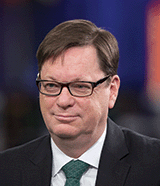 |
| Thursby’s priority is to build commercial banking in the Gulf for NBAD |
Exciting things are happening at National Bank of Abu Dhabi, under the leadership of former ANZ man Alex Thursby. The eye-catching stuff – the plan to build out franchises internationally through the west-east corridor that links Asia, Africa and the Middle East – is still largely for the future, but in the meantime a great deal of progress is under way in the UAE.
Thursby talks in terms of three pillars for the bank’s evolution, but the first one is the home market: developing commercial and retail businesses in the UAE and the Gulf. This will be the near-term priority. Private banking is being given increasing attention, the wholesale bank is growing, every opportunity in trade flows with Asia and Africa is being taken, there is new investment in rates capacity, a new cash management system is on its way and branches in the UAE are being modernized. Alongside all this is the natural corporate and institutional dealflow that comes when one is owned by the Abu Dhabi state.
While the transformation takes place, NBAD’s numbers are looking increasingly impressive. Net profits, at Dh4.73 billion ($1.29 billion), were up 9.3% year on year; total assets reached Dh325.1 billion at the end of 2013, up 8.1% year on year; customer loans grew 11.7% to Dh183.8 billion; and total capital adequacy under Basle II (which is what the UAE central bank runs on) was 18.2%, or 16.5% for tier 1. There are bigger banks in the country, notably last year’s winner, Emirates NBD, but none gives quite the same sense of good management and solid asset quality that NBAD does.
HSBC, which flat-out dominated DCM all over the Middle East, actually had a much closer race in the UAE during our review period than elsewhere in the region; Standard Chartered had a similarly strong year. But HSBC not only handled the most deals; it also demonstrated impressive breadth.
In fact, hardly any of its deals could be said to be ordinary. Its $500 million issue for Majid Al Futtaim was the first ever international corporate hybrid from the Middle East, a perpetual non-call five deal that was hardly mainstream yet brought in a $4 billion order book from 325 investors. The $350 million issue from Topaz Marine was only the third high-yield issue from a Middle East issuer, yet also pulled in a strong order book that topped $2.2 billion.
The Shuweihat 2 power station issue was a rare example of a project bond in the MENA region. An A$400 million ($370.3 million) deal for National Bank of Abu Dhabi showed geographical reach by taking a UAE bank to the Australian dollar markets. There was Islamic expertise in a $500 million sukuk for Al Hilal Bank, and another of the same size for Sharjah Islamic; there was scale and bank capital experience in a $1 billion issue, a perpetual tier 1, for Emirates NBD; and the size of the financial sector client base was illustrated by deals for First Gulf Bank and Commercial Bank of Dubai.
Goldman Sachs has dominated regional M&A as HSBC has dominated debt over the past 12 months, and it handled three key deals in the UAE during our review period.
One was the heavyweight: the merger of Aldar Properties and Sorouh Real Estate, the largest real estate merger to date in the MENA region, creating the third-largest publicly listed real estate company in the Middle East. A friendly merger of equals looks straightforward, but in fact this was the first merger of its kind between two listed Abu Dhabi companies. It creates a powerful institution with a strong balance sheet, lower risk profile, and a position of leadership across a number of different real estate sectors.
Another was an outbound deal, when Cepsa and its owner, Abu Dhabi’s International Petroleum Investment Company, bought Toronto and AIM-listed, Thailand and Malaysia-based E&P company Coastal Energy for $2.2 billion. Goldman was on the CEPSA/IPIC buyer end of the deal, further diversifying the Emirate’s global energy asset base.
The third involved the sale of Millennium Offshore Services Superholdings to HM MOS International. On the seller side this time, the Goldman role required being abreast of an A-grade principal investor list including a sovereign wealth fund, several MENA regional family offices and a clutch of Middle Eastern high-net-worth individuals.