Investors are repeatedly bombarded with figures produced by sub-Saharan Africa enthusiasts eager to promote the region as the world’s next big investment destination.
Africa has a population of more than 1 billion. Some 15% of people globally are African. The median age in sub-Saharan Africa is just over 18. According to the IMF, Ethiopia, Mozambique, Tanzania, the Democratic Republic of Congo, Ghana, Zambia and Nigeria will be among the 10 fastest-growing economies over the next five years. Real GDP growth reached 5% for the region in 2013 and is predicted to reach 6% this year.
The statements read like an Invest in Africa pamphlet, but they are beginning to sink into everyday rhetoric. Investors are becoming more familiar with an African story where – to a large extent – demographic change is transforming the region. A growing middle class in sub-Saharan Africa is creating a burgeoning consumer economy powered by GDP growth and democracy.
Investors are beginning to see sub-Saharan Africa as a genuinely attractive investment destination, while a greater understanding and piqued interest has shaped the development of Africa-focused investment funds.
 |
| CEO of Mara Group, Ashish Thakker |
Most recently, the creation of Atlas Mara has caught the attention of international media and investors. The cash shell listed on the London Stock Exchange in February and is fronted by the former chief executive of Barclays, Bob Diamond, who resigned amid the Libor scandal in 2012, and Ugandan golden boy and CEO of Mara Group, Ashish Thakker – who will incidentally also be the first African national in space on Virgin Galactic’s maiden voyage.
The $325 million investment vehicle has been created to target acquisitions in the growing sub-Saharan financial sector and aims to create the next regional leader in the sector. Some observers say that Atlas Mara hopes to create the next Ecobank of the continent. The firm is banking on the growing consumer sector and rising business opportunities in sub-Saharan Africa.
“Africa is undergoing a dramatic transformation, populations are booming, economies are diversifying and we’re seeing much greater political stability and regional cooperation across the continent,” says Thakker. “Foreign direct investment into Africa is increasing as the west wakes up to the opportunities that exist in the telecommunications, financial services, real estate, manufacturing and agriculture sectors. The financial services sector, in particular, is central to the development of Africa’s economy, and the underdeveloped nature of the sector presents a significant opportunity for growth. There has never been a more exciting time to invest in Africa.”
But while interest in the region is building, other, more public opportunities than specialist investment funds to access Africa’s consumer growth story are limited. There are 54 countries in Africa, but only 17 stock exchanges. In sub-Saharan Africa, the largest and most liquid of them are limited to South Africa, Nigeria and Kenya.
 |
| Kemal Ahmed, portfolio manager for Investec’s Horizon Markets Fund |
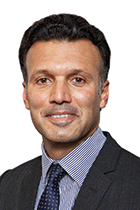
Kemal Ahmed, portfolio manager for Investec’s Horizon Markets Fund – an investment vehicle focused on public equities in 60 frontier and emerging markets that excludes the seven largest economies on the MSCI emerging markets index – is underweight Africa for this particular reason. “In our Horizon Markets universe, Africa accounts for about 5% of the market capitalization. It’s not my primary focus,” he says. “While investors should be very wary of lumping African countries into one generic group, generally speaking financials account for nearly 50% of public equity investments in frontier markets. The consumer sector accounts for very little. If you are looking to build an Africa portfolio in public equities, one reaches the inevitable conclusion that there will be a reasonable weighting towards financials across the continent – primarily in banks – and those will be limited to financials in certain countries.”
Kato Mukuru, senior financials analyst and head of equity research at Exotix, says: “In fact, there is so much money chasing the same assets, I don’t think the system is stable.”
It’s a similar story on the debt side. “In general, sub-Saharan Africa doesn’t have a vibrant corporate bond sector,” says Raymond O’Leary, co-head of Turkey, Israel and Africa at Deutsche Bank CMTS. “Traded debt is limited to sovereigns, state-owned enterprises, some central banks and those blue-chip companies that stand out, perhaps because they are listed in developed markets or benefit from some manner of credit enhancement.”
Daniel Berman, head of capital markets at Standard Chartered, says: “It’s not a question about how you get people interested in Africa anymore, but a question of what are they meant to invest in. In terms of assets, investment into Africa is still relatively small in comparison to other emerging markets.”
Getting to the root of the African growth story takes a little more digging. Private equity might be the key. During a panel discussion at the Africa CEO forum in Geneva in March, a discussion on general ways to invest in Africa quickly evolved to emphasize the benefits of private equity.
“Private equity is a way of accessing countries that public funds can’t,” says Cavan Osborne, portfolio manager for Old Mutual African Equities. “If you want to be part of the consumer story in Angola, Mozambique or Ethiopia, for example, often this is one of the best ways to do so.”
Doug Agble, partner at 8 Miles, a private equity firm exclusively focused on investments in Africa, adds: “If you are going to invest in Africa, it is essential to have country diversity and sector diversity. Several stock exchanges in Africa have a bias towards specific sectors, such as financial services or mining, so investing in a stock exchange might not achieve sector diversity for an investor. For investors trying to get exposure to different sectors in Africa, private equity is probably the best asset class to achieve this.
“The major downside with private equity is the lock-up period, which is typically 10 years, but the benefits and potential returns outweigh the negatives.”
Still in its early stages in sub-Saharan Africa, private equity can also have a developmental aspect, providing support to companies and businesspeople by providing a structure for economic growth to flourish.
 |
| Michelle Kathryn Essomé, CEO of the African Venture Capital and Private Equity Association |
“Private equity in Africa does not become a leveraged buyout like you often see in developed countries,” says Michelle Kathryn Essomé, CEO of the African Venture Capital and Private Equity Association (Avca), speaking at the CEO forum. “Private equity provides growth capital to entrepreneurs in Africa. It gives them cash and creates a partnership, a marriage where entrepreneurs are aligned with investors.”
“In Africa, private equity goes beneath the surface,” says Alex-Handrah Aimé, head of Emerging Capital Partners’ South Africa office. “Returns on African private equity are driven by growth of the company in question, so we do create jobs, opportunities and have significant impact on local economies. Private equity and sustainable development in sub-Saharan Africa are linked because you have to have an active role in the company you invest in. It’s more than just capital.”
Private equity in Africa is still a relatively small endeavour. Between 2005 and 2011, PE funds focused on Africa raised a modest $11 billion and invested $12 billion in the market. Over the same period, Asia-focused funds raised $160 billion and invested $140 billion.
The sector is growing. Private equity flows to Africa have been growing at 20% for the past three years. According to data compiled by Avca, the aggregate deal value of African deals done in 2013 was $3.2 billion, up from $1.6 billion in 2012. In the 2013 global limited partners survey held by the Emerging Markets Private Equity Association (Empea), sub-Saharan Africa was ranked the most attractive emerging market for general partner investment for the first time in the survey’s history. It also found that the region is expected to see the largest amount of limited partner interest over the next two years, accounting for a fifth of all global interest.
Large private equity firms that traditionally stayed away from Africa-focused funds are also changing tack: Carlyle Group, the alternative asset manager with more than $189 billion in assets under management, opened offices in Nigeria and South Africa in 2011 to get closer to the action. KKR, another global private equity heavyweight, recently took on Kayode Akinola, previously a partner at Helios Investment Partners, to push forward with the company’s growing Africa efforts.
“Over a decade or so ago, development finance institutions pioneered the private capital industry in Africa,” says Essomé. “They continue to perform a critical role, remaining some of the largest investors in private equity funds today, but there are now over 200 private equity funds targeting Africa. They have increasingly sophisticated investment strategies, varying from generalist country-focused funds to more sector or region-specific and even pan-African funds.”
Although private equity is still largely focused on the larger, more dynamic economies, such as South Africa, Nigeria and Kenya, some private equity firms are looking farther afield.
This year, Carlyle and Investec both bought stakes in J&J Africa, a pan-African logistics company headquartered in Mozambique that specializes in the road transportation of general cargo along the Beira corridor, one of southern Africa’s key trade routes.
Last year, Abraaj Group invested in African Industrial Services, a construction and manufacturing company based in Côte d’Ivoire with operations in Benin, Togo, Guinea, Senegal and Burkina Faso. XSML is a smaller African-focused private equity fund concentrating on frontier markets in central Africa; it has recently invested in Congo-based restaurant chain Inzia.
ECP, one of the more established Africa-focused private equity companies, has raised $2 billion in its 14-year history and made more than 50 investments in 43 countries throughout the continent.
 |
| Danladi Verheijen, managing director and co-founder of Africa-based investment firm Verod Capital |
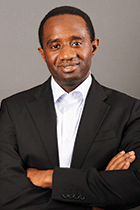
Private equity firms are broadening their horizons, but finding the right opportunities can still be difficult. “When our company started in 2008, we began with the mentality that if a business was legal and made money, we would pull the trigger to invest,” says Danladi Verheijen, managing director and co-founder of Africa-based investment firm Verod Capital.
One common barrier to investments is family-run companies unwilling to give up a piece of the profitable firm and unfamiliar with the concept of private equity. “There is a huge amount of family-owned businesses in Africa, but to convince these people to give up equity, to let an outsider in, can be really difficult,” says Aimé at ECP. “But understanding of the sector is increasing and these companies once closed off to private equity are looking at it as a viable option to grow.”
Kenya-based coffee company Nairobi Java House is one such example. “We discovered Java House while doing due diligence on another potential target,” says Aimé. “We recognized early on that this was a good company to get involved in, but they needed some convincing. Despite our history in Africa, they weren’t too familiar with us or private equity in general, so we introduced them to another one of our clients who could explain to them a bit more about how we could transform Java House as we had done elsewhere.”
Since ECP invested in Java House in 2012, the company has grown from 18 to 24 shops in Nairobi and Mombasa and employees have doubled to 1,006. With ECP, Java House is due to become a regional player, with plans to open up in neighbouring Uganda. “Java House needed to vet us before they would do business with us, and we had to prove we were worthy partners,” says Aimé.
But companies are becoming more comfortable with the idea of private equity. In some cases, African companies are growing so fast that they cannot be financed internally or they do not have the expertise to support growth at a time when bank financing is becoming more costly. In others, increased competition in the sector has encouraged the need for external capital and know-how. There are also cases where younger generations are not eager or willing to take over a family business.
“There is no hard and fast rule to how private equity funds come into partnerships with African companies,” says Agble. “We often see cases where entrepreneurs need capital but wish to remain in control and so give up a minority stake. Other times we have situations where owners are concerned about legacy because their younger generation are not interested in running the business.”
Verheijen says: “Slowly things have changed. We are now a lot more focused about investing primarily in consumer businesses where we can play a role in helping them realize their potential.”
As interest in private equity has risen, so has competition. “There is more competition among some of the bigger private equity firms that focus on Africa because economies are smaller. Businesses that have already reached a certain size and are more suitable to larger investments are limited,” says the CEO of another London-based private equity investor that typically invests between $15 million and $45 million in each company it targets.
“For instance, there may be about 20 companies in Tanzania that will be large enough for some of the bigger investors; then out of this 20, which are actually on the market? The universe of potential targets becomes much smaller the higher the ticket size,” says the CEO.
But Jonathan Matthews, director, industrials, at Actis, a global pan-emerging market private equity firm, disagrees: “The overriding point is that in sub-Saharan Africa, relative to other emerging markets, competition and valuations for corporates is pretty low because there are still so many good-quality companies to go around. At our level, there are only about three or four other private equity firms that are looking for the same size deals. In somewhere such as India, there would be about 20 firms chasing the same business.”
Actis has a growing portfolio of investments in emerging markets, with $6 billion of funds under management across Asia, Africa and Latin America. Currently Actis has $1.5 billion invested in 18 countries in Africa and has injected $2.6 billion overall in 64 investments across the continent. Each of its private equity investments is at the higher end of the spectrum, between $50 million and $150 million.
“As competition grows, we will diversify,” says Matthews. “This is something that we are looking into now. What sectors will our current partners look to expand into? What sectors will be attractive in the next five years? These are the subsectors we will start to invest in.”
Actis has a shadow portfolio of companies that it would like to buy. “For now we are monitoring them. We will begin to approach them when we think they are ready to do a deal.”
 |
Often, larger private equity funds with a focus on Africa actually partner with one another to achieve deals of scale: “In some cases, we think of potential competitors as potential partners,” says Peter Baird, head of private equity at Standard Chartered.
Africa telephone tower company IHS Group is an example. In 2011, ECP and Investec invested a combined $52 million in the Nigeria-based company. Since the partnership, IHS has acquired MTN towers from Côte d’Ivoire, Cameroon, Rwanda and Zambia, cementing its position as the largest independent mobile infrastructure company in Africa.
This year, IHS has raised an additional $420 million in equity to support further growth with Goldman Sachs, the IFC Global Infrastructure Fund and African Infrastructure Investment Managers.
For smaller private equity firms, larger ones can even offer a potential exit strategy. Mid-tier private equity company Verod Capital invested in GZ Industries, an aluminium-can manufacturing company based in Nigeria, at its inception in 2009. Since then, annual capacity at the factory has doubled from 600 million cans to 1.2 billion.
“Before, aluminium cans were imported into Nigeria, which made no sense,” says Verheijen. “I mean, it’s just like importing air, what was the point? So we backed the founding entrepreneurs and we built a factory together. The company has been a roaring success.” But Verod Capital might have had a small impact on the financial woes of Spain: “The new factory could have had something to do with the shutting down of an aluminium can plant there – a plant that used to export cans to Nigeria,” says Verheijen.
Once the company started to consider expansion outside Nigeria, GZ Industries was sold to Standard Chartered and Ashmore in January 2013. The new equity funding and support from the larger private equity firms will be used by GZ Industries to expand out of Nigeria into Kenya and elsewhere.
But then how do larger private equity firms plan to exit? “Multinationals are increasingly looking to buy in sub-Saharan Africa for strategic purposes, looking to gain access to the region without having to build up a company from scratch,” says Baird. “Nothing has been finalized as yet, but some have their eyes on potential buys. With GZ Industries, it will need a couple more years on the portfolio before it’s ready for a strategic sale.”
Standard Chartered’s idea resembles the path taken by west Africa-based Fan Milk. When Abraaj bought 100% of the frozen yoghurt and ice-cream company, international dairy giant Danone was soon cut into the deal, with a 49% stake in the company. The benefits for Danone and Abraaj are mutual: while Danone already has a presence in South Africa, Fan Milk offers a way in to the lucrative west African market, with operations in Ghana, Nigeria, Togo, Burkina Faso, Benin and Côte d’Ivoire.
Not only did Danone bring industry knowledge that Abraaj lacked, but Danone could also offer a full exit route for Abraaj in the future. Indeed, included in the deal is an agreement stating that Danone will eventually have a controlling stake in the firm. “This has been one of the most interesting private equity deals in recent years,” says Essomé at Avca.
And the process is cyclical, says David Wilton, chief investment officer and manager of global private equity at the International Finance Corporation. “As barriers to trade and customs in sub-Saharan Africa continue to fall, African companies will look to expand their businesses but will need more capital to do so. At the same time, the expansion of companies will make investment opportunities by multinationals and private equity firms alike more attractive as well. It’s a positive development.”
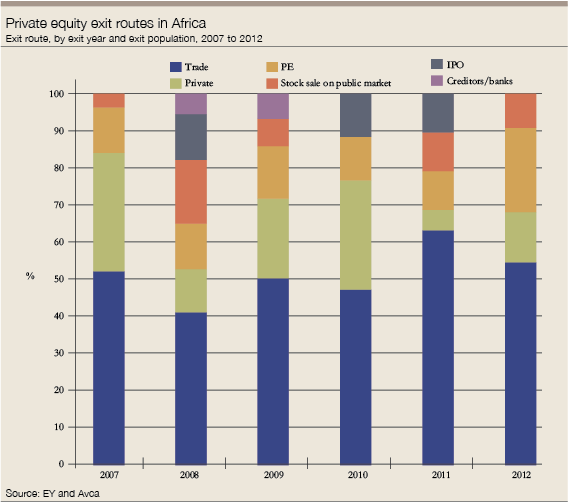
Exits remain challenging, but things are getting easier. According to ‘Harvesting growth’, an EY and Avca report in April of 2013, between 2007 and 2012, there were 118 exits by African private equity fund managers. Most important, however, these exits were not entirely focused on the more developed market of South Africa, which accounted for 42% of private equity exits. And they are making money. Analysis of 62 exits in 2012 showed that strategic and operational improvements in private equity are generating returns of almost double the Johannesburg Stock Exchange, according to EY and the Avca.
The remaining 58% of exits were spread across other regions of Africa. West Africa accounted for the second-highest proportion, 25%, and the other regions – east Africa, north Africa and southern Africa, excluding SA – accounted for 11% each. “This is a highly positive finding as it demonstrates that private equity houses across the continent not only can source good investment prospects, but also have a focused eye on the exit,” says Essomé.
Strategic sales to multinationals and secondary sales to larger private equity firms are both viable options for exits in the sub-Saharan African market. IPOs, however, still aren’t, primarily because of the relatively small size of stock markets outside South Africa. According to the EY and Avca report, only 9% of exits were via a stock sale on the public market in Africa. “Trade sales are still the most popular way to exit, but the mix is diversifying,” says Graham Stokoe, Africa private equity leader at EY.
“Local equity markets are not very liquid and pose a challenge when we are looking to exit, so this is often not our first port of call, but that’s not to say that they don’t happen,” says Aimé at ECP. “Challenges with exits are there, but private equity companies can take time with this, they hold on to the company for another year, to try to make them more attractive to potential buyers. It’s important to think about exit from the onset, but the underlying performance of the company and management is the most important thing. If that succeeds, then you won’t have any problems with exiting whichever way you chose.”
In ECP’s history in Africa, the company has fully exited 29 companies in its portfolio. One of the most recent exits for ECP was of Tunisian-based hygiene product manufacturer SAH via a listing on the Tunisian stock exchange, the largest on the Tunis bourse. The IPO was a resounding success: it was oversubscribed more than 22 times and ECP’s investment delivered a cash multiple of 2.4 times on exit.
In this case, diversification away from financials was embraced by investors, and that will be the case with others and will contribute to the deepening of the capital markets.
“Investors do put pressure on the capital markets in sub-Saharan Africa. Markets are small and need scale to deal with the pressure,” says Mukuru at Exotix. “Private equity can help. Longer-term investment into lesser-known and smaller Africa companies through private equity can create the next generation of listings. The long-term story is there. We need to convince people that this is an investable destination. There’s a lot of money to be made.”