 |
| Outstanding Contribution to Islamic Finance |
| Return to the Islamic finance awards index |
Mohamed Ali Elgari is one of the select handful of Shariah scholars without whom the Islamic finance industry could not exist. Shariah panels stamp products as being compliant with Islamic law; they carry the trust of Muslims that they are investing in a way consistent with their faith. Such is the diversity of their required skills – encyclopaedic knowledge of Islamic law, deep understanding of international business, fluency in English and Arabic at the very least – that there are few such scholars trusted by the world’s main Islamic institutions to serve on their Shariah boards. Ten years ago, there were only about five of them in the world; the picture has improved since, but not that much. Elgari is very much among that elite.
And he’s in considerable demand. The Jeddah-based Saudi scholar, born in Mecca in 1949 and holding a PhD from the University of California, fills a wide range of roles. Before one even gets to the advisory work, he serves as an expert at the Islamic Jurisprudence Academies of the Organization of Islamic Countries (OIC) and of the Islamic World League. He is an adviser to the Islamic Fiqh Academy, the most important centre for the study of Islam in the world; the Accounting and Auditing Organization for Islamic Financial Institutions (AAOIFI), the key standard-setting body for Islamic finance worldwide; and was until recently a professor of Islamic economics at King Abdul Aziz University in Jeddah and director of its centre for research in Islamic economics. A noted academic who has written many books and articles in Arabic and English, he is on the editorial board of many of the main academic publications in Islamic law, from the Gulf to Harvard.
Then there are the corporate advisory roles – HSBC Amanah, Standard Chartered Saadiq, CitiIslamic, Dow Jones Islamic indices, Islamic Development Bank, Islamic Bank of Asia, Abu Dhabi Islamic Bank, Saudi’s National Commercial Bank and numerous others. Like his peer from Bahrain, Shaikh Nizam Yaquby, who was given this award in 2007, he is near ubiquitous and has been as influential as anyone in framing what is considered acceptable or unacceptable in Islamic finance today.
A lot has changed during his time in the profession. Much of the hard work is already done, with the impetus for innovation having faded for two reasons: one, the financial crisis raised suspicion of derivatives and other new products; and two, the fact that so much has already been created. “The process of innovation is not as robust as it was 10 years ago,” he says. “Banks have already developed most of the components of a menu for basic commercial banking. After the financial crisis, people are becoming very cautious about what they develop, especially in terms of derivatives and risk management.”
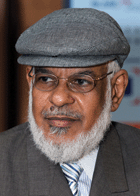 |
| Mohamed Ali Elgari is one of the select handful of Shariah scholars without whom the Islamic finance industry could not exist |
Islamic finance came through the financial crisis in remarkably good shape, protected by securities that must be underpinned by tangible assets. But, like the other smarter people in the industry, Elgari cautions against complacency: “We have to be careful. The fact that Islamic finance is Shariah-compatible is no protection: it can face problems like everything else. Some people have the wrong impression, that because it is Shariah-based, it is immune.” His work at AAOIFI, as well as his ubiquity across the world’s Shariah boards, has helped with the process of harmonization and standardization of Shariah rules that is often cited as a vital requirement for Islamic finance to grow. “One can see progress, although it is very slow,” he says. “These things happen in accordance with the needs of the participants. Where they need harmonization, it happens.”
Increasingly, the theme of Islamic finance is not so much standardization among existing jurisdictions as the expansion into new markets. Last year brought a new sukuk law and the first sukuk from Turkey; at the time of writing Egypt was attempting to do something similar. Elgari credits the UK with leading the way in this expansion beyond the more obvious markets, by changing rules around stamp duty when financing real estate through murabaha.
Asked about landmarks during his time in Islamic finance, he refers to particular structures: the first murabaha structure (“It looks simple, but from a banking point of view, managing the risk was a tremendous challenge”); the first equivalents to conventional loans (“This was the move that made it possible for Islamic banks, especially in Saudi Arabia, to become completely Islamic”). Asked to look 10 years ahead, he foresees “a major leap – innovation that changes the basic characteristics of Islamic banking. I feel this is coming. This has to happen.” By this he means a system that doesn’t just mirror what exists in the conventional world, but forges ahead on its own. “Some people say there is no difference between Islamic and conventional banking. Once this happens, the whole world will see it is superior to anything seen before.”
So what about this shortage of scholars – is it improving? Elgari believes that it is a problem, but not as serious as some think, partly because of a move to a more institutional approach to advisory that is beginning to emerge in the industry, “where an institution is relying on advice from scholars but has a life of its own that can survive the scholars. It has a methodology that can be established and that it can be known for.” And he believes newer names are beginning to emerge. “Some people are worried that once the five or six of us die, Islamic finance will have to be shut down. This will never happen, I’m sure.”



