 |
|
Best international Islamic bank Best structured products house |
| Return to the Islamic finance awards index |
Best international Islamic bank
HSBC Amanah has been a regular winner of this award, but with its decision to step back from retail Islamic banking apart from a continuing presence in Malaysia and Saudi Arabia, the way is clear for a new leader. Standard Chartered Saadiq is Euromoney’s choice.
Standard Chartered has long been a contender, even with HSBC fully in the picture. “By far the broader, more networked business” than its competitors’, says a rival bank. It’s that breadth of ability that sets the business apart, from syndication and sukuk to product development, private banking, wholesale, real estate and project finance. Six years on from its 2007 launch, Saadiq (which means ‘truthful’) is both global and impressively local, entrenched in its core markets and closely linked to regulators in many places where frameworks are still under development.
What makes an international leader? Scale is one thing. Saadiq combines structured finance and corporate/institutional banking services in 14 nations plus Africa with a respectable consumer banking presence in six: Bangladesh, Bahrain, Pakistan, Malaysia, Indonesia (through its Permata Bank subsidiary) and the United Arab Emirates.
Best structured products house
Another vital characteristic is innovation. This year Saadiq launched a Shariah-compliant $5 billion programme offering clients structured investments in a certificate format across rates, FX, commodities and equities, based on a choice of three different Islamic structures; a useful addition to the range of compliant investments for clients. It also launched the world’s first Islamic euro-clearing product in Frankfurt in Germany, following a dollar equivalent in New York in 2010. It revamped its private banking proposition out of London, Geneva, Jersey and the Dubai International Financial Centre; launched Islamic wholesale banking in Bangladesh, with 15 compliant products from financing to cash management and trade; and bolstered its existing prowess in risk management and Islamic derivatives.
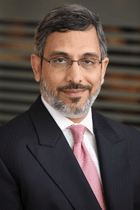 |
| Afaq Khan, CEO, has taken StanChart Saadiq global in just six years and kept it local |
Although it is not the defining characteristic, a leader also has to feature in the league tables. And although Standard Chartered is not the leader in sukuk (HSBC still holds that mantle), it has been a bookrunner on the second-highest volume and number of international sukuk deals over the past five years, logging 35 deals worth $6.46 billion between 2007 and October 2012. Over the same period, it was the leader in European, Middle East and African Islamic syndication.
It participates in the deals that matter. In addition to Euromoney’s Islamic deal of the year, the Jebel Ali Free Zone refinancing, it was a joint bookrunner on the $4 billion sovereign sukuk from the State of Qatar, the largest ever international Islamic bond, achieving record low funding levels for a sovereign sukuk in five-year and 10-year maturities. Other big bookrunner roles ranged from the Middle East (Qatar International Islamic Bank, Qatar Islamic Bank, Emirates Islamic Bank, Islamic Development Bank, Abu Dhabi National Energy Company and many others) to Asia (Noble Group and Bahrain Mumtalakat Holding in ringgit, the Republic of Indonesia in dollars) and Turkey (Kuveyt Turk Katilim Bankasi). Turkey was also fertile ground for some landmark syndications, as was the UAE, where the bank was joint lead arranger on a Dh3.55 billion ($966.5 million) facility for Emaar Malls. Although project finance was quiet in 2012, Standard Chartered was a mandated lead arranger on Emirates National Oil Company’s financing for a new terminal and pipeline, one of the few deals of note to go through.
Away from the league tables, there is plenty of activity, whether it’s a new strategic alliance with Prudential BSN Takaful in Malaysia or a partnership to offer Shariah-compliant hire-purchase financing to SMEs with Volvo Malaysia. Across the world, the impression is of an established business continuing to grow and evolve.
Maybe HSBC is right to focus so exclusively on two markets; it says that closing businesses in the UK, the UAE, Bahrain, Bangladesh, Singapore and Mauritius will still leave it with 83% of the Islamic business revenue it had beforehand. But if you believe there is an important role to be filled by a truly multinational enterprise seeking to be a part of Islamic finance development in markets emerging and evolved, then Standard Chartered Saadiq is the one that is closest to filling it today.



