|
|
| Kingdom of Morocco | |
| Size | $1 billion 10-year and $500 million 30-year debut Regulation S/Rule 144a bond |
| Bookrunners | Barclays Capital, BNP Paribas, Citi, Natixis |
| return to the Middle East and Africa Deals of the Year index | |
Moving to north Africa, debt was again the most interesting area of the capital markets, and nowhere more so than in the Kingdom of Morocco’s extraordinary $1.5 billion 10- and 30-year dollar debut in December.
This presented investors with something unusual. “The key challenge here was not one facing many sovereigns, like market access or banking problems,” says Charlie Berman, head of public-sector EMEA at Barclays, a bookrunner on the deal. “The challenges instead were about a very rare type of issuer: an investment-grade debut in the dollar market. There really aren’t many of those left.”
Morocco was not a total novice – it has issued in euros several times – but still “most investors were looking at the name for the first time,” says Darrant at BNP, also a bookrunner on this deal. All bookrunners found that the freshness and lack of familiarity with the credit was not a problem – quite the reverse. “Investors are calling out for diversification, for new credits,” says Darrant. “North African risk is a fairly untapped area for the US market.”
In that respect, Morocco is helped by being nothing like the rest of north Africa: stable, a kingdom and developing democracy, and quite separate from any nation touched by the Arab Spring. Investors are savvy enough to see the difference and in any case look globally for their comparables these days. “The compartmentalization of issuers into a Middle Eastern name – the world doesn’t like that anymore,” says Berman. “Investors are global. Names could be from anywhere, and the question will always be: is this asset cheap, rich or fair value?” Bookrunners report other triple-B names (Morocco is triple B minus), such as Turkey, Lithuania and Croatia, being used as comparables.
After a nine-day marketing campaign in the UAE, US and London, the response was extraordinary. Morocco went out looking for a 10-year bond, but quickly found longer-term investors, particularly insurers. “Thirty years was not something we had pitched to the investors,” says Berman. “As often happens, there is a reverse inquiry from a subset of investors saying: ‘We like 10-year, but we’d love 30.’ In this rate environment people are looking for duration and extra yield.”
So it was that a north African issuer, a notch above high yield, brought a dollar debut in 30-year tenor. “I have racked my brains and I can’t think of another issuer printing 30 years straight out of the gate,” says Darrant.
It flew out the door. The final combined order book was $7.9 billion from 475 accounts. Pricing on the 10-year tightened from 300 to 275 basis points over treasuries; most remarkably, the 30-year came at 290bp – lower than the initial guidance for the 10, and extremely close to it in pricing, all at a time when its 10-year euro paper was about 320bp over. “It’s hard to see how the deal could have gone better,” says Berman.
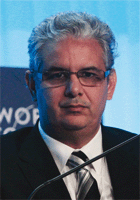 |
| Nizar Baraka, Morocco’s minister of economy and finance |
Morocco itself was delighted, with Nizar Baraka, minister of economy and finance, describing it to Euromoney as “a great success”. He considers it “an outcome of both the strong credit story and the optimal execution timing. The Kingdom of Morocco enjoys a resilient credit story, having a political and social stability supported by a new constitution that strengthens democratic processes and governance of the country, a resilient economy [average annual GDP growth of 4.34% between 2007 and 2011 and 5% in 2011] and a prudent fiscal and debt management strategy with a sound banking sector with high capital adequacy ratios.” The roadshow, he says, “positioned the kingdom as a key MENA sovereign, offering political and social stability, scarcity value and quality, with investment-grade ratings.” Baraka was more closely engaged in the deal than is often the case with finance ministers in sovereign issues – many leave it to a debt management office – and was involved in the timing of the deal, making a priority of announcing before the US Thanksgiving holiday. “We were also expecting some investor concerns related to the Arab Spring and the sociopolitical environment in the MENA region,” he adds. “However, we were pleasantly surprised by the strong investor knowledge of the specific situation of Morocco. The Kingdom did not actually experience a revolution, but rather an evolution of the political and economic reform processes” since the accession of King Mohammed VI 13 years ago. Morocco adopted a new constitution in July 2011 and followed it with elections that November, leading to a new coalition government. “The success of the roadshow and investor demand for the 10-year tranche, but also for the longer maturity, illustrate well the confidence in our country, our progress over the past decade and most of all the potential for the future,” Baraka says.
Baraka says that most questions were not about politics but about current and fiscal deficits, subsidies, methods of financing and sources of economic growth. Deficits have risen since 2011 through higher oil prices and government subsidy policy, but Baraka argues that “these higher deficits are temporary since the government has already taken some action to address them by starting to reform the subsidy system”. The government targets a drop in the fiscal deficit to 3% of GDP, and the current account deficit to 5% or 6%, by 2016.