 |
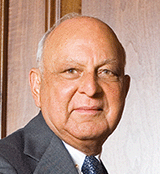
When Nemir Kirdar set up Investcorp in 1982, he didn’t just want to set up a new investment vehicle – he had the ambition to create an institution that would last for the long term. More than 30 years have passed since then and, with Investcorp still going strong, he has evidently succeeded.
From its offices in Bahrain, London and New York, Investcorp has managed to bridge the gap between the Middle East and the west, tapping into the revenues that the Gulf has garnered from its oil and gas exports and recycling them into investments in Europe and north America.
Along the way Kirdar, as chairman and chief executive of Investcorp, has helped his firm to back companies with tens of billions of dollars-worth of investments.
Born in the northern Iraqi city of Kirkuk in October 1936 to a prominent local family, Kirdar went to school in Baghdad and then on to Robert College in Istanbul, where he initially studied engineering before switching to economics and political science.
Following a coup in Iraq in 1958, Kirdar left for the US, where he completed his studies at the University of the Pacific in Stockton, California. After finishing his degree, Kirdar embarked on the first phase of his banking career in 1960, as a teller with the First National Bank of Arizona.
But with Iraq becoming more stable, in 1962 he returned there to work as a businessman. His first job was as manager of a travel agency owned by his brother, but by the following spring he had set up Nemir Kirdar Business Enterprises, helping international companies to enter the Iraqi market.
Life in Iraq got more difficult for Kirdar following the 1968 coup by the Ba’ath Party and he was briefly arrested in April 1969. That episode convinced him to leave the country once more and he went to New York to revive his banking career.
After two years of credit training in New York with Allied Bank International, he covered southeast Asia and Japan for the bank. In 1974, he briefly joined National Bank of North America, before moving on the same year to Chase Manhattan Bank as vice-president.
From 1976 to 1981, he was in charge of the bank’s activities in the Gulf, and towards the end of that period he was seconded to the Arab Monetary Fund to study the potential to develop investment-banking services in the Gulf region.
That proved to be the springboard for the move that would define Kirdar’s career, when he set up Investcorp in 1982. And the first deal that Investcorp did was a real estate transaction, taking a stake in the Manulife Plaza office building in Los Angeles in 1983.
The following year, it bought the underperforming luxury brand Tiffany from Avon Corporation, helping to turn it around, before listing it on the stock market three years later.
Ever since then, Investcorp has mixed luxury and the prosaic in deal making, buying into Chaumet and Gucci, but also convenience store chain Circle K.
Investcorp’s modus operandi is to look for deals and make investments before offering a portion of the deal to its clients in the Gulf, while keeping some back for itself. The idea is to present those clients with opportunities that they otherwise would not come across.
Every year Investcorp looks at around 400 transactions, makes bids on perhaps 15 of them and might win around four of the deals. In total, Kirdar estimates that Investcorp has probably placed around $40 billion in investments over its 30-year history.
Building a business from scratch is never easy, and ensuring that the business survives for more than three decades is harder still, especially if it is based in a region as turbulent as the Middle East.
On its own, such longevity would be impressive. But the achievement is even more remarkable for the fact that only once in Investcorp’s entire history has it posted a loss – that came in 2009 in the wake of the global economic crisis.
Since Kirdar set it up, Investcorp has grown into an organization employing more than 400 people, offering a model for the Middle East private equity industry. Although Kirdar is based in London, he travels regularly to Investcorp offices in Bahrain and New York.
The network is expanding, too, with offices now opening in Riyadh, Abu Dhabi and Doha as the company looks to get closer to its clients in the Gulf, but also to potential investment opportunities in the region.
The business’s greatest challenge might come when Kirdar decides to step back from the frontline. Those working closely with him at senior levels in the company are convinced that the right processes and systems are in place to ensure a smooth transition.
Once he steps down, Kirdar can be assured that he has achieved the ultimate vision set out for the business on its foundation: to establish an institution that can survive for the long term.



