 |
Discussing the short list of lunch options in central Lagos, a local small businessman says he has an idea how to get rich, had he the capital – poultry farming. He is not the only one with the idea. Private equity firms, including Carlyle, are on the look-out for such businesses. “There’s no limit to the number of chickens you could sell in Lagos,” says Hurley Doddy, co-CEO of Africa-focused private equity firm ECP, half joking. “Fast-food restaurants [in Nigeria] don’t have enough chicken; it’s a huge bottleneck.”
Quick-service restaurants (as the private equity industry apparently calls fast food) are doing a roaring trade in Africa. Foodstuffs still deemed a luxury by many Africans, such as chicken, are becoming more affordable, thanks to rising incomes.
Nigeria bans imports of chicken (and an increasing range of other food items). Because of the difficulty of sourcing food of reliable quality and quantity locally, many food retailers have to get round undeveloped local supply chains by taking matters into their own hands.
Take Chicken Republic, with more than 65 outlets in west Africa. Its owner is buying up more than 700 hectares of Nigerian farmland. It aims to produce 200,000 chickens a week by 2014, rising to 24 million birds a year, selling to Chicken Republic and other stores.
It is an approach more and more traders and consumer food firms have to take as African demand booms. Moreover, attracting more capital to farming will clearly bring big benefits to African economies.
Agriculture already accounts for almost half the continent’s GDP, according to the World Bank. It makes up a far higher proportion of the inflation basket than in more developed countries, and food imports sap much-needed foreign currency, unnecessarily.
Unnecessarily, because Africa is also home to around half of the world’s under-used arable land. Africa could be a breadbasket for an ever-larger global population. But since the 1980s, it has been a net importer of food.
The World Bank says agriculture in sub-Saharan Africa could become a $1 trillion industry by 2030. That is still far away. But if the industry is burgeoning, part of the reason is higher local demand, coupled with greater availability of finance.
As other emerging markets fell, Nigeria’s stock index rose 40% in the first half of 2013, and consumer stocks were hottest. Price-earnings ratios of subsidiaries of such firms as Nestlé, Guinness, Diageo and Unilever rose to the high 20s and beyond.
Few M&A deals will match the size of the $1.8 billion buyout of South Africa’s Massmart by US retailer Wal-Mart in 2011. But smaller deals in Africa’s consumer sector are becoming increasingly frequent and deals in the food and beverage sector are part of this.
Take the $190 million acquisition of the flour-milling subsidiary of Nigerian conglomerate Dangote late last year by South Africa’s Tiger Brands. Massmart is reportedly looking to buy a Kenyan supermarket chain, while France’s Carrefour is also expanding in Africa.
More investment in agriculture in Africa is in many ways an extension of the consumer story, says Wiebe Boer, CEO of the Tony Elumelu Foundation (set up by the former chief executive of one of Nigeria’s biggest banks, UBA).
“Even compared with two years ago, [investing in African agriculture] has taken off,” he says. “The horticulture sector in east Africa has existed for more than 10 years, for example. But now there’s an understanding that Africa itself is an important market [for farm produce].
“Agriculture [in Africa] is no longer looked at as development but as business.”
One sign of the increased investment interest in African agriculture is the acquisition (announced in late July) by US farm-seed firm DuPont Pioneer, of a South African equivalent, Pannar. DuPont hopes Pannar will be a springboard for the rest of Africa.
And a by-product is new domestic fertilizer plants: in Nigeria – where Dangote and India’s Indorama are getting funds from Standard Chartered and others for billion dollar-plus plants – and in east Africa, where hydrocarbon discoveries have brought new local feedstock.
The so-called land grab, in countries such as South Sudan, by rich-country government-linked investors, which happened in the latter part of the last decade, has slowed, for political reasons and because of the recognition of the need to involve local farming communities.
However, the production of more food for the local African population – which according to the UN is set to more than double to 2.4 billion by 2050 – is a necessity for African governments, as well as a still massively under-exploited opportunity for businesses and investors.
Nigeria, Africa’s most populous nation, spent around $11 billion on food imports last year. It is the world’s biggest rice importer. The government has banned imports of processed rice over the past year, while there is talk of a total ban on rice imports by 2015.
Nigeria also increased the tariff and levy on raw-sugar imports in January. The government is even trying to get more bread made from cassava (which unlike wheat is native to the tropics) and increased the levy on wheat imports this year as a result.
Edward George, head of soft-commodities research at Ecobank, says such measures could help Nigeria replicate its success a decade ago in boosting cement production after forcing firms to manufacture cement locally, by restricting import licences.
In effect, the government is encouraging more trading corporations servicing the domestic market, such as Dangote, to move from importing processed goods to processing, packaging and eventually buying or growing raw materials in Nigeria.
It works well for Africa’s lenders if companies not only sell more in Africa, but also process and grow more, keeping more of the value chain, and therefore the scope for profitable financing by local banks, within Africa.
Aliko Dangote – Nigeria and Africa’s richest man – built his group into a multi-billion-dollar firm by moving from simply trading commodities such as sugar, flour and especially cement towards producing the commodities locally in factories he owns in Nigeria.
Many observers also point to Zambeef, listed in Lusaka and on London’s junior exchange AIM, which is active across the value chain (or through vertical integration, as the jargon puts it).
Set up in 1994 with little more than a rented abattoir and a Land Rover, Zambeef now grows crops, rears and slaughters animals, and retails beef, chicken, bread, eggs and dairy products from its own supermarket counters and shops in Zambia, as well as in Nigeria and Ghana too.
The government’s goal in Nigeria is to follow Brazil, which went from being a net importer of food in the 1970s to a net exporter today, although with firms such as Zambeef, farming is becoming bigger business in Africa already.
Ada Osakwe, a former debt capital markets banker at BNP Paribas and now an adviser to Nigeria’s minister of agriculture, describes the ministry’s approach. “It’s about growing the food base, creating jobs and wealth, and diversifying the economy,” she says. “It’s about attracting private-sector financing.”
Despite an historical GDP contribution of more than 40%, agriculture accounted for only around 2% of credit advanced to the private sector in Nigeria in the five years to 2011, according to research from FBN Capital.
Partly thanks to a new central bank risk-sharing scheme for agricultural lending, agriculture’s share of lending rose, if only to 3.7%, in 2012. The central bank issued a circular in 2011 explicitly instructing banks to set up agriculture desks.
“Some banks [in Nigeria] have very ambitious targets [for lending to agriculture],” says Osakwe, pointing to Ecobank, FCMB, Fidelity and UBA as examples. “The banks are critical; they need to be in the game.”
Even Nigeria’s central bank governor, Lamido Sanusi, acknowledges the challenges in getting capital to agriculture in Nigeria, as elsewhere in Africa. “The banks have the capital, liquidity and the ability to lend,” he said, in an interview in late 2011.
He gave the example of a tomato-growing area in the far north of Nigeria: “About half of the output of that area gets lost between farm and market because there is no investment in storage, no investment in processing, and the tomatoes just perish.”
“At this moment, no bank would lend to a tomato farmer knowing that potentially 30% to 40% of what he produces would be lost.”
Ecobank’s George makes the comparison to gold mining: a sector where Africa has found less trouble attracting large amounts of foreign investment, perhaps partly because it is so much easier to get the product to market.
Helicopters are a commercially viable form of transport for remote gold mines. By contrast, making money in agriculture requires far greater weight, and a ground transport infrastructure and manufacturing base that Africa often lacks, even if the local consumer market is booming.
Nevertheless, banks are helping companies get round Africa’s infrastructure challenges: in the absence of such things as large trucking companies, aside from setting up local factories, another big part of Dangote’s success is investment in its own transport system.
In addition to owning ship terminals, Dangote distributes to up-country cement depots with a fleet of 3,000 trucks.
Some African companies, operating purely in food, have grown in large part through more idiosyncratic logistics networks. Take Fanmilk, a company selling ice cream, ice lollies and yoghurt, until recently owned by its Danish founder.
Dubai-based private equity company Abraaj announced that it had agreed to acquire 100% of Fanmilk this summer, in what it says is the largest-ever private equity deal in the consumer goods sector in sub-Saharan Africa outside South Africa.
Abraaj is effectively buying the delivery model – in this case several tens of thousands of bicycle and motorcycle vendors across West Africa – as much as the brand, warehouses and facilities to reconstitute the milk powder.
“The distribution platform is one of the greatest attractions in Fanmilk,” says Jacob Kholi, a partner at Abraaj. He says the company’s growth prospects might lie in using the same network to distribute other products, such as water or other snacks.
Brookside, an east African dairy firm, and another of Abraaj’s companies, works in a similar way: using agents on bicycles to collect milk, for regional demand, from small dairy farmers, and providing a livelihood, according to Abraaj, to more than 200,000 people.
It is another firm originating in East Africa, ETG, which is perhaps the foremost recent example of a company that has seen big returns from investments in storage, transport, processing and packaging of the food Africa grows and consumes.
Carlyle, Standard Chartered Private Equity and Pembani Remgro, a South African fund, invested $210 million for a strategic minority stake in ETG late last year. The idea is to exit via an IPO (perhaps in Singapore, given ETG’s trading links and processing facilities in Asia).
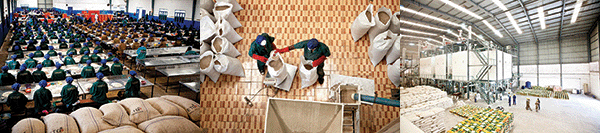 |
| Facilities at East-Africa-based ETG. Managing the food-supply chain in Africa is becoming big business |
Jean Craven, ETG’s head of corporate finance, says reinvesting profits in what he calls bricks and mortar made ETG, which was founded in the late 1960s, the much bigger company it is today. “The infrastructure is key; he who controls the infrastructure wins,” says Craven.
ETG now owns and rents warehouse storage capacity in east and southern Africa with capacity of more than a million metric tonnes, with further storage facilities in China, India, southeast Asia and west Africa.
It has its own haulage company, operating across east and southern Africa. It has even bought a fleet of barges to ply the coast of Mozambique, with plans to extend to Zambia and Malawi, by opening the Shire and Zambezi rivers to barges.
Although some exporters neglect basic value-adding processing (perhaps not even removing mud from coffee beans), ETG has more than 20 processing plants in six west and southern African countries, with some products retailed in Africa with ETG’s own branding.
ETG is not the only African group with roots in trade and retail to expand to in-country agricultural commodity processing. Kenya’s Bakhresa Group, or Tanzania’s Mohammed Enterprise, for example, also have divisions for logistics and agro-processing.
In Nigeria, Dangote, Honeywell and UAC – all with agro-processing divisions (Dangote is expanding his sugar-refining business for example) – are comparable, although given the much bigger domestic population, their growth dynamics in retail are slightly different.
Agribusiness in Nigeria has suffered more from competition with the oil industry, although almost all African merchant families have had to focus more on food than have equivalent groups, say, in the Arab Gulf, because of Africa’s bigger and less wealthy population.
Many Africa trading firms (which are often, in east Africa, built up, like ETG, by families descended from south Asian immigrants) further share the experience of having grown rapidly in size and sophistication in recent years, along with the economy and population.
ETG has focused much more on integrating the food-supply chain than other firms owned by trading families. From the late 1980s, for example, a big part of ETG’s business was supplying food-aid agencies such as the UN World Food Programme.
Groupe Rawji in the Democratic Republic of Congo has been more active in trade and retail in nonfood products such as motorcycles, oil and gas, and sometimes real estate and banking.
But aside from ETG there are also growing firms in trade (and by extension logistics), such as Zambia’s Nyiombo and Nigeria’s Elephant, that have focused, for example, on importing and distributing fertilizer and seed (which are often state-subsidized).
Banks have helped both Nyiombo and Elephant expand to neighbouring countries – often with import and export products suited to high-risk geographies, such as warehouse-receipt financing, also sometimes for exporting locally grown crops.
 |
| Chomba Sindazi, director at Standard Chartered’s solutions structuring team in Africa |
“Trade finance deals in African agricultural commodities are becoming bigger and more complex, and our clients in this area are expanding their geographic reach,” says Chomba Sindazi, director at Standard Chartered’s solutions structuring team in Africa. “As some of these deals can be up to $150 million or more, there is an increasing need to syndicate the exposure to banks based in Europe and elsewhere, due to limitations with the local banks’ single-client limits.”
Standard Chartered’s own agricultural commodities portfolio in Africa is around $2 billion and growing every year, says Sindazi. South Africa’s Standard Bank is also trying to transfer agricultural know-how gained in its home market to the rest of Africa.
International banks can also extend more finance to ETG and other African trading groups – enabling them to invest in infrastructure and trade commodities for export and import in greater volume – as the firms tighten accounting standards and corporate structures.
Craven says he joined ETG in 2008 from Standard Bank, where ETG had been a client, to help in this process, hiring KPMG to audit the accounts, for example, and moving to a holding company in Mauritius, all of which facilitated better access to capital.
“Our banking lines when I joined the group were less than $50 million, whereas now our available credit lines are $1.6 billion and more,” he says. “It opened the door for private equity investment. Lots of agribusinesses in Africa have to take this leap: banks want to enter the market, but it’s difficult for both ends to meet when there’s a lack of corporate governance and transparency.”
They should move quickly: with local demand booming, the so-called ABCD of global agribusiness and soft-commodities trading groups (ADM, Bunge, Cargill and Louis Dreyfus) appear to be investing more in their facilities in Africa.
As such clients expand in Africa, Berry Marttin, member of the executive board at Dutch agribusiness specialist Rabobank, says his international banking division will likely establish a direct presence in Africa, the only continent that does not have this.
Since 2006, a division of Rabobank has already bought minority stakes (sometimes from the state) in banks with large rural networks in Rwanda, Tanzania, Zambia and, in 2013, in Uganda.
Osakwe says Nigeria plans to divest from its Bank of Agriculture, which owns one of the country’s biggest bank branch networks, and even hopes Rabobank might invest (Rabobank has already been invited to undertake a strategic review of the bank).
Meanwhile, African banks are looking to finance the Africa operations of international traders: firms such as Armajaro, a London-based soft-commodities trader with a large African franchise, and ACE, a Geneva-based collateral-management firm.
“Managing the supply chain in agricultural commodities in Africa is becoming big business,” says one investment banker, who is considering the opportunities for IPOs. He cites Olam, which is now one of the world’s biggest agricultural trading firms.
Although incorporated in Singapore (where it listed in 2005) Olam’s origins are in exporting raw cashew nuts from Nigeria to provide foreign currency for Kewalram Chanrai Group (also based in Singapore, but originally Indian) to import and sell cars and white goods in Nigeria.
Ranveer Chauhan, Olam’s regional head for Africa, says Olam later expanded to source and process agricultural products in the US, Latin America, Asia and Australia, as well as in other African countries.
Africa is Olam’s biggest commitment in dollar terms, he says, including new capital outlays on coffee plantations in Tanzania and Zambia, on oil-palm plantations in Gabon, edible oil refining in Mozambique, and cocoa processing in Côte d’Ivoire.
It has invested tens of millions of dollars in a 10,000-hectare commercial rice farm and mill in central Nigeria over the past two years and says it is supplementing that with an out-grower scheme to buy rice from up to 16,000 smallholders: all for distribution in Nigeria.
Chauhan says firms such as Mohamed Enterprises are local competitors, but argues that one of Olam’s biggest advantages over global traders has been its integration, not just of processing, packaging and distribution, but also its connection with up-country farms.
This is out of the necessity, he says: to “build the supply chain brick by brick” in parts of less-developed Africa. Also, in countries such as Côte d’Ivoire, where there are security concerns, global firms often buy from Lebanese traders who manage supply to Abidjan.
However, once they have the logistics to aggregate smallholders’ produce, when well-funded international traders with more Africa-focused businesses buy directly from up-country farmers, it is not out of charity. They do it because it is profitable.
Outside South Africa, global traders without in-country warehouses and logistics can rarely buy in the kinds of volume they might find in a more developed market (where they might put together perhaps 100,000 tonnes of a particular crop in one deal).
“That’s been a barrier of entry for international [agriculture] companies and South African companies in Africa,” says Craven.
In South Africa, where farms are in some respects similar to developed markets, the average farm size is more than 2,000 hectares, he says. Crops are harvested mechanically, stored in silos at the farm and taken to milling corporations by truck or rail.
Outside South Africa, according to Craven, the average farm size in Africa is less than half a hectare: farmers are more likely to use their hands to pick and remove the kernels of maize, for example, and take their harvest to the local market by bike or in a wheelbarrow.
And whereas in South Africa big commercial farmers are up to date with maize prices thanks to the futures exchange, in other parts of the continent traders can get away with paying farmers barely enough to live off (which is not much).
Some of the big commercial farmers forced to leave Zimbabwe moved to Zambia. Their yields per hectare are much higher. But they also do not have the access to government-subsidized fertilizer that the smallholders enjoy.
Moreover, the big commercial farmers in Zambia have far higher overheads: perhaps John Deere combine harvesters; and big salaries, four-wheel-drive cars, satellite television and regular flights home for expatriate farm managers, says Craven.
As a result, he says, by buying from smallholders in the rest of Africa – where there is more effort needed to source, store and transport goods, and often higher risk of theft – traders can make a margin that is perhaps seven times higher than they might enjoy in South Africa.
That might sound unfair to smallholders. But buyers such as ETG also distribute government-subsidized fertilizer and seeds, and even cheap farm machinery (Mahindra tractors from India, in ETG’s case). They provide these farmers with the financing banks cannot supply.
It creates a market, that can buy and store crops in bulk, where elsewhere surplus might rot, or sell at a lower price. It is even in the interest of traders such as ETG that smallholders increase their activity (to the extent ETG sometimes provides training on crop cultivation).
This is important. For many development economists, such as India’s Amartya Sen, small-scale farming is the key to improving the agricultural supply chain in places such as Africa. After all, more than the half the population in Africa is already engaged in agriculture.
Stemming flows of migration away from agriculture is not just useful in terms of food production; it also reduces the political and financial instability of high unemployment, strained urban housing, infrastructure and state finances.
“Mobilizing capital to the millions of small farmers – only this will lead to the revolution in productivity,” says Sara Menker, a former commodities trader at Morgan Stanley, now setting up an agricultural data service based in Nairobi, Gro Intelligence. “The biggest constraint [to increased productivity] is that there is not enough capital that’s cheap enough.”
Better availability of data on product cycles, climate and other factors will enable banks to pool financing to small farmers, says Menker. But offtake and finance from international traders, while beneficial, might only ever reach a small portion of the farming population.
 |
| Eleni Gabre-Madhin, founder and CEO of a firm working to develop African commodity exchanges |
Commodity exchanges might help. Eleni Gabre-Madhin, founder and CEO of a firm working to develop African commodity exchanges, argues that it is because markets and exchanges are undeveloped that international traders create their own supply chains in the first place. Traders with good storage and transport facilities help prevent market failures (as exchanges do) by providing a more reliable market for smallholders’ produce. But even then, farmers lack timely pricing information, a problem exchanges can solve.
The Ethiopia Commodities Exchange (ECX) is one of Africa’s most successful exchanges. Gabre-Madhin was the brains behind this project, after writing a PhD on the Ethiopian grain market and working at the World Bank and the International Food Policy Research Institute.
Like other agribusinesses in Africa, ECX, which was set up in 2008, has had to join the missing links in the supply chain on its own: managing its own warehouses and helping grade produce traded on the exchange.
It also deploys electronic information and trading systems, so even farmers hundreds of kilometres away from Addis Ababa, in remote areas of Ethiopia, know the exchange price, preventing traders ripping them off.
Gabre-Madhin’s project, called eleni LLC, is to set up more commodity exchanges in Africa. She got equity backing earlier this year from Morgan Stanley, the International Finance Corporation and others. The aim, she says, is to create “well-governed commercially viable entities that over time go public”.
In an agreement with the Rwandan government, Tony Elumelu and other private investors are backing a new sub-regional commodities exchange in Rwanda, with similar goals, as well as technology from Nasdaq.
Some attribute ECX’s success to supportive local regulation of commodity trading (the exchange describes itself as an independent government organ). Still, according to Gabre-Madhin, it has served some 15 million farmers – far more than the biggest trading firms.
ECX’s trading volumes have equalled or surpassed volumes on the region’s biggest securities exchanges, she says, and ECX is also relatively advanced compared with other African exchanges in using T+1 settlement.
Furthermore, because there was no stock exchange in Ethiopia, previously there was no understanding of clearing and settlement. “Banks literally swapped cheques every week,” she says.
When banks realized it should be an important part of their business, they moved to more modern banking technology, according to Gabre-Madhin. “There was a massive shift in the banking industry [in Ethiopia] because of the exchange,” she says.
African smallholders often wait weeks to get paid, making it difficult to pay loans for fertilizer or school fees. The biggest creditor in Africa is the small farmer, she says, not Citi or Barclays. But thanks to ECX, farmers are getting payments the next day.
Now Gabre-Madhin hopes the development of similar exchanges will encourage banks to do more agricultural lending in sizes between the big trade deals and the microfinance they do today, via much more widely feasible warehouse-receipt financing.
“Banks are very keen to partner with exchanges,” she says, discussing the opportunities for banks in warehouse-receipt financing, as well as clearing and settlement. “They should be investing.”


