|
|
| Pentair & Tyco Flow | |
| Size | $4.9 billion all-stock Reverse Morris Trust merger |
| Date | September 2012 |
| Financial advisers | Goldman Sachs (Tyco), Deutsche Bank (Pentair) |
| return to the Global Deals of the Year index | |
Although so often in the past a harbinger of increased M&A dealmaking activity, rising equity markets failed to ignite the revival that advisory bankers had been hoping for last year.
Kept in check by the eurozone crisis, insipid global economic growth and an array of other macro-political events and risks that combined to create uncertainty, company chief executives instead opted to focus on fortifying their balance sheets and returning capital to shareholders.
As a result, worldwide M&A volumes last year fell 5.2% on 2011 to $2.06 trillion, according to Mergermarket.
But if most company chief executives erred on the side of caution, believing it was safer to sit tight and keep their powder dry amid uncertain times, others were boldly pressing ahead with dealmaking, pursuing M&A opportunities that in some cases proved to be transformational.
For Minneapolis-headquartered Pentair, a water filtration and thermal management company, its tax-free, all-stock $4.9 billion Reverse Morris Trust merger with Tyco Flow Control, the valve, actuator and control business of industrial conglomerate Tyco International, was one such transformational deal.
At a stroke this complex and innovative merger, which completed in September after being announced in March, created a new near-$10 billion global leader by enterprise and equity value in the filtration and flow-control industry, with more than $7.7 billion of estimated pro-forma revenues compared with an estimated $3.7 billion for Pentair alone. Immediately before the merger was announced, Pentair’s market capitalization was about $4.6 billion.
Include in that mix some $250 million of combined projected annual cost and tax savings by 2015, and balance-sheet strengthening in the form of reducing debt to 1.6 times from 2.7 times ebitda, and the headline numbers make impressive reading.
But the numbers, as ever, only tell part of what is a highly complex story that not only involved a three-way split of Tyco International, but the simultaneous execution of a merger, in a pretty challenging market, between a publicly traded company (Pentair) and one of Tyco’s spun-off businesses through a Reverse Morris Trust structure.
“There was a huge amount of work going on at Tyco at the time, as they were breaking up a highly complex diversified industrial group into three companies,” says Matthew McClure, managing director in the industrials team at Goldman Sachs, which advised Tyco International. “And so concurrently consummating a spin-merger was a heroic effort by the company.”
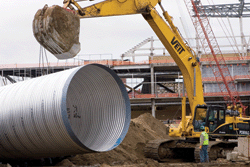 |
| Digging in: Pentair’s RMT merger with Tyco Flow |
In essence, the Reverse Morris Trust structure is designed to allow companies to avoid paying tax on mergers and acquisitions, if specific criteria are met. Ultimately, the key to the tax-free nature of an RMT transaction is that immediately after the transaction, historical shareholders of the parent company – Tyco International in this case – own more than 50% of the stock by vote and value of the new combined company. And so on completion of the merger with Tyco Flow Control, the pro-forma equity ownership of newly combined Pentair Inc was split thus: Tyco International owns 52.5% and Pentair 47.5%.
Given the structural complexity, RMT structures are not especially common. But what makes this particular transaction highly unusual is that its use was contemplated after an asset spin-off, according to David Noah, managing director in Deutsche Bank’s industrials coverage team in New York, which advised Pentair.
“This was a rare circumstance whereby the RMT structure was introduced after the straight spin-off of the Tyco Flow business had already been announced as the objective that Tyco was pursuing. Typically, the RMT would be contemplated upfront,” says Noah.
Although this dynamic is thought to be unprecedented, it’s not the only groundbreaking component – this transaction is the first ever redomiciling RMT merger.
Indeed, further enhancing the tax-efficiency of the merger under the RMT structure, the new combined Pentair will be incorporated in Schaffhausen, Switzerland, where Tyco is incorporated, although Pentair’s main office remains in Minneapolis, Minnesota.
For equity investors, and particularly the current shareholders, the expected tax savings both through the RMT structure and redomiciling, combined with the annual operating cost savings, are attractive given the potential to boost new Pentair’s earnings per share.
But in the end it was the entire merger proposition that underpinned the market’s emphatic response to the deal – Pentair’s share price soared 15% to about $48 a share on the news of the announcement on March 28, with Tyco’s jumping about 4.5% in a flat market.
“The combination produced a scale, global flow-control champion and offered investors a very attractive investment opportunity in this sector,” says McClure. “In a relatively low-return environment, offering shareholders the ability to participate in a lot of synergy-driven value creation is obviously compelling.”
Frank Oelerich, managing director, M&A, at Deutsche Bank in New York, believes investors penetrated the inherent complexity of the transaction to see the value on the other side. “Despite a complex transaction structure the market understood it easily, and as a result the shares have since performed very well. That is because it passed all the tests for equity investors in terms of valuation, value creation and strategic fit,” he says.