 |
|
|
Best SME finance house: Bank of America Merrill Lynch |
|
|
Also shortlisted: BNP Paribas |
Lending to small and medium-sized enterprises is one of the fundamental roles of a bank. But it is one that deleveraging since the financial crisis has brutally curtailed at some institutions. The re-establishment of credit channels to these corporates has become a political flashpoint in Europe as economic growth stagnates. Growing interest from non-bank lenders in lending to these firms means that banks are under more pressure not only over the volumes that they lend, but in how they service these clients across the board.
In many ways, financing SMEs is a highly domestic business, and identifying a global winner can therefore be a challenge. Bank of America Merrill Lynch was, however, the standout candidate for 2013 in Euromoney’s inaugural global SME finance house category on the strength of its ability to leverage its strong SME relationships worldwide.
Not surprisingly, BAML is a very big lender to mid-sized corporates. Its global commercial banking business has 30,000 clients and subsidiaries within the $50 million to $2 billion turnover range, but 5,699 of these clients have revenues of between $50 million and $250 million, and they are becoming increasingly focused on international expansion. “One of the big themes in the market over the past year has been the focus on international business,” says Alastair Borthwick, head of global commercial banking at BAML in New York. “There has been a steady healing of corporate balance sheets over the past four years and corporates are the most positive that they have been since 2007. The ability to expand internationally is now key. Last week I was talking to the CEO of a $50 million, 200-employee firm that now has operations in seven different countries.”
BAML was created from the roll-up of a number of large commercial banks that were themselves very large SME lenders. It is therefore no surprise that it focuses on streamlining solutions at the smaller end of the client spectrum. “As you rise up the corporate food chain you start to see firms with centralized treasury functions, but the $50 million to $75 million firm is not there yet,” says Galen Robbins, head of treasury solutions for commercial banking. “Every one of the clients in that range is doing business internationally. They may need accounts in London, accounts in Hong Kong, merchant acquiring in Australia. We can do that because we have people on the ground and can offer centralized service fulfilment in their own time zone.”
 |
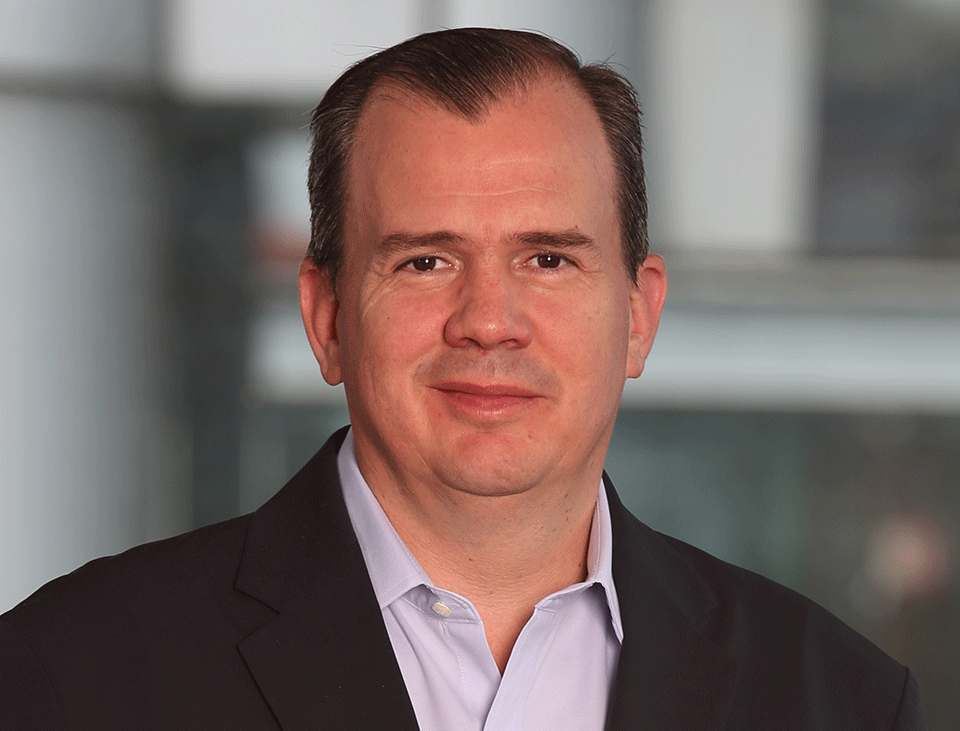
| Alastair Borthwick, head of global commercial banking at BAML in New York |
The key to effective banking of smaller firms is being able to offer them the kind of service available to larger corporates should they require it. One client, a plumbing company with sales of between $100 million and $500 million, built an assembly plant in Mexico four years ago with initial peso expenses of around Ps15 million ($1.1 million). As these grow, BAML is hedging them with peso one-year to two-year forwards.
The bank’s global payments platform covers 140 currencies in 190 countries and territories and its global liquidity function connects Asia Pacific, EMEA, Latin America and north America using a single platform. It has also focused strongly on providing local solutions in specific geographies. For example, in China BAML is the first foreign bank to build host-to-host connectivity with a local bank (ICBC) via automated connectivity to the People’s Bank of China cross-border renminbi regulatory system. It now offers renminbi demand deposit accounts, time deposits, remittances, liquidity management and FX services. The bank has also signed an exclusive cash management alliance in mainland China with China UnionPay – the first foreign bank to do so.
The ability to service smaller clients’ needs seamlessly and within their own time zone is essential as they expand. “Last year we had a smaller client in Houston that needed $5 million FX exposure locally for a subsidiary of a local entity in Mumbai,” says Robbins. “We were able to connect with parent and subsidiary and come up with a solution very quickly. This differentiates us: others can do this for large multinationals, but to be able to do it for an SME is pretty powerful.”
It is also the product of a strong and respected franchise at home. BAML is leader in paper to electronic, with 125,000 vendors part of its e-payables system, and is one of the largest corporate card providers in the US. But liquidity management is crucial too. Full Federal Deposit Insurance Corporation insurance on primary checking accounts and operating accounts (introduced as part of Dodd-Frank in 2010) expired at the end of 2012, prompting many US corporate treasurers to reassess their cash allocations. With a dedicated fixed-income investment off-balance-sheet group incorporating 35 sales people, BAML was able offer a range of solutions. “Because global liquidity investment solutions and global transaction services report together, we could go to our clients and show them on-balance-sheet and off-balance-sheet solutions,” says Robbins. “Not many of our peers can provide this kind of integrated advice.”