|
|||
| Regional Awards for Excellence 2013: Western Europe | |||
|
Western Europe winners by country Austria Belgium France Germany Greece Ireland Italy Netherlands Portugal Spain Switzerland United Kingdom |
|||
 |
Best Bank: Bank Unicredit Austria |
||
|
Many Austrian banks avoided the excesses of the pre-crisis credit and real estate booms, but the country’s banking sector still faces challenges stemming from that period. Principal among these is the resolution of ailing nationalized lender Hypo Alpe-Adria-Bank International, which has received €2.2 billion in state aid since 2008 and is the third-largest lender to the countries of the former Yugoslavia. The Austrian government has ruled out the establishment of a state-owned bad bank to deal with the problem and is looking to the privately owned banks themselves to stand behind any wind-down vehicle. The country’s two largest lenders – Erste Group and UniCredit Bank Austria – have already ruled out participation in such a deal; others are unlikely to be enthusiastic. The problems at the ailing lender, which if it is forced into insolvency might face losses of €5 billion to €6 billion, have worsened against a backdrop of improvement in wider sector fundamentals. At year-end December 2012, Austrian banks had a solvency ratio of 14.2%, with net profits for the sector at €3 billion for the year. Risk provisioning increased across the board to produce an average return on assets of around 0.3%. Austria’s banks tapped the European Central Bank’s long-term refinancing operation (LTRO) for €15.7 billion, and have already repaid €7.7 billion. The challenge that all of them face is managing the volatility inherent in their exposure to central and eastern Europe. In 2012, Austrian-owned domestic banks had €210.4 billion of exposure to central, eastern and southeastern Europe, which generated an aggregate €2 billion, most of which came from the Czech Republic and Russia. This was, however, mostly attributable to decreased provisioning rather than profit generation. The aggregate loan-loss provision ratio of these subsidiaries was still 7.6% at the end of 2012. UniCredit Bank Austria remains the best-capitalized banking group in Austria, having boosted its core tier 1 ratio to 10.8% by the end of March, and is the only big Austrian bank to have neither reported losses nor received state aid since the financial crisis. However, it is emerging Europe’s biggest lender and that exposure is starting to hurt. Bank Austria’s net write-downs of loans in the region rose by 31.6% in the first quarter of this year while its domestic write-downs fell by 11%. The bank has, however, been addressing the problem and is selling its Kazakhstan operations. It will merge its Czech and Slovak branches this year. It has also established an umbrella facility programme, under which loans based on its parent company’s credit rating can be accessed in 10 central and eastern European countries. This is essentially one loan available in 10 countries and has made it easier for Austrian companies with subsidiaries in these countries to raise finance. As co-bookrunner on Erste Group’s October 2012 capital raising, Goldman Sachs built upon its equally strong showing in the debt markets last year, where it was active on deals for the Republic of Austria, Österreichische Kontrollbank and Bawag PSK. |
|||
 |
Belgium |
||
|
BNP Paribas Fortis had a good year in 2012, with operating profit up 53.9% to €1.1 billion and earnings per share up 186.4% to 63c. This was against a backdrop of an economy that shrank by 0.2% during the period. The bank has been shrinking as well – achieving a balance-sheet reduction of more than 20% over the year. As part of this it agreed an early end to the state-guarantee scheme in place since May 2009 to cover losses on an initially €21.5 billion investment portfolio. The state had been guaranteeing up to €1.5 billion of losses on the assets at a cost to the bank of €48.8 million, but the asset pool has been reduced to a size where the guarantee is no longer necessary. The domestic operating environment is likely to remain tough for the foreseeable future. Demand for housing loans in Belgium fell during 2012 after two years of strong demand as a result of the expiry of a number of government grants and tax breaks during the year. Belgium’s budget deficit has widened to 3.9% of GDP from 3.7% last year, a figure that includes €2.92 billion used to buy Dexia preferred stock at year-end. But in April this year Credit Suisse and Texas-based Lone Star agreed to buy the distressed assets of Royal Park Investments, the bad bank formed from the collapse of Fortis and owned by the Kingdom of Belgium, BNP Paribas and Ageas (formerly Fortis). The assets will be sold for €6.7 billion and will reduce government debt by €1 billion (0.2% of GDP). BNP Paribas Fortis has tackled the challenges at home by expanding its specialized finance activities, expanding its product offering in savings and investments and targeting corporate’s working capital requirements. It is also investing substantially in its digital offering. Deutsche Bank cemented its position as a leading house across Belgian ECM, DCM and M&A during 2012. The German bank rose from outside the top 10 in ECM and M&A to rank second and fourth respectively; in DCM it moved from number eight to number two in the rankings. In M&A, Deutsche Bank advised on four of the five largest deals of the year, including AB InBev’s acquisition of a 50% stake in Grupo Modelo, which at €20 billion was the largest M&A deal in the country since 2008. It also advised AB InBev on the €2 billion acquisition of an 83.5% stake in Cerveceria Nacional Dominica. Deutsche Bank was also lead financial adviser to Sberbank on its largest-ever acquisition: Denizbank from Dexia. In DCM, Deutsche Bank was instrumental in the first-ever covered bond to be issued in Belgium. The issuer was Belfius Bank, the nationalized lender formerly part of Dexia, which placed €1.25 billion of pandbrieven at 1.25% in November. This was swiftly followed by an inaugural issue from KBC on which Deutsche Bank also advised. The bank was sole structuring adviser and co-arranger on both these deals, establishing itself in pole position in this new market. The InBev/Grupo Modelo acquisition also generated the largest-ever bond issuance in both US dollars and euro from a Belgian issuer. Deutsche was a bookrunner on both deals. In ECM the German bank was on two of the three largest deals of the year and was mandated by holding company GBL for two equity-linked transactions in quick succession. |
|||
 |
France
Best Bank: BNP Paribas |
||
|
France’s long-awaited banking reform came in at the end of last year with a whimper rather than a bang. Although the new rules stipulated that proprietary trading must be ring-fenced from the banks’ main activities, it stopped short of the separation of investment and commercial banking that the industry had feared. However tougher regulation of market-making, hedging and private equity has been proposed. The regulation is likely to have little impact on BNP Paribas, which derives roughly 1% of investment-banking revenues from proprietary trading. Despite these reforms, and an ambitious deleveraging programme, the bank increased financing to the French economy by 1.5% over the awards period and reported an increase in group-wide net income of more than 8% to €6.6 billion. It also has a fully loaded Basle III common equity tier 1 ratio of 9.9% and has doubled its surplus of stable funding to €69 billion. The 1.5% rise in loan outstandings was achieved despite a deceleration in demand for credit in France. BNP Paribas has also been active in addressing one of the region’s biggest problems: the flow of credit to small and medium-sized enterprises. It has launched the BNP Paribas small business centres initiative, with 58 such centres opened by the year-end, together with several SME innovation hubs. Outstanding loans to SMEs have increased by 2.7% as a result. In DCM BNP Paribas remains comfortably ahead of its peers, despite the investment bank being at the sharp end of the bank’s adaptation plan. It is again ranked number one bookrunner for all euro-denominated bonds during the period and was one of the three lead managers on EDF’s landmark corporate hybrid deal in January this year. Rothschild had another very strong year in M&A, advising on 65 transactions with a combined value of €28 billion. It now has a 35% market share. In 2012 it advised on three of the five largest M&A deals of the year. Key M&A transactions on which it advised include GDF Suez’s $10.8 billion acquisition of the remaining 30% stake in International Power. It also advised Casino on its €1.2 billion acquisition of a 50% stake in Monoprix from Galeries Lafayette following an acrimonious dispute over the valuation of the stake. Rothschild also advised Vinci on its €3 billion cross-border acquisition of Lisbon’s airport operator, ANA Aeroportos de Portugal, from the Portuguese state. Vinci beat three other bidders to the company, which operates airports in Lisbon, Porto and the Algarve region. The equity markets in France continue to be dominated by Société Générale CIB, which has a 16.3% market share for 2013 so far and has inked more than twice the number of deals of nearest rival BNP Paribas. The franchise has breadth as well as depth, with the bank active in all parts of the market. In March this year the bank was sole placement agent on BNP PSA’s €177 million accelerated bookbuild, and was instrumental in the French state’s disposal of 13 million shares in aerospace, defence and security firm Safran. That sale raised funding for a key initiative of François Hollande’s administration, the establishment of Banque Publique d’Investissement, a public institution targeted at supporting corporate finance, lending to SMEs, offering export assistance and financing innovation that was due to launch in June. SG was also involved in successful capital increases for Sequana and Alstom, the latter being the first capital increase by a CAC 40-listed issuer through accelerated bookbuilding since December 2006. |
|||
 |
Germany
Best Bank: Deutsche Bank |
||
|
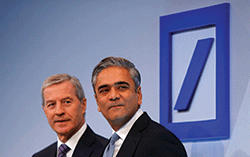
Having been regarded dismissively during the pre-crisis years for being conservative and cautious, Germany’s famed Mittelstand corporate sector is now the envy of its European peers, with many desperately trying to devise ways in which they can emulate its success. That is not, however, the case for Germany’s banks, the bedrock upon which that corporate success has been built. The country has 423 savings banks and 1,116 cooperative banks that together provide about two-thirds of all lending to Mittelstand companies and 43% of lending to all German companies and households. New European banking regulations make such lending far more expensive for them to undertake, and it is therefore little surprise that German finance minister Wolfgang Schäuble has lobbied so strongly for non-systemic German lenders to be excluded from the jurisdiction of the European Central Bank’s new cross-border supervisory authority. Not only is German banks’ traditional lending business becoming far less profitable for many of them; competition is also increasing for the Mittelstand business on which they rely. The traditionally strong, regional ties between these banks and their borrowers will act as a buffer to some degree, but there are uncomfortable days ahead for many of Germany’s banks. The largest of these, Deutsche Bank, has had a fair number of uncomfortable days over the past year – particularly with regard to its capitalization. It has, however, been addressing those concerns over the year with the reduction of risk-weighted assets by €80 billion and the increase in its fully loaded core tier 1 ratio to 8% from less than 6%. During the year its co-CEOs Jürgen Fitschen and Anshu Jain introduced Strategy 2015+, which reinforces the bank’s commitment to the universal banking model. It is also focusing on its domestic market, increasing its stake in Postbank to 94.1% and aligning coverage of mid-sized corporate clients, small corporate clients and private clients. This will add considerably to the competitive pressure to bank Germany’s corporates. It also expanded mortgage lending in Germany by €24 billion in 2012 and now provides one in eight of all mortgages in the country.
In investment banking, Deutsche Bank ranks in the top three of DCM, ECM and M&A in Germany – the only bank to do so. It was joint lead manager on Siemens’s four-tranche transaction in August last year – the short euro tranche of which became the first-ever corporate bond to price with a yield below the euro mid-swap rate. In ECM, Deutsche Bank was joint global coordinator and joint bookrunner for the €517 million IPO of Talanx in October – the first insurance IPO in Germany since 1994, the largest IPO in Germany since March 2010 and the largest listing in Europe for more than six months. Deutsche Bank was the only lead bank to remain on the ticket when Talanx dropped Citi and JPMorgan in September and promoted Berenberg Bank to global coordinator in order to close the deal on its third attempt. Morgan Stanley played a leading role in the most important M&A deal in Germany last year – the July €4.5 billion sale by Porsche Automobil Holding SE (PSE) of 50.1% of Porsche AG to Volkswagen. The sale, which merged all car manufacturing operations of PSE and VW after years of wrangling, followed three years of work by Morgan Stanley advising the Porsche and Piech families on the sale of assets and stakes to VW and Qatar Holdings in 2009; the €4 billion VW capital increase in 2010 and the €5 billion PSE capital increase in 2011. It also follows Porsche’s own failed bid to buy Volkswagen in 2009. Morgan Stanley was sole financial adviser to PSE on the transfer of the stake and solicited the waiver from US private placement noteholders that was necessary for the deal to go ahead. Morgan Stanley, which was ranked number two in German M&A over the awards period, with a 10.89% market share, also acted as lead financial adviser to Deutsche Telekom in the $9 billion merger of 100% owned subsidiary T-Mobile USA with Metro PCS. Morgan Stanley was also lead adviser to Deutsche Telekom on the withdrawn sale of T-Mobile to AT&T that fell through at the end of 2011. |
|||
 |
Greece Best Bank: National Bank of Greece Best Investment Bank: Deutsche Bank |
||
|
On June 14, National Bank of Greece announced that it had successfully raised 10.8% of the €9.8 billion capital increase mandated by the Bank of Greece from private investors, thus surpassing the 10% hurdle that otherwise might have resulted in its having to issue high-cost contingent convertibles to the Greek state and ultimately falling back into outright nationalization under control of the Hellenic Financial Stability Fund. The fund will now support the remainder of the capital increase, after almost 50% of the private capital raising was supplied by non-Greek buyers, implying a direct foreign investment into the country of €500 million. It was a crucial moment for the country’s banking champion at the end of a difficult 12 months. In 2012, Greek banks were hit hard by the private-sector involvement (PSI) on Greek government debt. NBG Group losses after tax for the full-year 2012 amounted to €2.1 billion as the quality of its loan book in Greece suffered from intense political uncertainty and deep recession. Accompanying the rise in loan delinquencies, and the drastic reduction in market interest rates on loans, the higher cost of raising funds under the Emergency Liquidity Assistance mechanism hit the bank’s net interest income. NBG Group deserves recognition for the way it has responded to this highly stressed economic environment by altering its business model and taking initiatives to fortify its capital position and balance sheet. Actions in this context included: the repurchase of part of the covered bonds and hybrid securities (core tier 1 capital of €302 million); the sale of a majority stake in the group’s insurance franchise in Turkey (profit before tax of €157.3 million); drastic reduction in domestic operating expenses; and strengthening of the balance sheet with the formation of provisions amounting to €2.5 billion. The group’s strategy was accompanied by big cost reductions across southeastern Europe and even stronger earnings from Finansbank, which posted a net profit of €668 million in 2012. The bank’s efforts have been rewarded with a return of deposits after the elections in the second half of last year, when some €2 billion of deposits were re-banked, further improving liquidity and the loan-to-deposit ratio as NBG delevered. One of the considerations in selecting Deutsche Bank as the best investment bank in western Europe this year has been its continuing commitment to the region’s troubled periphery. Topping the Dealogic bookrunner tables as the leading M&A adviser and debt capital markets arranger, Deutsche Bank is the best investment bank in Greece. In part, the bank’s prominence flows naturally from its lead role in galvanizing the banks behind the PSI in the spring of 2012. Following on from that, Deutsche Bank acted as lead structuring agent and joint dealer manager on the €61.4 billion bond buyback for the Hellenic Republic in December 2012. It was the only international investment bank to be involved in both transactions, reflecting its unparalleled understanding of the market for Greek government bonds. The Hellenic Republic has also entrusted Deutsche Bank with the key M&A advisory mandate on the central plank of its privatization programme, the sale of its 33% stake in gaming incumbent Opap. Deutsche’s bankers have toiled in the engine room of restructuring the country’s banks, for example advising the board of directors of Eurobank on the tender offer from National Bank of Greece and being appointed adviser to Piraeus Bank on the acquisition of the Greek operations of Bank of Cyprus, Laiki Bank and Hellenic Bank speedily put together following the bailout of Cyprus. In May 2012, Deutsche arranged a liability management exercise for Alpha Bank in which it tendered for outstandings of various issues of subordinated capital and hybrid debt and ultimately improved its core tier 1 capital ratio by 74 basis points. Large international corporations tempted into the Greek market rely on Deutsche Bank, which advised Henkel on the acquisition of Athens-listed Rilken through a cash-out merger. |
|||
 |
Ireland Best Bank: Bank of Ireland Best Investment Bank: Davy |
||
|
Bank of Ireland was the only Irish bank to avoid full nationalization during the crisis that broke over the country four years ago, and now looks to be leading the country back to some semblance of normality. At the end of May, still rated Ba1/BB+ by Moody’s and Standard & Poor’s, it became the first Irish bank since 2009 to sell senior unsecured debt, with a €500 million three-year offering of bonds priced to yield 220bp over mid-swaps. The lead managers were able to place these with real-money investors, including insurance companies, pension funds and asset managers around Europe, providing an important signal of confidence in the bank, the country and its banking system. The deal will reduce Bank of Ireland’s dependence on ECB funding and counts as a credit positive. It marks an important further step for the bank as it strives to show a restoration of capital and earnings capacity and stabilization of asset quality, even as concerns still persist among equity investors on all three scores. In 2012, Bank of Ireland led the return of Irish banks to the wholesale markets with a first covered bond since the crisis and a €250 million subordinated issue. It followed this up with a second and well-subscribed €500 million covered bond in March 2013. In addition, the ability of the Irish government this January to find buyers for €1 billion of Bank of Ireland contingent convertibles that were first issued to the government as part of its recapitalization in 2011 was an important positive both for the bank itself and for Ireland. Investors submitted bids totalling €5 billion for the high-trigger bonds, clearly attracted by the high coupons amid a yield drought. Although Bank of Ireland retains its crown as the national champion, with high domestic market share, its troubles are not all over. The central bank has recently delayed to 2014 capital stress tests for banks originally scheduled for this autumn, fuelling some fears of a further possible deterioration in asset quality, even though Bank of Ireland’s management offered guidance for a continued decrease in impairments through 2013 when it released interim results at the end of April. And although net interest margins improved in the second half of 2012 and the first quarter of 2013, offering some hope for internal capital generation, analysts still fret about the potential impact of any future ECB rate cut, given that two-thirds of the bank’s Irish mortgage book comprises tracker mortgages. The worry is that the bank might have to resort to a rights issue to meet future regulatory capital needs and redeem €1.8 billion of government preference shares that now constitute part of its 8.5% Basle III core tier 1 capital. Davy is the best investment bank in Ireland. Its signature stockbroking division dominates the equity capital markets arranger rankings in an admittedly quiet year. It has led six deals worth a combined $280 million; its nearest rival, Jefferies, has led just two. It is also a lead arranger of financings in the debt capital markets, including playing a key role in the sale by the Irish government of Bank of Ireland contingent convertibles discussed above. Notable M&A and capital market transactions Davy has completed across a range of different sectors include the sale of Permanent tsb Finance and the acquisition of the Oppenheimer Group on behalf of Total Produce. Davy also advised Petroceltic International on its merger with London-listed Melrose Resources earlier in the year, a landmark deal that created a Dublin-based, $550 million independent oil and gas company. Davy advised Westland Horticulture in Northern Ireland earlier in 2012 when it acquired Cranswick Pet Products in the UK. Davy’s capital markets teams assisted Glanbia Co-op in raising €135 million to fund its dairy ingredients joint venture. They have also been busy in the natural resources sector. Davy recently advised the National Treasury Management Agency on the issuance of a €5 billion 10-year benchmark bond in March 13, the country’s first such benchmark in over three years, denoting a restoration of market access for Ireland. It was an important deal to give investors comfort that Ireland would have more than a year’s worth of advance funding already in place when the EU/IMF programme reaches its scheduled end. |
|||
 |
Italy Best Bank: UniCredit Best Investment Bank: Goldman Sachs |
||
|
As well as being the largest bank in Italy, UniCredit is now also the leading arranger of debt capital markets financing for Italian borrowers, suggesting that it is charting a smart course as banks are forced to raise capital, as it has done successfully, delever and so find new ways to fund companies. UniCredit led $20.6 billion-equivalent of debt-raising for Italian issuers for the 12 months under review in 56 deals, giving it a market share close to 20%, almost double that of leading local rival Intesa Sanpaolo, which led 48 deals worth a combined $11.8 billion.
Following the successful completion of its memorable rights issue at the start of last year and with fully loaded Basle III capital adequacy at 9% by the end of 2012, UniCredit is now showing signs of starting to deliver for shareholders. In its most recent results for the first quarter of 2013 it reported a slowing pace of credit deterioration in Italy for the second quarter in a row, allowing the commercial bank in Italy to break even. Strict expense control and repricing of loans and liabilities even allowed the group as a whole to report a quarterly profit of €449 million. The bank’s management seems to be following a solid restructuring plan, while finding ways to support domestic customers. As well as capital, funding looks solid, with the bank able to access the senior unsecured markets in dollars and euros and issue lower tier 2 capital while buying certain outstanding bonds to tightly manage its liability costs. Macroeconomic conditions quite beyond management’s control remain the ever-present risk. Goldman Sachs is the top investment bank in Italy. In the ECM arranger rankings it narrowly pips local rival Mediobanca to the top spot by volume. It also leads the M&A rankings, where volume has been much greater in Italy over the past 12 months, coming ahead of close rivals Rothschild, Morgan Stanley and Deutsche Bank. And even in DCM, not always a Goldman strength, it is rubbing shoulders inside the top-10 arrangers with large Italian and other European universal banks. It advised on two out of the top-three largest transactions in Italy: as sole financial adviser to Cassa Depositi e Prestiti on its acquisition of a 30% stake in Snam, a deal valued at €3.5 billion; and as lead adviser to Atlantia on its €3.1 billion merger with Gemina to create a leading infrastructure player specializing in toll roads and airports During the reference period, Goldman strengthened its relationship in particular with the Fiat Group, executing the conversion of the preferred and savings shares of Fiat and Fiat Industrial in May 2012 and the conversion of Exor special shares announced in March 2013. In addition, Goldman acted as sole financial adviser to Fiat Industrial in the combination with its 88% owned subsidiary, CNH, listed in the US, creating the third-largest capital goods player globally. The structure is highly innovative as the combination will be executed via a double merger into a Dutch vehicle and the NewCo, with listings in New York and Milan, will introduce a loyalty voting scheme. In the much quieter equity capital markets, Goldman Sachs acted as joint global coordinator and joint bookrunner in the IPO of Moleskine, the larger of just two Italian IPOs in the period under review. It executed the two largest accelerated bookbuilt offerings in the past 12 months, the $612 million Snam offering and $486 million Luxottica deal. The firm has also been making its mark in the debt business. In Italy, it was joint bookrunner on the UniCredit €1.25 billion lower tier 2 deal, the largest such deal in a single tranche from a eurozone bank in 2012 and the first southern European benchmark lower tier 2 deal for more than a year. Playing to the big theme of the year in investment-grade debt capital markets, Goldman led the €750 million hybrid debt deal from Telecom Italia, the first such hybrid from an Italian corporate since 2006 and the opening salvo in that borrower’s planned €3 billion programme of hybrid issuance. |
|||
 |
Netherlands
Best Bank: ING Bank |
||
|
The restructuring of ING Group continues apace with the recent IPO of its US operations now successfully completed and attention turning to imminent disposals in Korea and Japan before the biggest test of all: the IPO of its European insurance business now scheduled for some time next year. Investors hope these restructuring efforts will help close the discount to book value at which ING shares still trade. In the domestic market, analysts are encouraged by other signs: improving interest margins on loans and stabilizing and even declining loan losses. The bank has continued to attract customers, looking more solid as its earnings and capital ratios improve. At the end of 2012 its pro-forma Basle III core tier 1 capital ratio had reached 10.4%. ING Bank’s domestic retail franchise continued to draw solid retail deposit volumes, with €9 billion of retail net funds entrusted in 2012, underscoring its ability to gather deposit funding even amid intense competition for savings. ING is the top-ranked bookrunner and arranger of syndicated loans in the Netherlands. Its teams in the Dutch retail market worked hard during 2012 to help customers manage their financial concerns. For example, with mortgages the bank has embraced a transparent price policy, with all fees published on its website. Customers now receive an interest renewal notification by email three months ahead of time, the hypotheekrente wekker (mortgage interest alert). Rabobank is the best investment bank in the Netherlands. It has arranged more bond deals for Dutch borrowers than any other bookrunner, ranking second by volume only to JPMorgan. This is an impressive effort for a bank that has only really stepped up its efforts in this cornerstone investment banking business in the past three years. In March this year it executed a €700 million 10-year deal for Wolters Kluwer, its seventh mandate from the global information and publishing company. The order book of over €3 billion drew demand from more than 200 accounts, allowing the deal to close after 75 minutes, price 10bp inside guidance and perform around 5bp up on the break. Rabobank was also joint bookrunner on the five-year €500 million deal for unrated Air France KLM last December that achieved investment-grade equivalent terms for a borrower from a troubled sector. The $500 million US private placement deal for Friesland Campina last year shows the strength of the Rabobank franchise. Friesland Campina is a long-standing client and the deal was supported by Rabobank’s Food & Agri Research. This led to strong investor interest, a substantially oversubscribed order book and final pricing well inside guidance. In June 2012 Rabobank was joint bookrunner on a €500 million five-year deal for insurance company Aegon. Aegon had not printed a euro senior unsecured deal since April 2009 and one year ago the senior FIG market was nervous and highly volatile, with short windows of opportunity for issuance. In March 2013, Rabobank was joint bookrunner and swap provider on a €1.25 billion private placement of residential mortgage bonds for Aegon and has led a series of RMB deals. In the equity capital markets, Rabobank is a leading arranger of small-cap and mid-cap deals and is increasingly seen on the bigger deals, for example acting as joint retail bookrunner on Ziggo’s IPO. It was also financial adviser to DE Master Blenders 1753 on its spin-off from Sara Lee, this being the largest listing on Euronext in 2012. In addition Rabobank has efficiently executed share buyback programmes for many Dutch clients, including Imtech, Nutreco, Van Lanschot and ASM. The bank’s M&A teams are particularly known for advising in the food and agri sector, in general industries in the Netherlands, as well as mid-cap and small-cap deals. Recent highlights including being appointed M&A adviser to Joh. A. Benckiser SE in its €7.6 billion recommended public offer for DE Master Blenders 1753. Rabobank is also set for a leading role in the financing of the envisaged transaction. Rabobank was exclusive M&A adviser to CSM on the sale of its bakery supplies business to Rhône Capital for €1.05 billion based on its long-standing relationship with the company and extensive M&A track record in the bakery sector. |
|||
 |
Portugal
Best Bank: Santander Totta |
||
|
Portugal’s government remains steadfast in its determination to stick to its austerity plan. Although this will benefit the country’s finances and economy in the long term, it has provided an awful backdrop to the banking industry. Two banks in Portugal stand out as being able to cope, if not exactly thrive, in this tough environment. The first is BPI, which managed to produce healthy profits from a strong capital base. But the best bank in Portugal award goes to Santander Totta. The bank managed to generate profits of over €250 million in 2012, the highest in the country. It did so with one of the strongest capital positions of any bank in Portugal: 12.3%. Deposits have grown, giving Santander a market share of more than 10%, while operating expenses have fallen by 9.5%, helping to produce a best-in-country cost-income ratio of 37.3%. That allowed the bank to generate a return on equity of 12.9%, a remarkable achievement given market conditions. In the perennial battle between CaixaBI and Espírito Santo Investment Bank, it is the latter which edges the award for best investment bank in Portugal this year. ESIB had a particularly good year in the M&A markets and was involved in 12 completed transactions in the period under review. These included advising China Three Gorges on taking a 21% stake in EDP; advising Brazil’s Camargo on its investment in Cimpor; and Sugalidal on its acquisition of a food business in Chile. ESIB was also the top-ranked bookrunner in the Portuguese debt capital markets, involved in deals for top names such as Portugal Telecom, EDP and Zon. In equity, it was financial adviser for public tender offers for Brisa and Cimpor. It also remained active in the project finance market, with transactions for Ascendi Group and Ybase. Portugal still needs to find smart solutions to its debt problems. No firm has provided more, and better, than Stormharbour. The firm opened an office in Lisbon only in 2012, so it is fair to say it has hit the ground running. It has led every securitization in the Portuguese market in 2012, including the first publicly placed securitization in five years for Banif, the Atlantes V transaction. It was sole adviser to a big Portuguese bank on a €1 billion balance sheet hedging and capital relief transaction, and is underpinning its business with active roles in trading both secondary Portuguese ABS and government bonds. Following a recent landmark €450 million securitization for EDP, Stormharbour looks like the firm to watch in Portugal. |
|||
 |
Spain
Best Bank: CaixaBank |
||
|
Spain’s banking system remains polarized between the well-run banks that continue to cope with the country’s economic mess and those that can barely survive. Three banking groups stand out: Santander and BBVA, which have benefited immensely from their strategic diversification away from their home market; and CaixaBank, which continues to perform well despite its position as a wholly Spanish financial institution. In terrible market conditions, CaixaBank managed to maintain positive earnings per share throughout 2012 and into the third quarter of 2013. It has done so despite continuing to acquire large swathes of the distressed Spanish banking sector. In August 2012, CaixaBank completed the integration of Banca Cívica, which itself had been formed from four savings banks as recently as 2010. It has since acquired the operations of Banco de Valencia. This has enabled the bank to grow assets, from €277 billion in the first quarter of 2012 to €367 billion by the end of the first quarter of 2013. Customer funds and loans both grew by around 25% over the same period. Tier 1 capital remains healthy at above 10%, despite the acquisitions. CaixaBank now has a strong position in the Spanish banking market, with 13 million customers. Whether or not the Spanish economy can recover sufficiently to enable the bank to generate decent profits is the big question, but CaixaBank is doing more to rehabilitate the country’s banking sector than any other firm. BBVA’s investment banking business has become a clear leader in Spain: the breadth of its capabilities across debt, M&A and equity stand out from the pack. In M&A, it advised on several landmark deals, such as the sale of OHL’s water business to Korea’s GSE&H, and leads the league tables. In equity, it was joint global coordinator for Repsol’s €1.364 billion accelerated bookbuild, as well as being involved in the rights issues for Banco Sabadel and Banco Popular. BBVA is also the leading arranger of project finance deals in Spain. And it has continued to build out its offerings in cash and liquidity management. BBVA has also had a particularly good year in the debt capital markets, despite an environment dominated by volatility and rising costs of funding. It reopened the market for Spanish corporates with Telefónica’s bond issue in September 2012. Although deals for banks dried up thanks to the LTRO, BBVA remained active in the financial institutions sector with an inaugural deal for Mapfre, which generated orders from over 400 accounts. It was hardly a stellar year for Spain’s equity markets, but there were a handful of important deals. Principal among them was the €2.5 billion rights issue for Banco Popular, on which UBS acted as joint global coordinator and bookrunner. The Swiss firm was also active in the block and convertible markets. UBS also showed itself to be the equity adviser of choice for Spain’s leading corporates, playing lead roles on Santander’s IPO in Mexico and the flotation of Telefónica’s German business. Citi continues to build an investment banking business to be reckoned with in Spain, and no more so than in the M&A market. It ranked second overall in the period under review, and completed 14 different transactions. Highlights included advisory roles in bank restructuring fund Frob’s restructuring of Bankia and the sale of a 48% stake in Euskaltel. It provided innovative solutions to a number of challenging transactions, such as Abertis acquiring its own shares from ACS and simultaneously exchanging those, plus cash, for OHL’s Brazilian and Chilean assets. |
|||
 |
Switzerland
Best Bank: UBS |
||
|
Sergio Ermotti’s strategic reappraisal of UBS’s investment banking business was music to the ears of the vocal and influential Swiss shareholder base. They will be equally pleased with the performance of the bank in its home market over the past year. UBS strengthened its position as the leading universal bank in Switzerland almost any way you choose to look at it. It now has market shares of above 25% in all five key business areas: retail, wealth management, corporates, investment banking and asset management. UBS in Switzerland is at the heart of Ermotti’s business: it contributes the largest part of the group’s profits, while accounting for less than a quarter of risk-weighted assets. In Switzerland, the bank has grown client deposits by 10% while reducing operating expenses by 11%. In retail, net new client assets rose by 31%; and UBS generated net new money in its wealth management business three times greater than Credit Suisse. UBS remains the leading flow house in Switzerland, thanks to its FX and fixed-income businesses, but Credit Suisse is currently the more successful investment bank. Credit Suisse is the clear leader in M&A advisory. Its role in the acquisition by Julius Baer of Merrill Lynch’s international wealth management business for almost $900 million was an enormous coup, both in terms of the innovative financing the firm put in place and the fact that it was chosen by a rival private bank to advise on such a transformative transaction. The related Julius Baer rights issue, as well as an acquisition-related capital increase for Dufry, the world’s leading duty-free business, helped Credit Suisse secure a leading position in the Swiss equity capital markets, as well as the only Swiss IPO during the 12 months under review, for EFG Financial Products. Credit Suisse was also the leading bookrunner of Swiss franc bond offerings, with a market share of 34%. In a low-yielding environment, the firm brought a number of deals in the asset-backed and hybrid markets that attracted strong investor interest. |
|||
 |
UK Best Bank: Lloyds Banking Group |
||
|
There has been little to cheer in the UK banking market for over five years. The industry remains something of a public pariah, politicians and regulators continue to meddle with banks to the detriment of one of the nation’s few world-class industries, and the country’s poor economy provides few avenues for growth among financial institutions. So the turnaround in the fortunes of Lloyds Banking Group provides a rare moment of pleasure, not least to UK chancellor of the exchequer George Osborne, who is likely to see the government’s empty coffers given a much-needed injection of cash from the forthcoming sale of some or all of UK Financial Investments’ 39% stake in the bank. Lloyds has always had an excellent UK retail and commercial bank, with an unrivalled network of branches and customers. But its legacy issues dragged the whole business down. Chief executive António Horta-Osório has dealt with those more quickly than anyone could have expected (see Banker of the year). That allows the market to look more closely at the underlying business. And investors seem to like what they see. From January 2012 to April 2013, Lloyds was the strongest performer on the FTSE100. The new Lloyds business model delivered a statutory profit of over £2 billion ($3.1 billion) in the first quarter of 2013, up from £280 million in the year before. Lloyds provided one in four mortgages to first-time buyers; it increased SME lending by 4%, compared with a market contraction of 4%; it increased core tier 1 capital to 12%, the highest of any UK bank; and reduced costs by 7%. Bankers working for Barclays in the UK will remember the past 12 months as a terrible time, as senior management changed and a new chief executive publicly questioned the legacy that 15 years of achievement had brought. But it was still a successful year for the firm’s investment banking business in the UK, which is robust, diversified and full of talented people. Its overall share of the UK market was almost 9%, more than 1.5 percentage points ahead of nearest rival JPMorgan. It ranks in the top two in the league tables in all key markets, with notable improvements in ECM (second, from 10th last year) and leveraged finance (first, from sixth last year). In M&A, Barclays played a key role on deals for International Power, Terra Firma, Cable & Wireless and Misys. In ECM, it was joint global coordinator on IPOs for Crest Nicholson and Greencoat UK Wind, and was also sole agent on Vodafone’s £1.5 billion share buyback programme. In a booming DCM market, Barclays was the lead manager of choice for UK corporates, acting as a bookrunner on 42 deals, or just over half of the deals completed in the review period. But even in that market, Barclays was trumped by RBS, which was bookrunner on 57 deals. That performance, and the range of deals that it was involved in, earns RBS the title of best debt house in the UK. Among the top corporate names using RBS’s capabilities were Diageo, Xstrata, Virgin Money and Icap. RBS helped to reopen the securitization market in the UK, with an RMBS deal for Leofric and the sale of its own legacy real estate assets via Isobel Finance. Structured finance highlights included deals for Peel Port, HS1 and Kelda. It was a difficult year for UK equity capital markets, but the performance of Bank of America Merrill Lynch stands out. Its deals included a $2 billion secondary accelerated bookbuild for Reckitt Benckiser; a firm placing and open offer for builder Redrow; a primary equity raising for Capco; and a £300 million unsecured convertible bond issue for Capital Shopping Centres. The M&A market was much busier, and there Rothschild was the dominant firm. It acted as adviser on no fewer than 77 deals. Its market share was more than 16% of completed deals, up from less than 10% last year. Clients that stepped up for Rothschild’s advice included Cookson, on its £2.1 billion demerger; AG Barr on its £2 billion merger with Britvic; supermarket chain Iceland for its management buyout; Cable & Wireless on its sale to Vodafone; and Four Seasons Healthcare on its sale to Terra Firma. |
|||