 |
|
|
Best Emerging markets M&A house: Goldman Sachs |
|
|
Also shortlisted: Citi, Credit Suisse and Deutsche Bank |
Since emerging markets M&A is a relatively capital-light business, the competition between global investment banks for a piece of the action remains fierce, even as many international banks are forced to reassess the value of maintaining on-the-ground sales and trading operations.
What’s more, with slower global growth, softer commodity prices, macro volatility, and the effects of quantitative easing inflating equity prices – vexing corporate valuations – M&A deal volumes have been challenged in both developed and developing markets.
Nevertheless, emerging market deal volumes continue to constitute around a third of the global M&A market – compared with under 10% a decade ago – and plenty of companies from the Gulf and Asia, in particular, demonstrated their financing firepower power and appetite for deals over the past year. What’s more, evidence abounds that the much-vaunted jump in south-south flows is providing banks with plenty of lucrative M&A advisory opportunities.
Nevertheless, for all the talk among multi-product international banks of the importance of having a deep local presence and providing banking facilities for clients as they grow from small enterprises into large corporates seeking capital market solutions, Goldman Sachs remains the natural M&A adviser from the perspective of emerging market corporate chieftains.
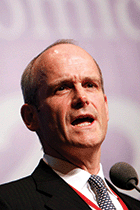 |
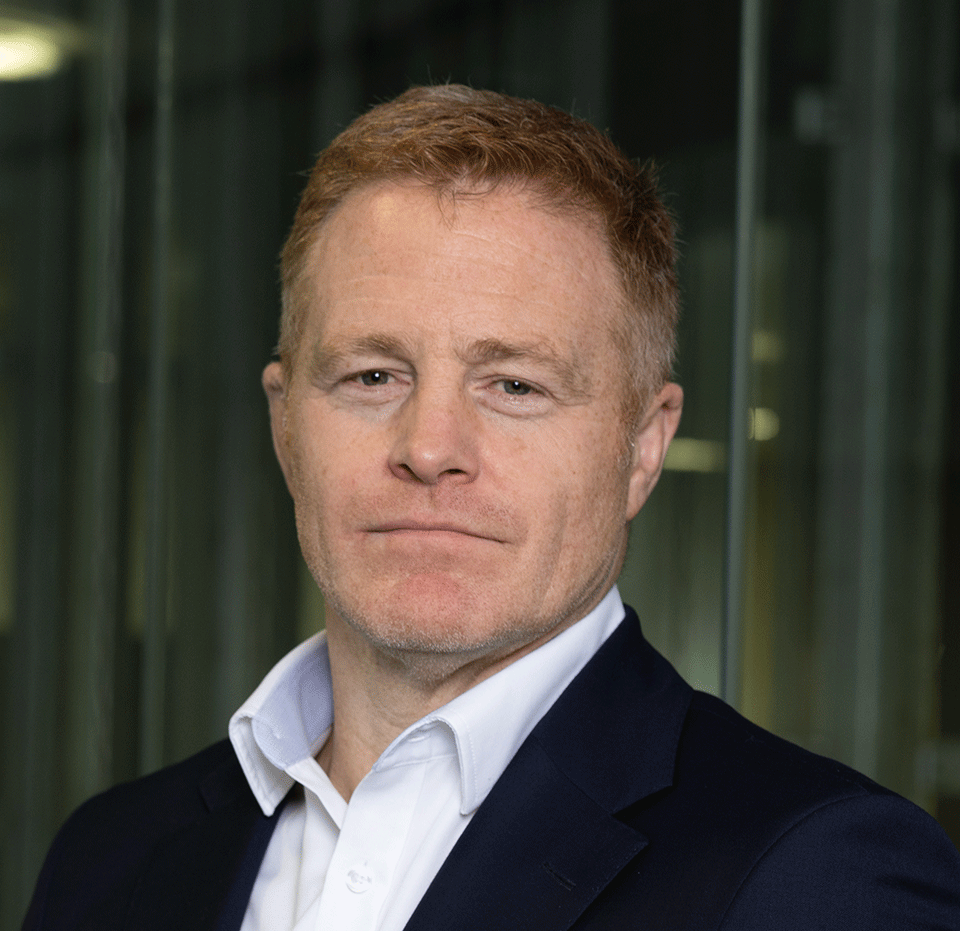
| Michael Evans: breadth of contacts and reputation for innovation |
Despite not boasting the same depth of local presence as some of its rivals, Goldman’s breadth of contacts and reputation for innovative and tailored client solutions ensure it consistently outranks its rivals. It was the top M&A adviser when either the target or the acquirer was an emerging market company over the awards period, advising on 128 transactions worth around $162 billion. That is a 19% market share, ahead of Citi at 17%. Goldman’s famed global prowess in the M&A business was underscored by its leading role in the Asia-Pacific region, where it remained at the top of the league table, with an 18% market share, extending its lead over Morgan Stanley, and advising on five of the top 10 completed deals, over the awards period.
Michael Evans, vice-chairman of Goldman Sachs, and global head of growth markets, says: “Our success is down to the fact we have prioritized emerging market investment banking and have decided to position our very best people in these growth markets. We have been consistent in our footprint and look at these markets in a holistic fashion. Coordination and communication within and between our teams globally is important to ensuring discipline, consistency of standards and that we are able to consistently connect our clients to the most interesting opportunities.”
Gregg Lemkau, co-head of global M&A at Goldman, adds: “Whether it is a developed market company looking to buy an emerging market business or vice-versa, our clients demand and deserve the highest-quality execution capabilities and capital markets knowledge everywhere in the world.”
Landmark transactions include CNOOC’s contentious $15.1 billion acquisition of Canada’s Nexen, the largest foreign acquisition by a Chinese company; Nippon Steel Corp’s $19.7 billion acquisition of Sumitomo Metal Industries; and Asia Pacific Breweries sale of a 39.7% stake to Heineken International for $4.4 billion, the largest-ever contested takeover offer in southeast Asia. The latter deal – also the largest in southeast Asia consumer M&A – underscores the growing complexity of EM deals, with Heineken’s offer subject to a contested public takeover battle involving many listed companies, within a complicated legal and regulatory framework. Lemkau says: “I can’t think of a more complicated transaction over the past 12 months. We were able to execute a deal of this nature thanks to having an experienced M&A team with on-the-ground presence in Singapore for the past five years.”
The bank remains the key player in landmark deals in the Gulf and Latin America, across the commodity, telecom and consumer sectors. In Latin America, Goldman demonstrated its FIG relationships, advising HSBC Bank (Panama) on its pending sale to Bancolombia for $2.1 billion. The landmark transaction in the Middle East includes advising the Qatar Foundation on the acquisition of a 5% stake in Bharti Airtel for $1.3 billion.
Price-discovery challenges and risk aversion remain a key drag on M&A flows in both developed and emerging markets, says Lemkau: “If you look at M&A conditions globally, such as the cheap cost and wide availability of capital, things are ripe for a strong M&A market. However, activity has been flat as CEOs remain in risk-off mode.”
If quantitative easing fades over time and market volatility abates, the value of underlying corporate assets might finally meet the expectations of budding sellers and buyers, boosting M&A flows. Nevertheless, Citi, Credit Suisse, Barclays Capital (which is strong in the MENA region) and Deutsche Bank (which is making inroads in CEEMEA, in particular) will continue to snap at Goldman’s M&A heels.