 |
|
|
Best Emerging markets bank: Citi |
|
|
Also shortlisted: HSBC and Standard Chartered |
No other emerging market banker launches an international sales pitch, using their corporate mantra, with as much relish as a Citi executive.
It’s appropriate then that the long-standing refrain used by Citi bankers of all stripes – that the bank boasts a local presence in 100 countries, more than any other US bank, and conducts business in 160 – has been given a new lease of life in recent years.
Chief executive Michael Corbat has followed in the footsteps of his ousted predecessor, Vikram Pandit, by deploying extra capital to growth markets, thanks to savings generated by Citi’s post-crisis balance-sheet surgery, with targeted cost-cutting and streamlining of non-core holdings across the group.
As global macroeconomic concerns, regulatory requirements and market pressures for cost-cutting bite universal-banking rivals, Citi continues to position its core global franchise in emerging markets, across retail, corporate and investment banking. In recent years, the bank has deepened its high-margin corporate and consumer banking presence in Latin America, ramped up its wealth management and retail capabilities in key Asia-Pacific markets, adopted a more focused strategy in the urban emerging European markets, and acquired ING Group’s custody services in seven CEE countries. In addition, Citi became the first international bank to launch a sole-branded credit card in China – a market projected to reach 900 million by 2020 and deepened its transaction-banking product capabilities in new markets in Africa.
 |
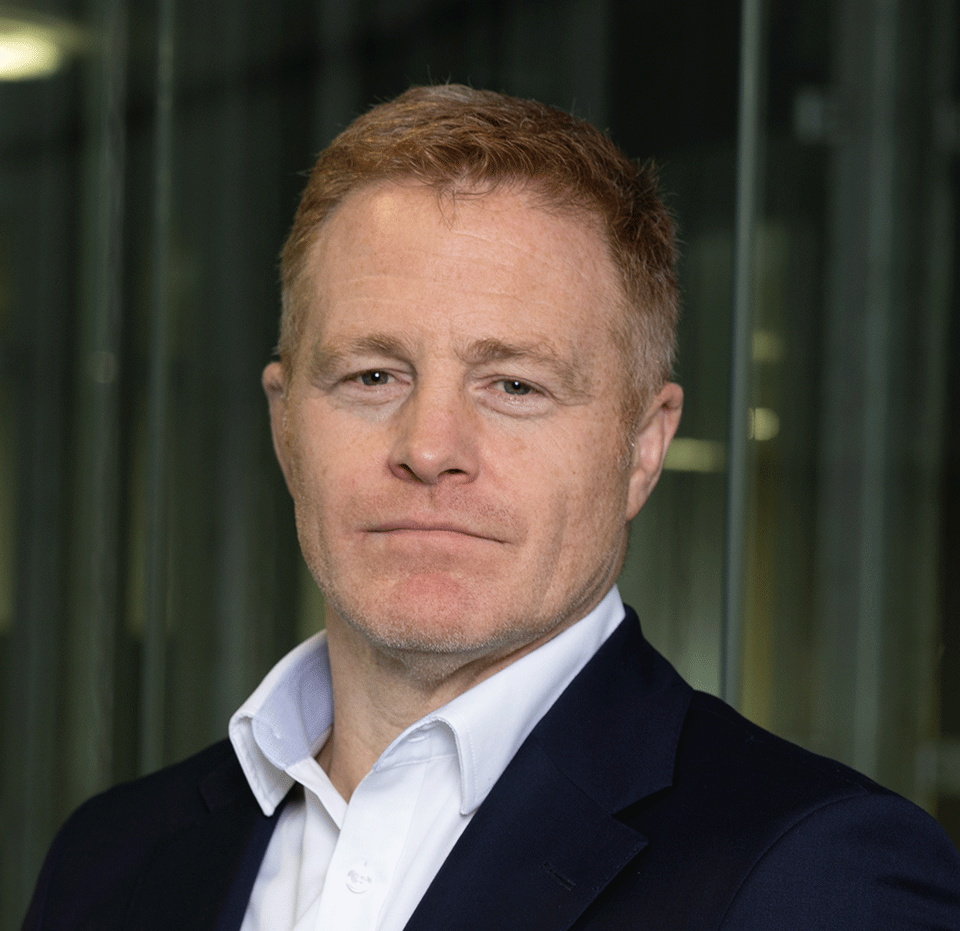
| Michael Corbat: Diversity has given the bank a new lease of life |
As credit expansion continues to outpace nominal GDP growth in developing markets, the bank has reaped the subsequent growth in loans, deposits and earnings. Revenues generated by Citi from outside north America have grown from 45% six years ago to over 60% currently, and the group easily generates over half its profit from emerging markets, with Latin America and Asia enjoying volume growth and higher-margin products, such as unsecured consumer lending. Citi’s Asia business alone generated a quarter of its global revenues and a third of global profit, with revenue for the awards period at $14.9 billion and net income at $3.7 billion. Accordingly, Corbat has recaptured Citi’s mojo with a compelling investment pitch based on the diversity of its franchise across product and geography, first-mover advantage and a business model, like HSBC’s, of leading with balance sheet to pursue affluent consumers and internationally mobile corporate clients. Over the past year, Citi expanded its south-south connectivity by providing renminbi services in Africa, competing with such banks as HSBC and Standard Chartered, and opened a further 10 Asia-focused desks in Europe, Africa and Latin America, to service Asian clients with growing cross-border needs.
Like HSBC, Citi now has a more targeted retail banking operation, exiting the low-revenue business in Pakistan, Romania and Turkey to focus on core retail markets in the Czech Republic, Egypt, Hungary, Poland and Russia. Nevertheless, with 1,700 branches in Mexico alone, 650 in Asia and 228 in EMEA, primarily in the CEE and the Middle East, Citi’s retail presence is vast. In addition, it has opened up what it calls ‘Smart Banking’ branches – digital banking platforms – in Bangkok, Jakarta, Manila, Shanghai and Taipei, while securing the first sole-branded credit card licence for an international bank in China.
Jonathan Larsen, global head of retail banking at Citi, sums up his bank’s ambition: “We are under no illusion that this credit card licence is a road to quick profit. We are not going to grab 20% of the China card market. We are looking for meaningful scale in some five or six cities.” He adds that Citi hopes to grow its China credit card offering to 5 million over the next four to five years.
Noting the challenge – given regulatory constraints and domestic competition – of building a profitable retail franchise in China of scale, Larsen cites Citi’s market-leading position as a wealth manager and credit card issuer in the broader Asian region as key to continued profitability amid the bull run in consumption. In addition, the bank has embarked on a big programme of investment in new technologies to bolster productivity in its retail operations and is transitioning from a local or regional consumer-banking model to a more integrated global operation, akin to the shift in its transaction-banking business.
In sum, Citi’s balance sheet and the authenticity of its local presence complements its full suite of commercial and investment banking products that, historically, has allowed it to generate more fees than arch-rival HSBC from the traditional investment banking business of DCM, M&A and ECM. Accordingly, Citi holds the top position in the global emerging markets investment bank revenue rankings, according to Dealogic, generating $624 million in revenue, with a 5% market share, over the awards period, notably increasing market share in the CEE and Africa. Manolo Falco, Citi’s co-head of corporate and investment banking in EMEA, says: “Our business model balances our corporate and investment banking capabilities to maximize efficiencies and to provide us with cross-selling opportunities to increase returns. But our model also captures the upside in the investment banking wallet.”