Best Bank in the US It is an approach that is winning customers. Over 2012, average deposits were up $64 billion year on year to $976 billion. Core checking and savings balances were also up $72 billion. Wells Fargo is also particularly good at cross-selling its products in order to keep growing. Consumer credit cards, lines of credit and loan sales in the retail banking stores in 2012 were up more than 50% from 2011 while client satisfaction results were at all-time highs in the fourth quarter. When it comes to small business loans, Wells Fargo is the number one lender in the US. The bank approved a record $1.24 billion in Small Business Administration (SBA) loans in 2012 and, for the fourth consecutive year, is the number one SBA 7(a) lender by dollar volume in the US. Wells Fargo, while having a community bank feel, benefits from the scale of large business when it comes to technology and innovation. Over 2012, the bank increased its mobile customers by a third and developed an iPad app for checking, payments and brokerage and trading.
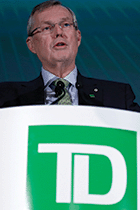
Although much of TD Bank’s expansion has been in the US, the bank has still found opportunities for growth in Canada. In the second quarter this year its earnings increased by 5%, “driven by healthy volume growth in business banking, improved credit performance and good expense management,” says chief executive of TD Bank Group Ed Clark. In spite of a slower personal loan and decreased mortgage environment, the bank has been able to increase its business and real estate secured lending. Clark has pointed to wealth management being a key source of revenue for the bank in light of the weaker domestic loan environment; in March this year, TD completed its acquisitions of US investment manager Epoch Investment Partners. Epoch adds about $25.9 billion in assets under management to the C$211 billion ($201 billion), already being managed by TD Asset Management. Epoch will also provide the bank’s Canadian retail and institutional customers with a broader range of products. Last year TD Bank also launched the TD Canada Trust Visa debit card, enabling customers to make purchases outside Canada directly from their bank accounts, backed by Visa security.
Taking advantage of its growing presence in the US, TD Bank has also been developing its cross-border banking services, making it easier for Canadians to open accounts in the US, build credit histories and apply for US mortgages. But Goldman Sachs is not just intact, it is cruising ahead of its peers in several markets. Its stock is up 60% over the 12 months to June 23 and its fourth-quarter earnings last year almost tripled over the year. In M&A, Goldman Sachs seems to be unbeatable. Last year, it was once again top of the league tables in the US, and second in Canada. When it comes to the most important M&A transactions, Goldman is always there. It advised on Nexen’s acquisition by CNOOC Canada for $17.7 billion. It advised NBCUniversal on the sale of its remaining 49% stake to Comcast Group for $16.7 billion. When it comes to complex transactions, the firm is a place to which clients turn, as in Kraft Foods’ spin-off of its North American grocery business for $36.1 billion. It is also a key partner in leveraged buyouts and private transactions, such as advising Gardner Denver on its proposed acquisition by KKR. And in hostile or unsolicited situations, Goldman Sachs is most often appointed. In equities, Goldman Sachs is ahead of all its peers in North America, with a 19% market share in sole bookrun US and Canadian equity deals. For the period in question the investment bank was the number one underwriter in North America for equity and equity-linked transactions. Goldman boasts the tightest pricing for issuers and the best performance for issuers on the first day of a deal. Clients such as Michael Kors consistently return to Goldman, for which the investment bank was active bookrunner on the fashion house’s 2011 IPO and then the three billion-dollar follow-ons over 2012 and 2013. In terms of innovation, Goldman was the sole bookrunner on mortgage insurer MGIC’s $695 million follow-on and $500 million convertible that allowed MGIC to price at a 2% coupon.
Best Investment Bank in Canada In equity capital markets, BMO Capital Markets is increasing the pressure on RBC, but the strength of its retail distribution across North America gives the bank an added edge. According to Dealogic, RBC Capital Markets led the most Canadian equity and equity-related deals over the period. Among the most important deals for RBC was Crescent Point’s C$800 million follow-on offering for common shares – the largest Canadian equity capital raise over the timeframe. The bank was also joint bookrunner on five preferred offerings for domestic energy company Enbridge, raising a total of C$2.1 billion. In M&A, RBC Capital Markets has its biggest lead – with 27.5% market share in all Canadian deals over the period, on 82 deals valued at $53 billion. The investment bank was adviser on 12 transactions greater than $1 billion or equivalent, such as the C$18.2 billion acquisition of Nexen by CNOOC – the largest Canadian target transaction of the year and the largest outbound acquisition ever completed by a Chinese company. Indeed it is in cross-border M&A transactions where RBC Capital Markets cleans up, being the largest global investment bank with headquarters in Canada.
Best Debt House in North America Jim Probert, head of Americas investment-grade capital markets at BAML, says: “At times when some banks were cutting costs around full-service distribution we didn’t. We stayed committed, and that is now paying dividends.” As investment-grade issuance boomed last year, BAML was at the forefront, leading 612 investment-grade deals, and eight of the 10 largest dollar-denominated investment-grade bond deals in the first quarter this year. In private placements, BAML has a 25% market share by deals – 50% more than its closest competitor. BAML’s global presence has put it on big multi-currency deals over the past 12 months, such as EDF’s hybrid offering in January this year and AT&T’s dollar-denominated and euro-denominated notes at the end of 2012. BAML is also the top-ranked Canadian dollar dealer for global issuers, leading the largest-ever corporate maple deal for AB InBev and sole leading GE Capital Canada’s C$300 million 10-year floating-rate note. Probert says that the firm has a competitive edge over rivals because of Merrill Lynch’s 18,000 brokers. “We definitely benefit from the thundering herd as we are able to distribute to retail investors as well as institutional investors,” he says. “That has been positive for preferred stock and baby bonds, which have been a large part of the market this past year.”
Best Equity House in North America The tech IPO characterized 2011 and early 2012, but in the past 12 months there has been a return to the equity market across every sector, and Citi’s broad-based expertise means it has captured market share. From the end of 2009 to the end of 2012, Citi’s market share in US equity and equity-linked products rose 33%, and the bank ranks in the top three for more sectors than any other bank. “Over the last year no one sector contributed more than 20% to total issuance, and we are best placed for that environment as we have broad-based sector strength,” says Philip Drury, who co-heads equity capital markets in the Americas at Citi with Doug Adams. The bank has been an active bookrunner on offerings from large household names in consumer, such as Dollar General; financials, such as ING’s US subsidiary; healthcare, such as Acadia; energy, such as Cobalt; and financial sponsors, such as the Carlyle Group. The bank’s broad-based expertise also meant it was able to embrace the return of niche markets. “Homebuilding came back this year, and we were there ready for that,” says Drury. Perhaps the most notable of its clients, however, was AIG. Citi was the only bank on all five transactions of the US government’s monetization of the insurance company.
Best M&A House in North America
In complex transactions, Barclays does indeed bring both advice and financing. The bank was financial adviser to Abbott Laboratories on the separation of its research-based pharmaceuticals business, AbbVie, and was joint arranger on Abbott and AbbVie’s $14.5 billion spin-off bridge and core credit facilities. “Our acquisition finance business is closely aligned with our M&A business, and most of the acquisition financings we do are for deals on which we advise. In 2012 we advised on 71% of the deals we financed,” says Gary Posternack, head of Americas M&A. In April this year, Barclays acted as financial adviser to Thermo Fisher Scientific and provided an underwritten hedge facility in support of its plan to acquire Life Technologies Corporation for $15.8 billion. Barclays is also a leader in private equity M&A, ranking top in the LBO M&A league tables. This year it has been adviser to Silver Lake Partners in its definite agreement with Michael Dell to acquire Dell for $24.4 billion. It was also the adviser to Cerberus Capital Management, which, with an investor consortium, announced a definitive agreement to acquire 877 stores and related pharmacies from Supervalu in a transaction valued at $3.3 billion.
Best Project Finance House in North America RBC Capital Markets was also the sole financial adviser and lead arranger to Bayonne Water, a special purpose entity owned by KKR and United Water for a $150 million concession for the wastewater, storm water and sewer overflow systems in Bayonne, New Jersey. RBC Capital Markets’ global presence has also enabled the firm to become a leader in cross-border project finance transactions. In July last year, it was joint financial adviser and mandated lead arranger and hedge provider to a consortium of global investors to acquire Open Grid Europe – the largest gas transmission business in Germany, in a €3.2 billion deal.
Best Risk Adviser in North America In Canada, HSBC has a large international presence and with four offices has been a key adviser to Canadian corporates with international business and US business.”We participated in the bridge financing, debt and equity take-outs and swap hedges on the debt for the acquisition of a European company by a Canadian corporate,” says Ed Murphy, managing director, head of corporate treasury solutions, HSBC Bank Canada. HSBC served as duration manager and hedge coordinator for a multi-billion 30-year offering by one US corporate. The bank has also worked with private equity firms, banks and insurance companies across North America to manage interest rate exposure or currency risk in renminbis.
Best Flow House in North America The firm has cleared in excess of $18 trillion since it began clearing in 2009 and has doubled its volume of cleared transactions since March of this year. Specifically in the US, Barclays has played a pivotal role in the post-credit crisis securitization market. The firm is a market leader in underwriting non-agency RMBS, and in deconstructing pre-crisis CDOs – in the past 12 months unlocking some $10 billion of securities. In credit, Barclays has one of the few remaining and top-ranking credit research teams; it also trades the largest volume of CDS indices globally. Finally, in FX, Barclays is a top-three player with its Barx platforms.
Best Cash Management House in North America |