At the end of each of the hundreds of interviews with bankers that are part of judging its annual Awards for excellence, Euromoney asks them to give an honest assessment, not for attribution, of the opposition. There’s been a common theme this year. “Goldman Sachs is a phenomenally well-run firm,” says a senior banker at one of its big US rivals. His counterpart at a leading European firm agrees: “We’re working our guts out, and have been for years, to build the kind of corporate franchise Goldman Sachs has. They already have what everyone else wants and they just need to keep it ticking over.” A third tells Euromoney: “If you’re saying it’s between us and Goldman for this one, well, I’ll respect your judgment if you give it to them.”
And unlike in previous years, competitors’ teeth aren’t gritted quite as tightly as they say this. The old criticisms now are almost ritualistic. Goldman looks out for itself first and its clients second, unlike, of course, the speaker and his firm, who care only for clients.
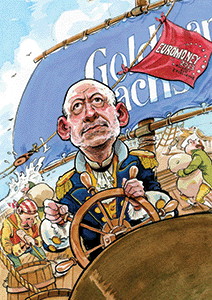
After the SEC charged Goldman back in April 2010 with defrauding customers over the Abacus sub-prime mortgage CDO, an outpouring of public resentment cascaded over the firm. It was excoriated for preying on its customers. Three years and one $500 million settlement on and those clients, it seems, prefer Goldman over any other investment bank to represent their interests.
 |
“Our business has remained strong because we focus on building long-term relationships with our clients,” says David Solomon, global head of investment banking. “Some of our peers lead with capital when building a relationship; we start with our people and intellectual capital and then deliver to the client whatever else is needed. That’s how we build trust. Throughout that period we had lots of conversations with clients who were concerned by what was in the papers. But they told us that what they were reading simply did not accord with their experience of actually working with us.”
Occasionally, something more convincing pops out amid the general characterization of Goldman as a proprietary trading, principal-focused firm prioritizing its own investments over its clients’ that some rivals still trot out even after Dodd-Frank and Volker made all that a bit redundant.
One of the very smartest heads of markets businesses at another bank says: “Goldman is very good at devising complex structured solutions, as are we. When you devise something that might leave, say, 15 points of value on the table, the institutional approach here is to try to industrialize that solution, mass market it and take only one point of value but do it 15 times. At Goldman the attitude is: ‘Let’s take the 15 points.’” He pauses, before concluding: “Sometimes I wish we were more like Goldman.”
Naming Goldman Sachs this year’s best investment bank was not the toughest call Euromoney has ever had to make. Way out ahead at the top of the global M&A advisory league table, comfortably ranked first in global equity capital markets, Goldman has even shown up well in the debt capital markets rankings at precisely the time when DCM comprises the biggest single component of the investment banking fee pie.
In the period under review it was ranked seventh in global DCM, fifth in the more remunerative global high-yield ranking. All around the debt markets in the past year rivals have been muttering about the firm’s new aggression from bidding on government bond auctions to competing for leveraged finance, structured and other DCM mandates. “A few years ago they seemed to give up a bit on DCM, but now they’re back. I don’t understand how clients let them get away with that,” moans the global head of DCM at another leading bank.
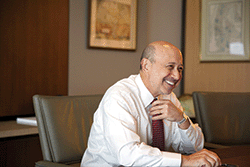 |
| Lloyd Blankfein, chairman and chief executive of Goldman Sachs |
Euromoney puts the question to Lloyd Blankfein, chairman and chief executive of Goldman Sachs. “You have to distinguish sometimes between a league table position and a true capability,” he says. “The debt business has been a better business to be in over the past 12 months. Banks have been less anxious to put assets on their balance sheets, borrowers are turning to the capital markets, the financing calendar has been much bigger, terms have become more sensible, as have the attendant risks. Why have we been doing more debt business? Because that’s what our clients want us to do. And we’ve always had a capability to do it when it supports them.”
It’s a remarkable thought that Goldman can simply ramp up whatever business is flavour of the month, take the earnings, scale back resources when that business slackens and repeat the process at will. Blankfein suggests this is not quite how it works, that senior management does not take a top-down view to maximize earnings from hot areas. “This is not a command-and-control firm,” he says. “Now don’t misunderstand me. This is a control firm, in the sense of position limits and risk controls.” Indeed, one reason why Goldman got through the financial crisis better than its rivals in the first place was precisely because its approach to career management regularly takes high-profile bankers out of the income-producing businesses and puts them into control functions. Rather, Blankfein’s point is that its strong showing in debt was not a strategic management decision to ride the boom in rates and credit.
He says: “We don’t spot an opportunity and the lightning flies from our fingertips. We didn’t set a dial to have a certain league table position or market share in debt. We have done some of the biggest and most complex debt underwritings. We have always had that capability. But we are only intermediaries. And it’s our dealing with investors every day that will determine how we allocate our resources and focus. I’m a great believer in the cyclicality of things.”
It’s not hard to see how this works in practice. The biggest-ever investment-grade corporate bond was sold in May this year. The $17 billion multi-tranche offering from Apple Inc had two lead banks. One, appointed for its close work with the firm’s treasury relating to transaction banking as well as for its market-leading debt market capability, was Deutsche Bank. The other was Goldman, the firm to which Apple management turned after the company came under pressure from shareholder activist David Einhorn to return some of its abundant cash surplus.
Goldman wasn’t exactly Apple’s house bank. The company hasn’t engaged in a lot of investment banking activity in the past 15 years. Goldman did not take Apple public although it called on the company regularly, especially after Steve Jobs returned there from NeXT in 1998. Solomon says: “We are always working for our clients, not just when they are conducting transactions. Our goal is to call on people regularly and to learn their business and earn their trust. We’ve had a long-term relationship with Apple and we were proud to be a part of their inaugural bond.” The bond deal, funding an accelerated stock repurchase programme, was its strategic response to external pressure, and Goldman complemented Deutsche’s role on the historic bond deal, coming at it from a different starting point.
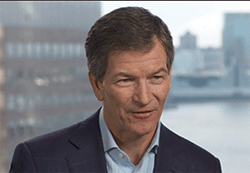 |
| Gene Sykes, global co-head of M&A at Goldman Sachs |
“We have a very prominent position as the lead adviser to firms that come under pressure from shareholder activists,” says Gene Sykes, global co-head of M&A at Goldman Sachs. “In part that follows from this firm’s historical reputation in the 1980s as an expert defender of companies that were subject to hostile raids. But responding to activists is very different to raid defence. You can’t fight your own shareholders, and often many are sympathetic to and quietly aligned with the activists.”
Apple wanted the world to know that it had asked Goldman to help craft a response to the activists’ challenge, denoting that whatever the outcome – a dividend or buyback or other strategic action – it felt confident it would appeal to shareholders’ interests.
As the equity business turned down in the past decade, Goldman was already building up its debt capability. In certain regions, Asia for example, as it saw some other banks retrench in the high-yield and investment-grade markets, it grabbed the chance to do debt deals for clients that it never had before. It built quickly and also on the treasury side of the business, providing such things as deal-contingent currency hedges, sometimes on transactions where it wasn’t even a lead bookrunner.
Its solid capability in pricing and hedging risk in the debt markets have seen Goldman, renowned as an M&A and equity firm, through the boom years in debt. Its most recent financial report, for the first quarter of this year, showed debt underwriting producing record quarterly net revenues of $694 million, with strong contributions from leveraged finance and commercial mortgage underwriting.
Rivals still question the bank’s long-term future without a deposit-taking business and diversity of funding. “It’s a mystery how Goldman can continue to do so well as a monoline,” says the head of investment banking at a universal bank. “It’s a proven business model over decades. But they have to accept that the world has changed. They cannot commit as much capital, leverage, etc, as the universal banks.”
While many of the banks Euromoney has talked to have been caught up in profound internal restructuring in the years since the financial crisis and subsequent regulatory response, with many exiting businesses and redeploying resources as they give up on ambitions to serve all customers in all markets, Goldman has been through much less of this angst. “We’re not a retail firm,” says Blankfein. “We’ve had periodic forays into retail and been generally unsuccessful; from time to time we will forget that. We are at heart an institutional, wholesale firm, and that brings a certain homogeneity of culture and makes many aspects of our firm easy to manage. And because most of our earnings come from investment banking activities, we can really focus our minds on these activities.”
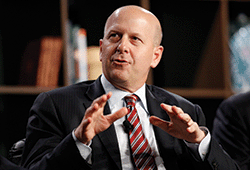 |
| David Solomon, global head of investment banking |
Not for Goldman the agonies of tearing up the business plan and rewriting it. “We like our business model,” says Solomon, “and our relative position in the market. We worry about the competitive landscape because we face strong peers daily, but we invest a lot of time and energy into having the right mix of people, assets and other resources to compete.” The firm has dutifully gone through its review of processes and procedures and published its new business standards, but the one great lesson Goldman staff talk about from the aftermath of the SEC’s suit is that they should pay more attention to how the firm is perceived and to potential reputational risk.
These people are not exactly suffering an existential crisis.
Their big challenge was preserving the franchise the firm had, not building a new one while admitting the old business plan was redundant. “One thing that doesn’t get written about much,” says Blankfein, “is the extraordinary resilience of this firm. You couldn’t find an organization that was more under the gun than we were and that could have caused great instability. We weren’t complacent. But the leadership of this firm remained stable; the board remained stable; and the strategy intact. Our clients and shareholders stuck with us and we have the highest multiple to book in our peer group.”
One of the highlight corporate finance transactions of the year in which Goldman played a lead role was its advice to Walgreen on the acquisition of a 45% stake in Alliance Boots from its private equity owners plus an option on the remaining 55%, a first step towards an eventual merger that has already enabled the two companies to achieve scale efficiencies while also negotiating a joint venture with another wholesale distributor. Walgreen is a classic mid-western all-American company now reinventing itself as a global player.
Goldman had been investment banker to Walgreen for almost 20 years, during which time it had done only one big deal: buying the large retail drugstore chain Duane Read. It didn’t do nothing at all in those 20 years, but a few financing and hedging fees weren’t exactly a pot of gold for its bankers. Still Goldman kept covering the firm diligently and when it eventually chose to reposition its business in the light of regulatory change around affordable healthcare, Goldman threw everything at it: its top M&A people, its regulatory experts, its UK bankers, its private sponsor coverage team, in a $28 billion deal that was one of the biggest of the year (see best global M&A house ).
Some rivals suggest that Goldman’s corporate franchise is so strong that it doesn’t expend too much effort in executing deals. That always sounds a bit desperate in searching for a weak spot.
In emerging markets, Goldman executed some fascinating and complex deals in the past 12 months, for example working for Singapore drinks maker Fraser and Neave on its eventual $6.9 billion acquisition by Thai Beverage. Gregg Lemkau, co-head of global mergers and acquisitions at Goldman Sachs, says: “We represented the target in a situation where there were multiple bidders, unsolicited bids, processes that were stopped and restarted, all with Heineken’s pursuit of Fraser and Neave’s stake in Asia Pacific Breweries in the background.”
Another success was advising Nexen Inc on its contentious $17.7 billion acquisition by CNOOC Canada, which brought Goldman’s famed government relations experts to the fore. Sykes says: “This was the sale of a Canadian oil and gas company with US assets that required approvals from regulators in both countries to a Chinese acquirer. It was a great outcome for Nexen shareholders because, after they had approved it, Canadian regulators said it would be the last one they’d permit for a while.”
The head of corporate and investment banking at a large universal banking rival concedes: “Despite all the bad reputational issues around them, Goldman are still the first call on advisory mandates. There are two reasons: the quality of the people there, who have been able to maintain the connection with clients; and how quickly they, as a firm, can go after opportunities.” The inevitable “but” duly follows. “The question for their clients now is: how deep does the model go? And the broader question is: how do they serve the global economy? Goldman serves only a narrow part of what we now call investment banking. And they have the smartest people, but to what purpose other than to make themselves money?”
Even after as good a year as Goldman has just enjoyed, Blankfein will be pondering all these long-term issues and the short-term angles. His comments on retail suggest no strategic change of direction is envisaged, even as its great monoline rival, Morgan Stanley, hopes to benefit from the stable earnings, funding and risk diversification of its enlarged retail brokerage.
As rates in developed markets start to rise, the universal banks will benefit from improved net interest margin if they can recycle retail deposits for which they pay nothing into low-risk instruments with positive carry. But rising rates will slow debt underwriting and could yet wreak havoc with loans on their balance sheets, especially if borrowers are hit by rising debt-service costs before economies progress into self-sustaining recovery. Does Goldman’s model suggest it ultimately lacks relevance, or does it free it from a burden of operational complexity and unhedgeable risks as correlation rises along with volatility and illiquidity?
Five years ago, Euromoney named Goldman Sachs as its best investment bank in recognition of how well it had managed its risks through the financial crisis, forcing its traders to mark to market, benefiting from the knowledge its risk controllers had garnered from the mortgage-backed markets when they themselves were working in those markets. The firm had grown to resemble a giant hedge fund and private equity investor in the years between going public and the height of the leverage-driven boom of 2006. Now it had shown the risk-management capability that justified that risk appetite.
Blankfein didn’t really want the award, pleading with Euromoney not to declare victory on the firm’s behalf at an arbitrary snapshot moment in time. He seemed almost to have a premonition of the furies that would soon be unleashed around him, although even he was taken aback by their intensity. He says that he couldn’t bear to open a newspaper for 18 months for fear of feeling ill at what he might read about the firm. Being too smart in an industry that prides itself on smarts, by definition, makes the other guy look dumb. It was in pursuit of Goldman’s high returns on equity in the boom that others, without the same risk-management capability, had levered up and put on risks that proved too complex to manage. That’s a sure way to be hated on Wall Street.
And what does he think of receiving the award again, after another stand-out year for the firm? “I’m a worrier,” says Blankfein. “Having a good year just kind of snuck up on us. Don’t think senior management has been reclining here while people feed us grapes and fan us with palm fronds. My job is to peer around corners for things that could go wrong and I don’t have to look very far for things to worry about.”
He lists a few. “The M&A business isn’t exactly at record levels. It’s at quite low levels. Our multiple isn’t at 1.5 times book and our return on equity is not as high as it’s been. I can worry that the recovery isn’t going too well, or that it’s going so well rates might shoot up. Not so long ago, people were talking about how the emerging markets were drivers of global growth and they had diverged from the developed markets. They don’t look so diverged now. I worry that legislators and regulators, while trying to do the right things, might get the balance wrong. I spend a lot of time on regulation, trying to adapt to it in working constructively with regulators.”
This tour though the macro worries besetting the markets and the industry seems to cheer up Blankfein. As he gathers his papers to head for an early flight, looking to beat the storm clouds descending on New York this rain-sodden June morning, he sounds suddenly determined. Perhaps his inner voice is asking: if he’s worried, how does the competition feel? The amused twinkle round the eyes as he joked about grapes and palm fronds fades and the jaw sets as he goes all investment bankery again. “We’re still in a third-quartile opportunity set right now.”




