It was a small line in a long paper. But to Shanghai’s Free-Trade Zone – and possibly to China as a whole – it was a sentence loaded with importance.
Although lacking in specific detail, the communiqué of the Third Plenum of the 18th Communist Party, published on November 12 after four days of intense discussion, demonstrates Beijing’s dedication to pursuing reform in a variety of areas, not just in the economy.
China’s new leaders, Li Keqiang, China’s premier, and Xi Jinping, the general secretary of the CPC, mention tax reform, land reform, green innovation and even cultural development as focuses to be addressed. China also aims to deepen reform of the judicial system. The emphasis on social justice hints that Beijing might soon revise its outdated and discriminatory registration system, known as Hukou, whereby stringent laws prevent rural migrant workers from seeking social benefits in the cities.
“The Third Plenum might not be all that explicit at the moment, but does highlight the direction of current party ideology and commitment of Beijing to these goals,” says a senior executive at an international bank based in Shanghai. “At the Third Plenum the government actually put the interests of citizens before economic reform – for the first time in Chinese history. This time around, social as well as economic reform has become the master plan.”
Mentioned in passing in the communiqué is the use of free trade zones (FTZs) to relax investment access and expand inland and coastal openness. And although no locations are specified, China watchers can be sure that Beijing is pointing to the first FTZ, opened in Shanghai on September 29.
The short sentence, buried in the middle of the announcement, might seem at first glance to mean that the free trade zone in Shanghai is not all that important. Beng-Hong Lee, head of foreign exchange trading at Deutsche Bank in China, says that is not the case: “Rarely is a specific project mentioned in very high level communiqués such as this one – actually, we don’t expect them to lay out specifics at all so early on. The fact that they even mention the zone just shows how important the project is.”
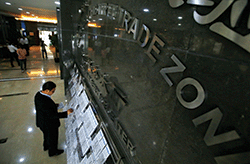 |
| Shanghai’s FTZ is open for business |
The development of the FTZ reflects China’s dedication to pass on market reform to the national level. “Don’t forget, the official name of the zone is ‘China (Shanghai) Pilot Free Trade Zone’,” says Zhou Leyi, deputy head of the Bank of China’s FTZ branch preparatory group. “This is an initiative led from the top, not just Shanghai. But it also needs to be considered a test. The developing course of the zone will definitely lead to some necessary improvements and adjustments on government’s policy.”
What is clear, however, is that the creation of the Shanghai FTZ is directly aligned with the economic and financial reforms referred to at this year’s Third Plenum. The hope is that if financial and economic reforms are deemed a success in the zone, China’s leaders will eventually implement them in the rest of the country.
“The outside world expects China to liberalize for the sake of liberalization,” says one Shanghai based banker. “But from China’s standpoint, motivation and liberalization need to serve the people and growth. Leaders will be cautious. This is an important experiment from China’s standpoint: to embrace the outside economy in different ways, to gain access, to learn about the outside world and to set up a framework for what China can look like in the future.”
A new reform committee has been created, dedicated to overseeing reform coordination, implementation and supervision. There is a rumour in Shanghai that the committee will be led by general secretary Xi, illustrating the pivotal role that the central government will play in reform.
Expectations for the zone are high. Echoing some policies applied in Shenzhen in the 1980s, China will open up competition in the services sector, and foreign companies will be able to set up subsidiaries or joint ventures in the FTZ without having to apply for prior approval from the Chinese government. The entertainment industry, education, healthcare, insurance companies, law firms and banking will all be opened up to foreign investment.
Of course, as is the case with most changes in China, there will be restrictions – heavy ones. Detailed on the FTZ’s website is a negative list: 1,069 businesses in 89 divisions within 18 main categories that are identified as off limits. Investment in telecommunications and intellectual property remain restricted areas of investment for foreigners.
 |
| Richard Gu, senior consultant at Linklaters in Shanghai |
“The negative list could be seen as a positive development in China, because it does mean that anything not on the list, no matter how comprehensive the list may be, is accessible rather than having to seek approval to do any type of business in China in the first place,” says Richard Gu, senior consultant at Linklaters in Shanghai.
Gu’s associate, Nicola Mayo, a partner at Linklaters, adds: “In reality there aren’t many differences to what exists outside of the zone. Some of what is on the list is just a repetition of what already exists, and some only clarifies concessions that have been talked about in principle outside of the zone but haven’t been implemented. All they’ve done so far is say they will implement them. I don’t think the long, negative list is as revolutionary as it looks at first sight.”
The hope, however, is that the list will be reduced over time. It is due for revision within a year.
But combine the lengthy negative list and a lack of clarity when it comes to policy and reform within the FTZ, and multinational corporations – the type that China hopes to attract to the zone – appear to be losing interest. As of September 15, there were 675 registered enterprises in the zone but only 33 were foreign companies, says Gu.
Mayo says: “Foreign companies are beginning to act conservatively. They are waiting to see what granular policies and reforms will actually be put in place before they invest in the zone. At the moment, there have been no significant changes or noteworthy policies introduced. Other than the negative list that accompanied the opening of the FTZ on September 29, there have been no detailed rules about how business will be conducted within the zone.”
Take one example: a new policy in the FTZ will allow the establishment of wholly owned foreign-invested medical institutions. The introduction of flexible, high-end medical services in the zone could become a possibility with high earnings potential, says another banker.
Mayo says: “But if you can set up one inside the zone, does this mean you can set up one outside it? What if you own a majority stake in a hospital in the zone, would this apply to all their subsidiaries outside the zone? No one knows.”
Wei highlights practical problems that are yet to be ironed out: “What about foreign medicines. Will they be freely allowed in the zone? These issues are enough to stop growth in the zone and to discourage foreign investors from going there.”
Similar issues remain for most other service sectors that have been granted permission to operate in the zone.
If you already have a business in China, Gu suggests it would be best to just keep this going until some real, distinct policies have been put in place. “Once something like an offshore account is opened, which means you can channel funds out of China, that will be a real change. Until something bigger happens, you might as well stay put.” And that’s exactly what Linklaters is doing.
Shenyin & Wanguo Securities Company is also treading a careful path. “If we can open a branch there, we can extend our client base and our business because the overall scope of our business will grow,” says Kathy Kaiyuan Xu, head of international business at the securities company. “Our futures company has already opened a subsidiary there, which could help ease the process for us when it comes to setting up a physical presence in the zone – which I believe is very important. But at the moment I don’t think there are actually any securities companies registered in the zone.”
She adds: “So far there have been little details released about the zone. We probably will go there, but how big should our presence be and what actually will be able to do? Changes are lagging behind our expectations, so we will only submit our application once things have become more clear.”
One of the factors that streamlines the application process is that up-front minimum capital requirements to set up shop in the zone have been abolished. This rule has been implemented in the zone before any revisions have been made in national company law. Technically, setting up a company without any up-front capital requirements in the FTZ could be considered illegal, although it is supported by the central government, says Mayo.
Within the FTZ, the authorities on November 6 approved the establishment of an international energy exchange with registered capital of Rmb5 billion ($821 million) as a joint venture between the Shanghai Futures Exchange and the Shanghai Futures Information Technology Company. It is the largest financial company set up in the zone so far.
“This means that for the first time, foreign investors will be able to trade freely on China’s futures exchange and it will also introduce the futures trading of other energy products such as natural gas,” says Xu.
But Li Wei, an economist at Standard Chartered, argues that up to 95% of businesses being set up are being established by individuals who are speculating that the companies they register will be worth something more to someone else once the zone is up and running. “All they intend on doing is to resell their company name or even their registration number at a later date, especially as there are no capital requirements,” he says.
On the same day that the zone was officially opened, a new wall was erected at one of the main gates marking the opening and one of the entrances to the FTZ in Waigaoqiao, one of the four areas in Shanghai that make up the 29 square kilometres that encompass the FTZ. Behind the wall is the building where people can register a company in the zone. Spilling out of the doors are tens of ordinary looking people, huddled against the cold but queuing patiently for their turn. On the surface, nothing spectacular appears to be going on.
Wei says: “The free trade zone has become a sort of Disneyland for speculators. Multinationals in the zone would help with opening up and reform, but this is not what’s happening at the moment. What you are more likely to see are hordes of middle-aged women trying to open up any type of business in the zone.”
Although there have also been reports that people have been rushing to set up companies in the zone with as little as $1 up-front capital, Han Zheng, the Communist Party chief in Shanghai, has denied this is the case.
Gu says: “There was a conference held by the European Union Chamber of Commerce recently, which Mr Zheng attended. At the question and answer session afterwards, Mr Zheng seemed really open and ready to talk about some of the issues people had surrounding the FTZ in Shanghai.
“The issue of $1 companies opening up in the zone was directly addressed by him. He stated that actually for the 33 foreign-invested companies, there was an average committed capital of $17 million each. For domestic companies, this was much lower, at Rmb16 million. But the point is these numbers are quite sizeable. Technically you can set up a company for $1 in the zone, but I think Zheng was highlighting that this wasn’t the norm. But I do question the details.”
Rumours abound that Zheng will be moved from his post as party secretary in Shanghai to be Xi Jinping’s right-hand man in the reform committee. “If this is true, it would be very good news for the FTZ in Shanghai,” says Xu. “Having Mr Zheng in Beijing means that he would push through reforms in the FTZ as well as looking into deeper, national reforms.”
What about having a physical presence in the zone? This isn’t clear either. “The zone has a finite size,” says Mayo. “Does this mean that if you register your company there, you need to have a presence there? Or could you be situated outside the zone? We don’t know, and it will probably vary depending on the service sector in question.”
 |
| Leonard Khaw, partner of international tax at Deloitte in China |
Some observers argue that the right to have a presence outside the FTZ will have to be granted. Some of these say that, if it proves necessary, Beijing can arbitrarily add to the zone, because for some service sectors, such as law firms or financial advisers, a physical presence is necessary. A restaurant has already had to be removed to make space for another office, as the area in Waigaoqiao is on its way to reaching full capacity, says Leonard Khaw, partner of international tax at Deloitte in China.
Bank of China’s FTZ branch was opened on September 29, the day the zone was officially launched. “We began prepping for approval to set up in the zone back in March, and we looked into developing communication with regulatory bodies to ensure we were doing things correctly,” says Leyi. “At the beginning of September we set up a working group with the CEO of the bank in charge of this. By the middle of September, we sent a team to Hong Kong to learn from them how they operate in an open economy. Overall the process was quick and easy because there is now a new, streamlined service if you want to open up a business in the FTZ. We didn’t run into any problems.”
Citi was one of the first international banks to gain approval from the authorities to set up in the zone. Citi’s lofty, modern building dominates its surroundings in the Waigaoqiao section of the FTZ towards the northeast of Pudong. Still, there was little movement in or around the building on a morning six weeks after the zone opened.
 |
| Andrew Au, CEO of Citi in China |
“Shanghai has a good track record for reforms, so our first reaction when the zone was introduced was to open up there,” says Andrew Au, CEO of Citi in China. “We issued our press release a few minutes after the official opening of the zone. There is a lot of interest, but we will have to wait and see what we can do. We need to wait for more policy to come through.
“We are constantly on the lookout for opportunities in China, because China is consistent. In the last 30 years of economic reforms, we have only reaped benefits. We don’t see any risks to being present there even this early on because the sense is that things will only get more liberal.”
Banks joining Bank of China and Citi in the zone include Deutsche Bank, DBS, Hang Seng Bank, HSBC, ANZ and Bank of East Asia. Domestically, Shanghai Pudong Development Bank, ICBC, China Construction Bank and the Agricultural Bank of China have all had approvals to set up shop in Waigaoqiao.
“I’m not sure that these banks have registered completely of their own accord,” says Gu. “I do believe that some of the banks and companies that have set up in the zone already could be politically motivated – there to curry favour with the Communist Party and show support for this latest initiative.”
For some, there is nothing wrong with a show of support: “We are supportive of all major initiatives of the government. Other than being a commercially driven bank we have a part to play. If we can help to develop the market, we will be there and it shows to the city we are committed and we want to contribute. Moreover, banks provide financial services to clients so we need to be there before our clients get there – it’s a greenfield play, so we are in a different position to the other service sectors,” says the Shanghai based banker.
In essence, the FTZ aims to encourage and support competition between domestic and international banks on a level playing field. Qualified foreign financial institutions will be able to set up banks, Chinese investors will be able to set up joint ventures with foreign institutions and Chinese banks will be able to partake in offshore banking. The zone will in effect become an offshore area in the middle of the mainland.
As the Shanghai based banker puts it: “In China we expect liberalization to accelerate in the next couple of years, so we want to be ahead of the curve for every single development, not only to win over the government.”
This mentality is rife within the banking sector in particular. “There are very few risks to us opening in the FTZ before specific policies come to light,” says Au. “No one really knew what the SEZ in Shenzhen would consist of at first. But it was successful. We have a long-term belief that operations in China will open up and succeed, although it may not be all that smooth.”
What has grabbed the attention of the international community is the potential in the financial sector. Capital account convertibility, interest rate liberalization, renminbi cross-border usage and foreign exchange management are all expected to be tested in the zone before being transferred to the national level. “But the zone should not be considered a tax play,” says Gu. “Preferential taxes in the zone would mean that the model couldn’t be replicated nationwide.”
The remarkable growth and development that China has experienced since the beginning of reform and opening-up, a model that relied heavily on government intervention and investment, is hardly sustainable anymore. Bloated state-owned enterprises, corruption and worrying levels of pollution combined with over-intervention in economic activities by the government have suppressed market vigour.
One of the most intriguing features of the Plenum’s communiqué was Beijing’s revision of how the market – and not the Communist Party – will eventually have the dominant role in China’s economy and play a decisive role in allocating resources, breeding efficiency over corruption. The word ‘market’ was mentioned in the communiqué 22 times.
Comparisons between the FTZ in Shanghai and Shenzhen’s SEZ abound. “Shenzhen was a real game changer back then. The hope is Shanghai will be the new Shenzhen,” says Richard Fu, director for Asian commodity trading at Newedge.
There will be other big draws to setting up in the zone than tax incentives. Probably one of the biggest pull factors and riskiest reforms promised for the FTZ, however, is the convertibility of the renminbi on the capital account, allowing renminbi to be freely exchanged with foreign currencies for investment and asset allocation.
Although China already allows renminbi convertibility for trade through its current account, it restricts free exchange of investment through schemes including the qualified foreign institutional investor (QFII) programme, the Renminbi QFII programme and the qualified domestic institutional investor (QDII) programme. Although the authorities have increased these quotas over time, there are still restrictions.
 |
| Jennifer Qin, Asia-Pacific investment manager at Deloitte in Shanghai |
“QFII allows foreign capital to be invested in the domestic secondary stock market within a quota. And to do this you need to get so many approvals from [foreign exchange regulator] Safe and other regulatory bodies before even going to a custodian bank to do all the transactions, which can be a laborious process,” says Jennifer Qin, Asia-Pacific investment manager at Deloitte in Shanghai. “But with the FTZ, if foreign accounts are allowed to trade on the secondary market, you won’t need the lengthy process. All you’ll need is a legitimate business account to show you are a valid money manager.”
In theory, capital flows in and out of the zone would be much freer than they currently are and, if managed well, could be a feature of China’s national financial landscape.
But the fear of losing economic control remains one of the biggest limits to reform and opening up for the Communist Party and the risk of arbitrage through opening the capital account raises serious concerns.
“With authentic investments there’s no problem,” says Gu. “But what about hot money? There is a real risk that people could take all their money out of China, and how can you stop them if the capital account is opened?”
At the same time that China hopes to open up and reform, GDP growth is slowing, bubbles in the housing market are coming to the surface and local government debt is rising. All have become points of contention in China. “I’d say that investors are much more likely to short China in this environment,” says Wei.
Gu says: “One restriction that will most definitely be put in place will be that capital account convertibility will be limited to certain sectors.” The volatile and speculative real estate sector will most likely be off limits.
On the other hand, analysts question how the government will prevent flows of cash from the offshore FTZ from seeping into the rest of China.
Chi Lo, senior strategist at BNP Paribas in Hong Kong, argues that for the renminbi to be truly convertible within such a small zone in China, policy would need to be air-tight to make sure that money doesn’t just sink into a black hole and disappear from the zone completely. “But how can you in practice ring-fence a free-trade zone? So far there has been no game plan mentioned that would overcome this problem,” says Lo.
Qinwei Wang, China economist at Capital Economics based in London, highlights the problem: “For example, if companies in the zone are able to borrow offshore, without regulations, this money could easily flow out of the zone into other regions, and capital inflows would continue to increase.”
Some reformists say that it is necessary to face reality: capital outflows from the zone to the rest of China are a distinct possibility and this needs to be regulated. “But at the same time, government think-tanks say that once capital account opening has begun, reversing the trend may cause more damage to the reform agenda overall. This could actually delay or even postpone reform,” says Wei.
“Opening up the capital account needs to be gradual and coordinated – but it also has to involve the whole country. It cannot be confined to such a small area,” Wei continues. “The Shanghai FTZ is only a small step in the whole reform process. I wouldn’t expect a fully open capital account any time soon.”
Some believe there is an easily workable solution to this problem; ring-fencing separate pools of liquidity for one organization in two jurisdictions.
Lee says: “For a company that has a Chinese regional presence, but also a working business in the FTZ and offshore, liquidity could be separated into two accounts – one to remain onshore and one that can be used for offshore purposes. This allows clients to centralize their activities in one location.
“For instance, if you are a major multinational company, with a manufacturing facility in China and a large one outside, you are most likely to have a regional treasury centre where you want all China market access and offshore access to be controlled in the same place. Two accounts, one concerning onshore and one where you can do offshore activities, could work. And the two can be segregated by a financial firewall and easily monitored. The breakthrough will be that once you have this kind of firewall you can start digging little holes in the barrier to allow some flows to move into the mainland and vice versa.”
In fact, in July, under circular 168, the People’s Bank of China relaxed the rules on corporates’ ability to lend excess cash offshore – up to a certain limit and mediated by banks, however. “This is the beginning of crossborder cash-pooling capability on the national level,” says Lee. “And the FTZ will be able to test and adjust variations of this policy.”
How easy will it be to tell the difference between illegal arbitrage and savvy investment measures? “To a certain extent, China has had an open current account policy and is a major trading country,” says Lee. “People will choose the location to fund and the currency to invoice in. Moreover, the forward curve is still pricing at a significant dollar premium compared with the interest rate differential. So as long as you have capital controls at the same time that the current account has opened up, all trading companies and corporates will selectively chose the best hedging strategy and this won’t always be arbitrage. Corporates will always want to improve the way they organize their cashflow.”
Another factor to add to the equation is the rumoured creation of an international board in the FTZ, a trading platform allowing foreign companies to float in China and Chinese investors the chance to invest in them onshore, something that has been considered in China for the past four of five years.
This remains a rumour, and it has been denied by the authorities in China. Moreover, the IPO market in China has been stagnant for a while.
Wei says: “If large multinationals are listed in the zone, who would want to hold stock of SOEs? This could cause problems in the stock market and it could fall significantly, creating social concerns – concerns that China cannot afford.”
The real answer is that no one really knows what will happen once the capital account starts opening up, says Gu. Capital flight out of the FTZ is just one theory among many. Again, granular details regarding policies in the zone are lacking. All anyone can do is speculate.
“The point is that the government doesn’t want to give an exact framework of how the zone will work all at once because it could limit the possibilities of what the zone could do and how it could adapt,” says Qin. “Policies will be introduced on a piece-by-piece basis. But what is also interesting is that we hope that investors in China will be able to have direct dialogue with the government. We think there will be more leeway and lobbying to achieve what investors and businesses want, not just what goals the government hopes to achieve.”
It is certain, however, that choosing Shanghai for the pilot FTZ in an important symbol. “It’s a major jurisdiction, known around the world as China’s ambitious financial hub,” says Khaw. “It cannot afford to fail. It won’t fail. And the backing of the government will mean that Shanghai has to be a success.”



