Tunisia has undergone the smoothest post-2011 political transition of all three states. An interim government, elected last autumn, is expected to finish drafting a new constitution by October, while full legislative elections are scheduled for spring 2013. With a strong civil society, a relatively homogenous and small population of 10 million and no recent history of conflict, the country has avoided any serious violence since forcing out president Zine El Abidine Ben Ali in January last year.
That relative success appears to have reaped some rewards – or at least helped in the avoidance of the type of losses inflicted on Egypt. According to figures from Tunisia’s Foreign Investment Promotion Agency (FIPA), FDI inflows were $690 million in the first half of 2012.
“No large foreign investor left the country, and 70% of the FDI announced in 2010 was actually implemented in 2011, despite the situation,” says Nourredine Zekri, who was put in charge of FIPA shortly after Ben Ali’s departure.
Tunisia successfully sold a seven-year $485 million sovereign bond in July, its first tapping of international capital markets since 2007, and one that was fully guaranteed by the US government. The new government, led by the moderate Islamist party Ennahda, has also received both Gulf and European support. In April, Qatar lent Tunisia $500 million at 2.5% over five years, and in July the Saudi Fund for Development issued $220 million in project-specific loans priced at 2% over 20 years. The European Investment Bank agreed loans for two projects in 2011 – one in phosphates mining, another for a road upgrade – and plans to fund more this year.
It has not all been plain sailing. Unemployment remains stubbornly high, deep regional inequalities persist and a budget deficit of around 6% of GDP is expected for 2012.
In May, Standard & Poor’s downgraded Tunisia’s sovereign rating to junk. Infighting has not helped matters. The respected central bank governor, Mustafa Nabli, was fired in June after a protracted spat with the new constituent assembly, which he accused of interfering in the bank’s affairs. His dismissal also prompted the resignation of finance minister Houcine Dimassi.
Egypt has been dogged by uncertainty since Hosni Mubarak was ousted in February 2011.
“We are in a new phase of a long and protracted power struggle,” says Alia Moubayed, senior Middle East economist at Barclays. “I would interpret the parliament showdown as an example of how the Muslim Brotherhood and the SCAF will continue to fight each other, but within the confines of state institutions and through a negotiated framework.”
That power struggle has so far been discouraging.
“There is definitely [investor] interest in Egypt, but people and institutions are put off by the constant political bad news,” says Angus Blair, who heads Cairo-based thinktank the Signet Institute. “Once we are past this period then things will be better, but we have not turned the corner yet.”
In the meantime, Egypt’s financial life support has come not only from Qatar, but also from Saudi Arabia, which in May transferred $1 billion to the central bank and has promised almost $1 billion of additional support later. In July the Jeddah-based Islamic Development Bank agreed a $1 billion loan to help pay for fuel and food imports, while the EIB and other institutional lenders are involved in specific project funding.
“There are pressures on the external front and the financial front, and there is uncertainty over policy. We don’t really know who is in charge, or what they stand for,” Liz Martins, a Dubai-based economist at HSBC Middle East, tells Euromoney. “This isn’t necessarily related to the Islamist issue, it’s to do with clarity and decision-making.”
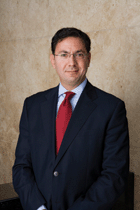 |
| Ahmed Badreldin, a senior private equity partner at Dubai-based Abraaj Capital |
With a new cabinet now in place, a long-discussed IMF package might now stand a better chance of materializing. In August, finance minister Mumtaz al-Said hinted that Egypt would now seek $4.8 billion from the IMF rather than the previously mooted $3.8 billion, although details of any economic programme attached to the loan were still unclear at the time of writing.
Libya, in contrast to its two neighbours, is unlikely to require any such external financial support. Oil production has already almost recovered to pre-conflict levels and, thanks to the bounce-back, GDP growth is projected to be among the highest in the world in 2012.
The political transition since the death of Muammar Gaddafi in October 2011 has gone better than many expected. By most accounts the Libyan private sector has flourished in 2012, unshackled by state regulations and catering to a healthy consumer demand that has been propped up by public-sector salaries and generous government subsidies on fuels and foodstuffs.
“Pre-revolution Libya was an extremely difficult market to penetrate but offered significant potential given the lack of consumer choice in several services and products,” says Ahmed Badreldin, a senior private equity partner at Dubai-based Abraaj Capital. “As Libya begins to stabilize it will be a very ripe market for investment with strong governmental support.”