On August 11, Egyptian president Mohamed Mursi hosted an iftar dinner to break the fast of Ramadan in Cairo for the emir of Qatar, Sheikh Hamad bin Khalifa Al-Thani, who was paying a one-day visit to the Egyptian capital. The recently inaugurated Mursi, a former party official from the Muslim Brotherhood’s Justice and Construction Party, had sworn in his new cabinet just over a week before meeting the emir.
Soon after the summit it was announced that Qatar would deposit $2 billion with the Central Bank of Egypt to support the country’s finances. Egypt’s foreign-currency reserves had dropped to $14.4 billion in July from $36 billion on the eve of the Arab Spring, its balance of payments deficit had more than doubled in the first nine months of the latest financial year, and foreign investment inflows stood at $218 million in the first quarter of 2012 compared with $2.1 billion a year earlier.
Qatar’s pledge might prove a vital lifeline for Egyptian state coffers, and such support had long been promised by Doha, but it was also evidence for those who see the energy-rich Gulf, particularly Qatar, leveraging financial resources to acquire political influence or even cheap assets in post-Arab Spring countries.
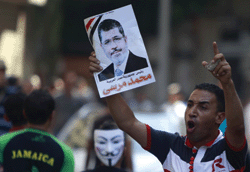 |
| Spring leaders: a supporter of Egypt’s president Mohamed Mursi holding his poster during a demonstration in Tahrir Square in Cairo |
A day after the announcement of Qatar’s deposit, Mursi unexpectedly “retired” two senior generals who had sat on the Supreme Council for the Armed Forces (SCAF), the powerful military body that had effectively ruled Egypt since Hosni Mubarak’s removal in February 2011. Coincidence or not, speculation about Doha’s influence over Egypt’s Islamist-led government was noisy – a presidential spokesman even had to deny allegations that Qatar would be granted rights over the Suez Canal. On August 30, Société Générale said it was negotiating with Qatar National Bank on the sale of its Egyptian subsidiary – the second-largest bank on the local stock exchange.
The relationship between the two countries is just one thread of the complex, changing web of regional dynamics in the wake of the Arab Spring. Just as Egypt, Libya and Tunisia took very different routes to shake off their authoritarian leaders last year, so each is now undergoing a transition that reflects their contrasting political, economic, social and historical undercurrents – and will determine how overseas investors of all types interact with them.
“As always, you cannot separate geopolitics from investment strategy in the Middle East, and even more so after the Arab Spring,” says Alia Moubayed, senior Middle East economist at Barclays. “This is very important for the flow of funds within the region.”
It is perhaps especially relevant when it comes to the Gulf states, whose monarchs have so far survived the wave of unrest but not been immune to it. Some have openly tried to shape events in the region, while others have looked on nervously, more focused on neutralizing potential threats at home than extending their reach overseas.
Meanwhile, local and regional private-sector investors are beginning to eye up opportunities. Even though important deals have been in short supply so far, greater clarity on the political situation in all three countries might now lead to greater investment activity, or at least a closer examination of how their respective business environments have been affected by the upheaval.
One such impact is a resurgent nationalism; Egyptians, Libyans and Tunisians are keen to protect both the gains they made last year and their countries’ prize assets, while newly democratic governments now have to contend with winning votes rather than maintaining dictatorships.
In many ways this is new territory, but one that might prove fertile ground for those able to navigate it successfully.
On a state level, most Gulf support so far seems to have come from Qatar and Saudi Arabia; the United Arab Emirates has adopted a lukewarm attitude to engaging with new Islamist-led governments and focused on cracking down on political Islam at home. How they interact with Egypt, Tunisia and Libya therefore depends partly on their political attitude, but also on their own capabilities. Analysts say that Saudi Arabia, with its bigger and more diversified private sector, can be an investor on more levels than its Gulf neighbours.
“Most of the GCC countries, to a much lesser extent Saudi Arabia, have a limited industrial base at home, which partly reflects their resource endowments,” says Moubayed. “They see opportunities to develop ventures in many of the Arab Spring countries using their own financing and investment arms.
“Qatar, for instance, has little industrial base outside the gas sector, and is instead trying to build a portfolio of brand investments though acquisition and joint ventures. It also wants to get its own companies active in the Arab Spring markets, for example Qtel or Qatari Diar.”
Egypt, by far the largest economy and consumer market in the region, presents the most obviously attractive opportunity.
“There are a lot of assets that are of interest,” says Hazem Shawki, head of investment banking for the Middle East and North Africa at Goldman Sachs. “The GCC has traditionally looked to Egypt as an attractive emerging economy, and they are comfortable with it because they understand it. There are a few deals getting done at the moment, but the issue is that most people are bargain-hunting; unless you have distressed sellers then there is not so much appetite to buy. We have seen some trades but no major deals.”
Goldman Sachs has been involved in one such deal by advising Qinvest, the Qatari state-controlled investment bank, on its bid to spin off the investment banking arm of Egypt’s EFG Hermes. Although the transaction was approved by EFG shareholders in May, the Egyptian market authorities put the process on hold in July after seeking clarification on certain details of the buyout. EFG said in July that it expected the process to be complete by October.
The transaction is politically charged for a number of reasons, not least its size, as well as because several senior members of the EFG Hermes management were arrested in May on charges of insider trading under the Mubarak regime. The Qatari offer also prompted a rival and ultimately rejected bid that was put together by a group of Egyptian investors, including Orascom Telecom chairman Naguib Sawiris, under the name of Planet IB.
On the equity side, Qatar Petroleum International invested $362 million for a 27.9% stake, with state-owned Egyptian General Petroleum Corporation and several European funds among the other shareholders. EFG acted as placement manager for the equity component and Société Générale arranged the debt financing.
The diverse funding sources of the project, with private and public sector, local, regional and international involvement, could perhaps be replicated on other big projects in the future.
The EIB is now exploring a potential role in Libya, for instance, while the European Bank for Reconstruction and Development, originally created to support the post-Cold War transition of eastern Europe, amended its statutes last year to allow it to operate in Jordan, Morocco, Tunisia and Egypt.
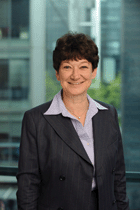 |
| Hildegard Gacek, managing director for the EBRD’s southern and eastern Mediterranean region |
Hildegard Gacek, managing director for the EBRD’s southern and eastern Mediterranean region, says the bank aims to lend €1 billion across the four countries in its first year and then €2.5 billion annually from 2014 onwards.
“We have discussed our operations and priorities with the countries involved; we think we have a pretty good idea of what our role will be,” Gacek tells Euromoney. “Our focus will be on the private sector and particularly SMEs, but we would also consider public-sector projects on a case-by-case basis.”
Like the EIB, the EBRD says it already has a close working relationship with other European institutions, plus the World Bank, and is seeking to cooperate with local and regional funds.
In April the EBRD signed an agreement with the Arab Monetary Fund to cooperate in financial markets and trade finance, and Gacek hopes to work with players based in the region.
As in Egypt, deals have been in short supply in Tunisia and Libya – although again Qatar has emerged as the most proactive of the Gulf countries. Qatar National Bank (QNB) completed a 49% purchase of Benghazi-based Bank of Commerce and Development in April, a buyout that had initially received approval during the final months of the Gaddafi regime. It gives QNB a foothold in the high-potential Libyan banking market, where Jordan’s Arab Bank and France’s BNP Paribas already own stakes in local lenders.
State-controlled Qatar Petroleum International has expressed interest in funding a new $2 billion oil refinery in Tunisia, although no firm agreement had been signed at the time of writing, while Qatar Diar, a real estate development firm owned by the Qatari government, also expects to start work on two large mixed-use projects this year.
Observers inside Tunisia say that private-sector investors, both local and international, are also taking a closer look at the new environment.
“In terms of deals there will be a lull, I would say, but a lot of discussions are going on. In the medium term [Tunisia] will be more attractive to foreign investors because before the revolution there were entire areas of the economy that were in effect closed,” says Jean-Guillaume Habay, executive director of private equity at Swicorp, a regional investment bank headquartered in Tunis.
“We are looking at a number of transactions; on the private equity side we recently closed a deal to buy a stake in a leading paper-manufacturing company.”
Although much clearly remains on hold, the consensus is that the revolutions have opened doors that used to be closed. One common outcome in all three countries is that the private sector, and especially smaller firms and start-ups, can expect a brighter future than under the old regimes.
“The revolution has created a sense of national pride and given many entrepreneurs the empowerment to go it alone and fill certain niche or under-penetrated sections of the market,” says Ahmed Badreldin, a senior private equity partner at Dubai-based Abraaj Capital says of Egypt.
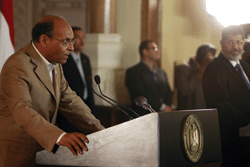 |
| Spring leaders: Moncef Marzouki, Tunisia |
The same is also true of Tunisia and Libya. “Prior to the revolution, investment opportunities in key sectors were accessible to only a few,” says Badreldin. “Now we feel that there is a level playing field in these countries. Also, in the medium term, the Arab Spring is expected to generate higher GDP per capita, which in turn will create a stronger domestic demand that will help domestic companies thrive.”
Badreldin says that Abraaj is working on two new transactions in Tunisia, one in the fast-moving consumer goods sector and the other in automobile parts. Both are between €5 million and €15 million in value and by the end of 2012, Abraaj expects to have a total of more than $50 million invested in the country.
Another emerging opportunity concerns the fate of assets that were previously owned by members of the old regimes. Tunisia has been the trailblazer at dealing with sequestered assets. Having seized hundreds of assets owned by the extended Ben Ali clan, including companies, houses, yachts and cars, the government intends to raise about $738 million this year by selling stakes in six firms, including car distributor Ennakl, Carthage Cement and Banque de Tunisie.
Also up for grabs is a 25% share in the largest mobile operator, Tunisiana, which was previously held by a Ben Ali in-law. Tunisiana is already majority-owned by Kuwait’s Wataniya, which in turn is majority-owned by Qatar’s Qtel, meaning that the Qatari firm is barred from participating in the auction later this year.
“I see a big opportunity in the sale of assets belonging to the [former president’s] family, especially as these are profitable businesses in areas that had a quasi-monopoly,” says Emanuele Santi, an economist at Tunis-based African Development Bank. “Despite its high rating in the various business and competitiveness rankings, Tunisia was actually much more closed than many international observers appeared to believe before 2011. Many people overlooked this. You had limits on certain areas of business, like franchising, which was highly controlled, and on real estate. There were regulations on imports, and many rules were informally implemented, even if they didn’t exist on paper.”
The line between state assets and those owned by the ruling family was even more blurred in Libya, where the prospects for privatization are theoretically enormous given the legacy of state control. Telecom operators remain entirely in the hands of the public sector, for instance, as do airports, ports, many large industrial concerns and most of the banking sector.
But selling these to overseas or even local investors will be a thorny issue, given strong nationalist sentiment – and wariness of foreign motives, even from those countries that supported the anti-Gaddafi rebellion last year – that Libya’s revolution seems to have begotten. And unlike Tunisia or Egypt, of course, the government in Tripoli does not need the cash.
Sensitivity around privatization is equally acute in Egypt, where state privatization deals throughout the 2000s – often involving Gulf investors – massaged foreign investment statistics but were often perceived as ways for a corrupt elite to enrich itself.
“There has been a negative nationalist reaction to the privatization process that was previously under way. I would be surprised if that process continued in the same way as before, even though in Egypt it essentially finished in 2008,” says Goldman’s Shawki.
Foreign funds might instead find it easier to buy into new stock market listings rather than privatizations, an area that several analysts think might blossom in the years ahead.
“I’m positive about the prospects for IPOs [in Egypt],” says Angus Blair, who heads Cairo-based think tank the Signet Institute. “Some people want to cash out of their companies. A good number of smaller firms, especially in the IT sector, which has grown rapidly in recent years, may list on the Nilex. There are also some larger companies that want to list in the future.”
Others are also bullish on prospects for the Libyan Stock Market, which was established in 2008 and reopened in March this year with a handful of active listings and minimal trading volumes.
“We think the Libyan market will be bigger than Tunisia in three or four years’ time, says Issam Ayari, a director at Tunis-based broker and asset manager Tunisie Valeurs, which plans to open a Tripoli office before the end of 2012. “We have lots of interest from clients who say that whenever the market really opens up to foreign investors then they would like to buy, particularly in banks. The most important thing for our clients is to have clarity on the legal environment, but this is not there yet.”
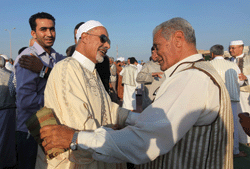 |
| Spring leaders: Mohammed Magarief, Libya |
How that regulatory environment evolves will be central to the attractiveness of each country, whether investors are from the Gulf, Europe or farther afield. Tunisia is still revamping its investment codes, while in August Libya’s transitional authorities published a new law that limits foreign shareholdings in Libyan companies to 49%.
The new realities of democracy might also have an effect on the pace of change, especially with larger or politically sensitive deals.
“Libya has made remarkable progress on getting oil up and running again,” says Liz Martins, a Dubai-based economist at HSBC Middle East. “But it may find it is much harder to get things done quickly in a more democratic setting. Like Iraq, it has lots of money but may find that political infighting and a dysfunctional government slow things down. Libya also has a lack of institutional capacity, and this might also make for slow progress.”
Although these are early days in all three countries, it seems likely that the large, state-led Gulf players will focus on big government-to-government projects, especially in infrastructure, while nimbler private-sector investors might be better placed to profit from the region’s new-found commercial freedom for small and medium-sized companies, as well as entrepreneurs. A word should also be put in for Turkey, which seems to have emerged as a commercial winner in post-Arab Spring north Africa.
All those with commercial ambitions on the region, however, will have to contend with reinvigorated local populations that will want to play a much bigger role in society than before the Arab Spring, as well as politicians that – unlike pre-2011 – might pay more attention to whether or not foreign investment deals are genuinely able to create jobs, reduce internal inequalities and ultimately win votes.
Unsurprisingly, given the political wrangling, most large-scale investment plans have so far been put on the back burner in all three countries.
“In terms of private-sector confidence, commerce and business is happening but there is a wait-and-see attitude on expansions and new investments,” says Mohamed Ozalp, general manager of Blom Bank Egypt. “There are lots of foreign and local investors who are ready, and they will move very quickly once things stabilize and we have a clearer picture of what’s happening and where we’re going. From the GCC [Gulf Cooperation Council] there is definitely an interest in terms of sovereign support, greenfield investments and buyouts. On the corporate side there are lots of opportunities and this helps them to diversify.”