
|
|
| Barzan Gas Company financing | |
| Size | $7.25 billion |
| Date | December 13 2011 |
| Financial adviser | RBS |
| Pricing | 130bp-200bp (commercial tranche) |
| Tenor | 16 years |
| return to the Middle East & Africa Deals of the Year index | |
As credit tightened around the world, the best deals in the Middle East were those that opened new avenues for finance.
The financing behind Qatar’s $10.4 billion Barzan Gas Company is a good example. The scheme is to develop a block of offshore gas reserves and construct onshore processing facilities in Qatar.
Barzan Gas Company’s sponsors are Qatar Petroleum (with 93% of the stock) and Exxon Mobil (with 7%). Equity makes up 30% of the project cost, so the 16-year facilities from banks, export-credit agencies and other financiers total $7.25 billion. It makes this the largest project financing in the world in 2011, according to Dealogic. It is also Qatar Petroleum’s largest ever project, according to the firm.
“Banks wanting to do business in Qatar had to show support for this deal,” says Meshaal Al Mahmoud, head of project financing at Qatar Petroleum. Indeed, Qatar Petroleum’s finance director, Abdulrahman Al Shaibi, is a member of the State Finance Policy Committee, which oversees financings done by Qatari state-owned institutions.
Nevertheless, the crisis in the eurozone meant there was a notable absence of commitments from French banks, even though they are traditionally stalwarts in project finance, including in the Gulf. Al Mahmoud and his team chose to target an alternative and previously rare source of cross-border dollar liquidity in the region – banks from other Arab Gulf states.
Out of the project’s 31 lenders, Gulf banks accounted for 36% of commitments; Asia accounted for 32%; Europe for 25%; and the US for 7%. Banks from outside Qatar – Samba and Riyad Bank in Saudi Arabia, and National Bank of Abu Dhabi – accounted for 40% of the regional banks’ commitments to Barzan.
This is an important advance for the region’s financing market, as Gulf banks usually restrict their provision of long-term funding to strategic projects sponsored by key domestic clients. Saudi Aramco’s sway as a sponsor is large in Saudi Arabia, for example.
 |
|
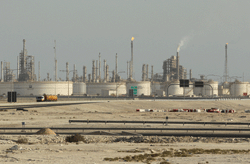
| A petroleum refinery of Qatar Petroleum. The Barzan deal needed QP’s support, and is ‘central to the country’s development plans’ |
Dissatisfaction at unemployment expressed during the Arab Spring has made regional and domestic developmental schemes a greater priority. More importantly, the Gulf’s corporates and banks are awash with dollar liquidity, partly thanks to high oil prices. After 2008, Gulf banks found it more difficult to access dollar funding because of high-profile debt restructurings, and the debate as to whether or not Gulf currencies should unhitch themselves from the US dollar. Now fears of corporate restructuring in the region have abated, while official pronouncements have repeatedly rebuffed speculation of de-pegs from the dollar.
However, part of the financing’s success – as well as its challenges – was down to the fact that Barzan is not oriented towards demand outside the Middle East. Barzan’s gas production will be for domestic consumption, primarily electricity generation. Qatar had one of the globe’s highest GDP growth rates last year and the boom is expected to continue as the state prepares to host the football World Cup in 2022 and possibly the summer Olympics in 2020.
Orientation towards future domestic demand meant support from Qatar Petroleum was even more vital than normal. Banks will retain recourse to the sponsors – unusually – even after the project is completed, unless the projected increase in domestic demand has been realized.
“Barzan is central to Qatar’s development plans as it should supply gas to meet the country’s future power demand,” says Al Mahmoud.
The biggest tranche, amounting to $3.34 billion (uncovered by export-credit agencies) was oversubscribed and pays between 130 basis points and 200bp over Libor, depending on the stage in the project’s life. Given the global market environment prevailing in late-2011, getting a financing of such size done at all is a testament to the dedication of the sponsor and its staff, as much as to the banks.
“When we approached the financing market for the Barzan project in mid-2011 we made absolutely certain there were no technical or commercial deficiencies within the deal’s structure and guarantees,” says Al Mahmoud. “This success is a vote of confidence by the market on the credit strength of the state of Qatar and Qatar Petroleum’s projects.”




