|
|
| Kinder Morgan | |
| Size | $3.3 billion private equity-backed initial public offering |
| Date | February 2011 |
| Lead managers | Goldman Sachs, Barclays Capital |
| Issue price | $30 |
| return to the Global Deals of the Year index | |
The fate of another benchmark IPO last year could not have been more different: by the end of 2011 Kinder Morgan’s $3.3 billion IPO – which was launched in February – was the only top-10 global IPO that was trading above its issue price. The deal was the largest in the energy sector since 1998 and is one of the top-five private-equity-backed IPOs ever. Its sheer size in one of the most volatile years in the equity markets is impressive – particularly as it was led only by Goldman Sachs as left lead and Barclays Capital. But it is the structure that makes it unique.
Kinder Morgan went private in 2007 via a management buyout funded by Goldman Sachs, Highstar Capital, Carlyle Group and Riverstone Holdings. Indeed it was Goldman that advised the firm, and, next to Rich Kinder, Goldman Sachs was the largest private-equity backer, and remains an investor. The firm did, however, retain its publicly traded master limited partnership, Kinder Morgan Partners, with Kinder Morgan Inc as the general partner. As an MLP, the cashflows are split between the shareholders and the general partner. The underlying growth of the MLP coupled with earnings and distribution growth translated into the general partner being an attractive proposition for the market. The challenge, however, was that MLPs have a predominantly retail investor base. MLPs pay their shareholders distributions, similar to dividends, which under US tax law requires the end investor to file a K1 tax form. Institutional investors prefer not to receive K1 forms as they are complicated from an internal accounting perspective, so the institutional market generally favours investing in C-Corps. Yet the MLP market has boomed over the past decade in the US. The market now has a capitalization of close to $280 billion, and there are more than 80 publicly traded MLPs like Kinder Morgan Partners. “The MLP sector has been attracting more investment and capital as both investors and companies recognize the need for the US to continue to build out and invest in its energy infrastructure, including pipelines,” says John Daly, head of natural resources and industrials in the financing group at Goldman Sachs. While an MLP was a popular route, the size of Kinder Morgan Inc (with a market cap of around $21.2 billion at the time of the IPO), meant that the deal would need to be structured to capture the institutional investor base. “Structuring the IPO as a C-Corp helped to broaden its appeal to institutional shareholders who were attracted to the yield-plus growth story,” says Daly. It is only the third deal in which a general partner has gone public as C-Corp. The one previous one was Targa in December 2010 – also led by Barclays Capital.
The challenge, therefore, for the bookrunners and Kinder Morgan was educating an entirely new investor base about how the cash flowed up from the MLP to the C-Corp, and how the cashflow would grow and produce dividends. Around 86% of Kinder Morgan Inc’s cashflow is derived from its general partner interest in Kinder Morgan Partners. The six-day roadshow in Canada and the US comprised 14 group events and 50 one-on-one pitches. The latter had a 90% success rate.
 |
|
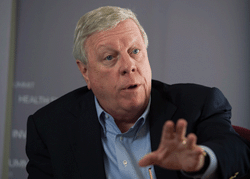
| Investors said Richard Kinder’s credibility was a key ingredient in the success of Kinder Morgan‘s complex IPO |
Paul Bjorneby, managing director in ECM at Barclays Capital, says: “We leveraged both our traditional MLP institutional investor base and also all of the major yield- and income-oriented mutual funds and money managers. The pitch was how it was a tremendous management team and company, rich in assets, and that the deal is in the investor-friendly structure of a C-Corp.” As a new structure there were few comparables to offer investors, which added to the challenges. Around 85% of the deal was placed with institutional investors, and half of that was allocated to 20 institutions, establishing a core group of long-term shareholders. Deals of the size of Kinder Morgan’s typically have several bookrunners, but by keeping the number of bookrunners to just two, it was easier for the message about the structure to be kept on track. Credit must also be given to Kinder Morgan chief executive Rich Kinder. “Kinder is extremely well respected, and has a lot of credibility with investors,” says an investor in the IPO. “He used to run a public company so there was no question regarding his experience. He’s also known for being very shareholder friendly.”
The warm reception by investors during the roadshow enabled the deal to be increased in size and to be priced higher than expected. Bjorneby says: “Initially we had contemplated a deal of around $2.2 billion, with a price range of $26 to $29.” The deal ended up pricing at $30 a share, resulting in a $3.3 billion IPO. Post-IPO, shares have held up well. On January 18 the stock closed at $33.70. Bjorneby also points to yield, which he says is important to shareholders. That has held fairly steady at around 3.6% now, compared with 3.87% at pricing.
The IPO has enabled KMI to use its stock as acquisition currency for its $21.1 billion purchase of El Paso Corporation, which was agreed last October. It is one of the biggest energy deals in history and, when finalized, will make Kinder Morgan the biggest of North America’s midstream energy companies.
| |
|
Global markets Cargill Inc/The Mosaic Company |
| Glencore |
| Kinder Morgan |
| European Union |
| Rabobank |
| Crest Nicholson |
| BNP Paribas Emerging Balanced Note index |
| Return to the Deals of the Year main index |


