The $2.3 billion unauthorized trading loss at UBS last autumn would be one such. The rape accusation against former IMF head Dominique Strauss-Kahn would be another.
But the announcement that JPMorgan had mislaid $2 billion and counting because of a hedging mishap is in a league of its own.
Why do I say that? Partly it is because of the repercussions for JPMorgan and partly because of the repercussions for the industry. Essentially, this loss makes the universal banks and investment brokers uninvestable. If the supposed best in breed can go so spectacularly awry, who knows what lurks under the hood at other, less well-managed firms?
For some months now the US banks had been covertly lobbying against the rigid imposition of the Volcker Rule. This rule, meant to come into force this summer, aims to separate proprietary trading from customer activity at US federally insured banks. After the JPMorgan stunt, regulators’ fangs have been sharpened: there will be no escaping their elongated tentacles.
Just as the burgeoning shareholder spring probably marks the end of excessive chief executive compensation, so the JPMorgan loss probably marks the end of freewheeling, high-noon investment banking and ushers in an era of utility-like activity where banks finally accept that they are the servants and clients are the masters.
Big banks will be viewed as lenders. They might find it increasingly difficult to win ancillary business as clients worry about the conflicts inherent in the big-bank model. Such conflicts are even evident in the JPMorgan story. The losses were apparently a result of JPMorgan’s chief investment office (CIO) trading certain credit default swaps but, according to the New York Times, other parts of the institution actually put the opposite side of the trade on.
For a while, I have had doubts about JPMorgan and its management. As long ago as July 2009 I wrote a column criticizing the board and warned: “The bank avoided major balance-sheet blow-ups in 2008… However the bank is not perfect and we should not fall into the trap of genuflecting hagiography.” In November 2009, I queried why a talented banker like Bill Winters had effectively been let go as co-head of the investment bank.
The losses at the CIO are more than a hiccup for JPMorgan’s chief executive, Jamie Dimon. I view this incident as akin to a roadblock in his career. Some had whispered that Jamie was destined to be US Treasury secretary when Tim Geithner steps down. Although I was sceptical as to how much political capital Jamie had built on Capitol Hill, the prospect of him ending up in Washington is surely now a fanciful dream.
 |
Some would call it “tall poppy syndrome”. Dimon, the one banker who sailed through the 2008 financial abyss, is finally cut down to size. I see it slightly differently.
Remember Jamie liked to stress how he was “a hands-on micro-manager”, a master of minutiae. Not for him the cerebral broad-brush approach of the strategic chief. No Sir! Dimon always implied that he was in the trenches crunching the numbers, totally on top of the risks his subordinates were taking, dedicated to protecting JPMorgan’s fortress balance sheet. Well, that’s all gone a bit pear-shaped, hasn’t it?
First, the losses occurred in a division that most investors didn’t even know existed. One could be forgiven for asking: “What does a CIO do and why is it investing (or should that be gambling with) such huge sums of money?”
Who did the CIO report to in the organization? Wasn’t it Jamie himself? One of the facts missed in this whole saga is that the chief risk officer of the CIO reported to that division’s head, Ina Drew, who in turn reported straight to Dimon. The bank’s chief risk officer, the highly respected John Hogan, might have had no idea what risks the CIO was taking. Where’s the corporate governance in that?
And finally whose money was the CIO playing with? It appears that client deposits were being invested in risky trades to make money for the bank. The US public won’t like that, and neither will the regulators – although the latter might pause to reflect that they in part created a problem that led so many clients to deposit money with the outsized bank that JPMorgan Chase became after the crisis.
“Jamie’s finished,” a wise source opined. “Because he always stressed he was immersed in all the details, the only posture he can now adopt is one of ritualistic self-abasement. Jamie’s turning Japanese.”
I’m not as convinced as source that Jamie’s career is over but his halo is certainly tarnished. I suspect that there will be a move to separate the chairmanship and CEO roles at JPMorgan. I reflected on this in November 2009 when I wrote: “Too much power may be concentrated in [Dimon’s] hands given his role as chairman, chief executive and president of the company. Is Dimon in danger of catching ‘red carpet fever’ and falling prey to his own PR machine? Hubris is always followed by Nemesis.”
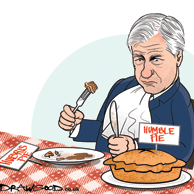
Dear reader, please remember to take note of my musings in future! Dimon is suffering his nemesis moment. But I suspect he might have to eat a lot more humble pie as the size of the losses balloon. He has agreed to testify before the Senate banking committee this month and it could get ugly as the kimono is lifted on the bank’s transgressions.