Wearing a wrenching slowdown in the world’s second-largest economy, Beijing has again reached into its box of tricks, searching for a bit of magic. Alas, all it seems to have found is the same dusty old plan it concocted four years ago: a budget-busting stimulus package designed to boost a flagging economy artificially buttressed by cheap credit and industrial overcapacity.
Unlike Beijing’s first, initially lauded, shot at pump-priming in December 2008, which diverted $600 billion from state banks into new high-speed rail lines and highways, the second has attracted a mix of bafflement and derision.
In late August, province-level Chinese Communist Party officials lined up to announce their own spending sprees. Tianjin, a big city in the northeast, broke first, issuing plans to pump Rmb1.5 trillion ($240 billion) into everything from aerospace equipment to electric cars. Chongqing in the southwest, a big municipality governed until recently by the disgraced Bo Xilai, vowed to boost investment in local telecoms and auto firms by the same amount.
And still they came: Guangdong, Guizhou, Shanxi and Heilongjiang provinces, plus the cities of Ningbo, Nanjing and Changsha, each pledging to pump between Rmb800 billion and Rmb3 trillion into pet projects and companies. By late August, a mind-boggling Rmb8.3 trillion had in theory been set aside by local officials, topping out at a cool $1.3 trillion, 18% of GDP.
| China’s new stimulus era |
| Local investment plans by province and city |
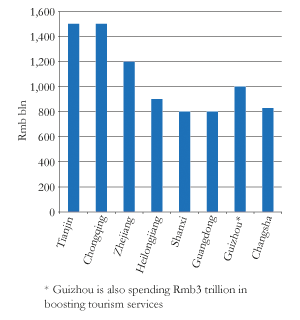 |
| Source: Local governments |
The only problem for the authors of China’s second stimulus package, it seems, is that no one appears to believe a word they’re saying. Nicholas Lardy, a senior fellow at the Peterson Institute for International Economics and author of China’s rise: Challenges and opportunities, describes the plan as full of “hot air”, a series of spending sprees containing no clear timeline, nor any guidance on where or how more than $1 trillion in new funding might be sourced. “In short,” Lardy adds, these plans “look pretty aspirational to me.” Carl Walter, a former long-standing mainland investment banker at JPMorgan and co-author of Red capitalism: The fragile foundation of China’s extraordinary rise, says the whole idea “smacks of panic”. The Communist Party “has no other ideas of how to jumpstart the economy, so [they] rely on old ideas”.
Many observers, including Li Yang, a vice-president at the Chinese Academy of Social Sciences, a top thinktank, have questioned where the money will come from. The 2008 plan – let’s call it Stimulus Spree One (SSI) – was credible largely because it was announced and championed by a single, unquestionable authority, the central government in Beijing, and delivered by a coterie of large state-run lenders.
It also did what it promised. China posted economic growth of 8.7% in 2009, even while the economies of the US and Germany shrank by 3.5%. China’s leaders have long believed that a minimum annual growth rate of 8% is required to prevent the country sinking into recession.
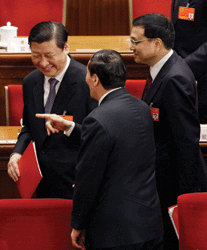 |
| Is a power vacuum around the expected ascension to power of Li Keqiang (r) and Xi Jinping (l) leading local leaders to make commitments they cannot keep? |
The 2012 plan, stimulus spree two (SSII), is a different kettle of fish. It has (at the time of publication) no blessing from anyone at cabinet level, let alone from premier Wen Jiabao or president Hu Jintao. No party elder has given his consent to the plan, let alone identified sources of funding. It exists on paper only; an idea orphaned at birth. Many believe local officials are merely second-guessing what they assume top leaders want them to do without having to be asked. In July, Wen issued a strong encomium to other leaders at an annual seaside retreat about the importance of strong local investment. From that day, says a US investment banker in Beijing, “it was probably only a matter of time before something mad like this happened”.
Indeed, second-guessing and being second-guessed, in a country long on secrecy and opacity, has always been a national pursuit. In modern China, where the only issue that matters is the economy and how large it is, it’s perhaps unsurprising that local bigwigs should have grabbed the bull by the horns for a second time, and in exactly the same way. Most Chinese officials still believe SSI achieved its ambition – to boost growth while the economies of the west stumbled and nearly fell – so why shouldn’t the same trick be repeated a second time?
Indeed, if nothing else, this is probably as good a reason as any to disregard SSII. The more one shouts, the less there usually is to say. ‘Outside noisy, inside empty’, as the Chinese proverb goes. Zhiwei Zhang, chief China economist at Nomura, notes: “You can’t take these headline figures seriously because they’re all inflated by local governments who are competing with each other to announce the biggest number and to attract foreign and central government investment.”
Moreover, while China at the highest level prepares to hand power peacefully from one set of leaders to another, at lower levels the transition has already taken place. A new generation of local mandarins has been in place since early summer. Each has an incentive to start with a bang, and the best way to achieve this is through a few explosive economic quarters. “We can expect [this new generation of local leaders] to put more pressure on the central government to provide financing” for these stimulus projects, says Nomura’s Zhang.
Of course, top leaders might put a stop to SSII before it even gets started, in which case provincial stimulus boosters will look foolish at best, and treasonous at worst. But that’s the chance many are taking. “Nothing ventured, nothing gained,” says a prominent China investment banker. “It’s high risk and high reward.”
For many, this entire escapade can appear a little crackpot. It also demonstrates how rudderless Beijing is at the moment. The current cabinet is packing up its pots and pans, getting ready to shuffle into retirement. And none of the men expected to ascend in November to the 18th Politburo Standing Committee, the highest office in Chinese political life, wants to make a calamitous misstep so late in the game, particularly individuals such as Li Keqiang and Xi Jinping, who most observers predict will be the future premier and president respectively. This leaves a power and thought vacuum – rare in China’s tightly orchestrated political economy – allowing those further down the ladder of power to be heard.
Not that all the stimulus plans are entirely without credence. Zhejiang province, a paradise for private-sector firms, announced on August 22 an eminently sensible and well-considered stimulus plan. A list of 441 investable projects, seeking total investment of Rmb1.2 trillion, were unveiled, most led by private-sector interests.
Nomura’s Zhang described Zhejiang’s plan as “more credible” than the others, for three reasons. First, most projects were already slated for inclusion in China’s current Five-Year Plan running to 2015, making them harder to cancel. Second, most projects are financed from outside the state sector in a province where private investments in infrastructure, such as the construction of the 36-kilometre-long Hangzhou Bay bridge, have so far delivered good returns for investors.
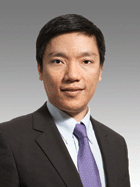 |
| Zhiwei Zhang, chief China economist at Nomura |
Finally, Zhejiang officials have promised to stump up extra capital if a project stumbles, helping make even complex projects attractive to the private sector. “Zhejiang,” says Zhang, “could set a model for public-private partnerships in promoting investments. Such a model would have a better chance of promoting growth in an economically viable and sustainable way.” No one, of course, wants China to judder to a halt. Its economy, tipped to grow by between 8% and 8.5% in 2012, is one of only a few keeping global business braziers stoked. A serious downturn would cripple growth prospects in South Korea and Taiwan, as well as dent profits at German and Japanese corporates dependent on exports to China.
Already, there are signs that growth is slowing across the mainland. In one week in July, three diverse firms, US chipmaker AMD, British fashion label Burberry and domestic carrier China Southern, voiced separate concerns about flagging revenues at their mainland operations. More worryingly, Chinese steel production fell year on year in the third week of August, the first decline in 31 years.
And this chatter about investment sprees across China might be masking a more serious problem: overcapacity. For decades, economic growth has largely depended on exporting lower-cost goods to Europe and the US. As consumers in those economies reined in their spending, China sought to divert homemade goods to emerging markets, with only moderate success. Efforts to boost retail spending at home have also stalled. The household consumption rate in China is stuck at around the 40% mark, one of the lowest rates of any of the largest global economies.
Overcapacity, which the IMF says has been a problem in China for more than a decade, is becoming a serious issue. Automobiles, white goods, electronic equipment, clothing and household goods: all, in inventory terms, are at a record high in China. Millions of homes sit empty in cities, yet still more are built. Coal and iron ore piles up at ports across the country, forcing ships to return home with their cargo or anchor for months at sea.
Even big multinationals are struggling. Chinese corporate leaders such as footwear manufacturer Li Ning and white-goods maker Haier have scaled back production targets. In August, construction equipment maker Caterpillar became the latest foreign corporate to confess that overcapacity in China had forced it to cut production and sell excess stock to smaller markets.
China’s inventory index, comprising total inventories divided by sales, stood at 1.98 at the end of June, according to the National Bureau of Statistics (NBS). More than 1.5 is seen as dangerously high. In the latest sign that China’s manufacturing sector is in decline, the HSBC Flash Purchasing Managers’ Index fell to 47.8 in August 2012, below the 49.3 reading posted in July: any score under 50 marks out an economy as contracting rather than expanding.
This is bad news in a country seeking to go upmarket: to set a long-term marker as a producer of high-end goods that generate hefty margins for its corporates. That isn’t going to happen so long as retailers such as Beijing-based 360Buy.com are actively promising to sell household goods at a zero profit margin.
“All that is being done is simply creating new ghost towns on top of old ones,” says the former banker Walter. “These new projects [created by stimulus sprees] will not create new capital. They will simply destroy existing capital while boosting GDP on a one-time basis.”
 |
| Li-Gang Liu, head of Greater China Economics at ANZ in Hong Kong |
Li-Gang Liu, head of Greater China Economics at ANZ in Hong Kong, adds: “My view is that [there is no] need for additional stimulus because [China’s] investment programme is already large enough.” Nor, contrary to local myth, has the first stimulus package been wholly kind to China. SSI, according to data from leading banks and the NBS, pumped anything from Rmb10 trillion to Rmb20 trillion into China’s economy between early 2009 and mid-2011, creating an infrastructure boom that dwarfed any of the 20th-century nation-building phases in the US or Europe.
Some of that went into worthy projects. A trip from Shanghai inland 180 kilometres to the vibrant city of Hangzhou is now just 45 minutes by high-speed rail, down from two hours. You zip over freshly minted motorways and past gleaming, arched bridges, all of which, including the train and steel lines along which you glide, have been built since the onset, four years ago, of China’s stimulus era.
Yet too much capital has also been wasted on white elephants. Stimulus also resulted in China diverting trillions of dollars from its banks, through regional Communist Party offices, and into the maw of shadowy local government financing vehicles. Total outstanding lending to all LGFVs hit $1.5 trillion by the end of 2011; various global institutions, along with the China Banking Regulatory Commission have warned that between 30% and 40% of these loans will go sour.
If that happens, it will push up the non-performing loan ratios at leading Chinese banks, from an official rate of between 1% and 2% to above 10%. A new stimulus spree, through SSII, would further boost China’s banking system’s pool of soured loans in the long term, many of which might continue to hang around on lenders’ books for decades.
Perhaps another question should be asked. Can China afford another stimulus spree? Here, opinion is divided. Most foreign experts ultimately believe that the country cannot afford another de facto bailout: a wild injection of state finances into a sclerotic and still largely isolated economy bedevilled by overcapacity.
SSI was largely paid for by state-run banks channelling the savings of retail customers into big infrastructure projects. But that left those banks severely financially stretched, to the point where most were forced to launch multi-billion-dollar rights issues to credulous investors in Shanghai and Hong Kong. Since banks are virtually the sole big source of financing in China, it’s hard to see where fresh capital can come from to fund SSII. As Walter puts it: “If the banks are tapped out, that’s it.”
|
||||||||||||||||||||||||
Even the praise of stimulus boosters sounds a little faint. Ratings agency Standard & Poor’s said in an August 22 note that China could afford to deliver a new stimulus package, but added that a new spree would risk making “bad investments”. Either way, it’s hard to see how any plan to repeat SSI could be financed, given that the headline credit growth target has plateaued, while the banking system is already experiencing severe difficulty extending new medium- and long-term loans. The only parties who might indeed believe in SSII are likely to be provincial governments that grew fat and indebted thanks to cheap loans secured in the first stimulus era. Local debt hit a record $1.7 trillion at the end of March 2012. And falling land sales, which comprise the bulk of local government earnings, are forcing provincial officials to cast around desperately for new source of funding.
For many, the only viable answer, at least in their own eyes, might be in more stimulus and more debt. It’s notable that two cities leading the charge on SSII are Tianjin and Chongqing. Fixed investment in Chongqing comprised 55% of provincial GDP in 2011, according to data from financial information provider CEIC. In Tianjin, the figure topped 70%. Both municipalities posted economic growth of 16.4% in 2011; both are desperate to maintain that rate for as long as possible.
China’s provinces are going to need an answer on stimulus – and soon. Either way, the outcome is unlikely to be good for Beijing. If central government acquiesces to the demands of investment-hungry provinces, it looks rudderless, showing a disinclination to lead from the front. If it bans new stimulus, the economy is likely to slow, and first China, then its regional and global feeder economies, will flag too. And all in what, by Chinese standards, ranks as an election year.
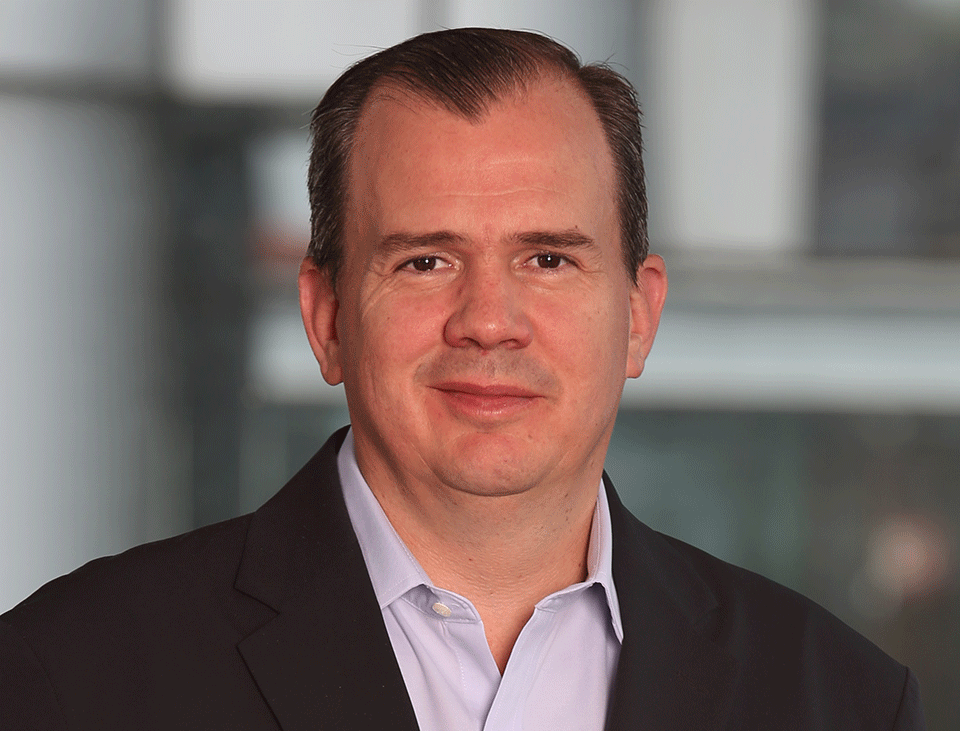
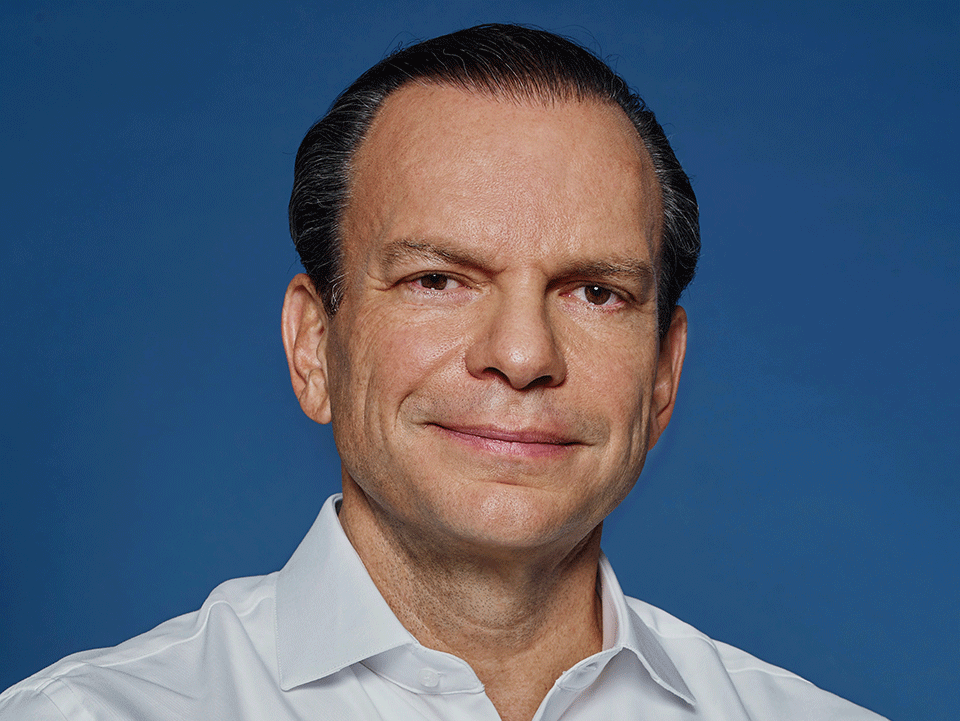
How does it all end? “Badly,” says Fraser Howie, a co-author with Walter on Red capitalism. “Recession at best. Lots of debt, lots of white-elephant projects and the fiscal cupboard bare.”