 |
|
|
Best Investment Bank: Deutsche Bank |
|
|
Also nominated: Citi and Morgan Stanley |
Deutsche Bank’s leadership in global investment banking is built on the foundation of its dominant position across most of the traded financial markets. In foreign exchange, it has been ranked number one for market share in Euromoney’s annual ranking for eight years. It is the top-ranked firm globally in all rates derivatives across the major currencies, according to Euromoney’s survey published in March. Intriguingly, for a bank headquartered in the eurozone, Deutsche is now the top-ranked firm for market share in dollar rates: the goal of long and steady investment by the bank.
Since Anshu Jain, then co-head of Deutsche’s corporate and investment bank and now co-chief executive of the whole bank, took the key strategic decisions three years ago to close down proprietary trading and exit some of the principal businesses at the centre of the financial system crisis in 2008 and 2009, Deutsche has concentrated its bankers’ efforts on addressing customers’ requirements instead of devising ever-more complex products for its traders.
A classic example: in March 2012, Deutsche executed the largest-ever longevity hedge, for Aegon, by finding a way to distribute longevity risk to real-money investors for the first time.
The deal transferred risk from €12 billion of Aegon’s €30 billion of Dutch reserves. As well as being the largest-ever such trade, it was the first to reference population mortality in continental Europe, in this case the Dutch population, with a series of model points representative, in demographic breakdown and annuity amount, of Aegon’s underlying portfolio. This transaction enables Aegon to manage economic capital in such a way that it can increase the capacity of its pensions business.
In the classic corporate finance businesses, Deutsche Bank made further progress this year, building far beyond its traditional strength in debt capital markets. Again, the key breakthroughs have been in the largest market with the biggest revenues. As well as being the top-ranked firm in US dollar rates, Deutsche is now a top-five US debt capital markets house, complementing its position as the top debt markets bookrunner in Europe in the 12 months under review.
Similarly in equity capital markets, Deutsche has the top market share for Europe, and is the only firm with a share above 10% in the period under review, putting it ahead of Goldman Sachs, Credit Suisse, JPMorgan and Morgan Stanley. In the US, always the toughest market for non-US firms to break into, it is now comfortably inside the top 10 as an equity arranger, according to Dealogic. It has made strides in key Asian markets, for example now being inside the top five in Hong Kong.
A noteworthy success was being named one of the active joint bookrunners on AIG Group’s $8.7 billion re-emergence offering in May 2011. Deutsche Bank was also included on AIA’s $6 billion sell-down in March: the second-largest accelerated bookbuild ever done in Asia. Being included on those required credibility with the US government, the vendor of the AIG stake, as well as strong equity capability in Asia.
 |
|
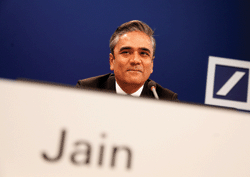
Anshu Jain: focusing on customers’ needs, not complex products |
In M&A, a business so long dominated by a small handful of firms, Deutsche now ranks third in Europe and is established in the top 10 in the US. Growing numbers of US and Canadian companies are now choosing Deutsche over US firms to advise on complex overseas acquisitions, for example Colfax on its £1.5 billion ($2.3 billion) purchase of Charter, a company three times its own size, and Molson Coors on its €2.65 billion acquisition of Starbev.
Deutsche is a growing force in China-related M&A. It was sole adviser to CGNPC on its $2.2 billion acquisition of Kalahari Minerals in February 2012. It advised the Moreira Salles family of Brazil on the September 2011 sale of a $1.95 billion 15% stake in CBMM to a Chinese consortium that included Citic – the first overseas acquisition by a state-owned Chinese company.
The bank is now a force in the big global M&A deals, for example advising Xstrata on its $48 billion merger with Glencore, which will be the largest-ever mining M&A deal, assuming it is approved.
Deutsche Bank has won many new corporate clients in the past year, such as Echo Star, BTG Pactual and Saudi Electricity, after building a new integrated corporate coverage model. For many of these companies, Deutsche Bank’s ability to offer strategic advice, financing and risk management has been a key selling point.
The breadth and depth of its business model has served it well in 2011/12: a year that put European banks at a disadvantage to US banks but during which Deutsche Bank improved its position across almost every area. It is noteworthy that Deutsche managed all this while reducing its value at risk by 30% from the first quarter of 2011 to the first quarter of 2012. That is more, by far, than any other leading bank that reports quarterly value at risk in a comparable way. Its investment bank also reports a return on equity well above most of its peers.



