 |
|
|
Best Wealth Manager: UBS Wealth Management |
|
|
Also nominated: Citi Private Bank and Credit Suisse Private Bank |
In the first quarter of this year, UBS’s pre-tax profit in wealth management was up more than 23%. Net new money more than doubled to SFr6.7 billion ($7 billion). Gross margin was up two basis points to 93bp. It marked the confirmation of the turnaround for the Swiss bank. UBS’s reputation was damaged during the crisis, with big write-downs, a bailout from the Swiss government, and allegations of helping US clients evade taxes. Competitors picked up UBS’s market share, and it was doubtful that the wealth manager would be able to come back. But over the past 12 months, the firm has done just that, and it has reinvented itself to become a more modern and client-focused business.
The fact that the entire bank has strengthened its balance sheet and returned to a position of stability has been crucial for clients. Jürg Zeltner, chief executive of UBS Wealth Management, says: “To be able to talk about the environment we are in with clients without the question of where UBS will be is very important. We’re not in a place of defence any more.” At the end of the first quarter the bank’s core tier 1 ratio was 16.7%, up from 14.1% the previous quarter. Its net profit attributable to shareholders was also almost three times that of the previous quarter.
Now in a position of strength, UBS Wealth Management is able to focus on its new strategy. “The days of using the offshore model for the sole purpose of bank-client confidentiality are gone,” says Zeltner. “There are barely any clients now who want that kind of service. What matters to clients is content. So we are concentrating on becoming a true investment house – opening up more to open architecture, access to the best managers in the world, expanding our global reach, creating the CIO office.”
 |
|
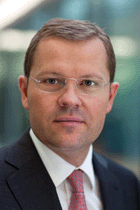
“We are concentrating on becoming a true investment house – opening up more to open architecture, access to the best managers in the world, expanding our global reach, creating the CIO office”
Jürg Zeltner, chief executive, UBS Wealth Management |
The CIO office opened in New York in June and is headed by Alex Friedman. It sits above UBS’s New York offices on Park Avenue and looks more suited to Apple than to a private bank. It is white, shiny, with lots of glass and modern amenities. Zeltner says it is important that UBS Wealth Management has an office in the US and hopes that clients will see the shift to a more modern investment-management style. “The US is the biggest market in the world, so we have to be here.” Certainly the firm’s recommitment has paid off. In the first quarter Wealth Management Americas under Bob McCann attracted doubled net new money, reaching $4.6 billion, and pre-tax profit rose 34%.
But the CIO office has a much deeper role for UBS than simply establishing itself in the US. It is designed to bring together an investment philosophy and strategy for the entire wealth management group – not dissimilar to that at Citi Private Bank. UBS has 900 analysts globally, leading to a collective asset allocation and investment strategy. “That was not how we used to be. We didn’t publish what our asset allocation was or have this one approach. This is better. We have to put it out there and tell clients what we think in order to be credible. It means we are now coming to clients with ideas, saying: “‘This is what we believe. Here is where we see the opportunities around that.’ Clients are very welcoming to that shared experience and spirit.” Zeltner says ideas are going to be more important than ever. “The buy-and-hold days are over. Today, there is no beta tailwind. Clients need to be shown ideas to position themselves and deal with this new environment. They need that macro view.”
Although UBS has been scaling back its investment bank, Zeltner says it is a necessity for a wealth manager to be linked to one. “You don’t need to be top three in investment banking, but you have to have access to capital markets and research. It’s expensive but you cannot be credible to high-net-worth clients if you don’t have that expertise.”
A sense of humility now pervades UBS. It is one that sits much better with high-net-worth individuals still suspicious of their banks. Zeltner says:”It is early days for us in this turnaround story. We still have gaps. We need to build our track record. We need to be recognized. It is early days for the industry too. I don’t see many firms talking about content and what can be done to protect client assets. That needs to happen, and we have made the move to do that.”



