Best investment bank 2012
|
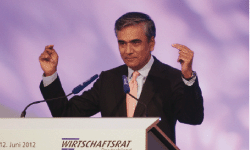
Come September, Anshu Jain, co-chairman of the group executive committee and management board of Deutsche Bank, will be presenting on the bank’s strategy 100 days into his tenure alongside Jürgen Fitschen, as co-head of the eurozone’s regional champion bank.
He will face plenty of questions on the bank’s plans to build its fully loaded Basle III core equity tier 1 ratio: how far can it raise equity organically now that plans to sell its global alternative asset management division appear to have foundered? Can it sell or mitigate more risk-weighted assets without hurting the bank’s earnings and profits, and what return on tangible common equity can the bank generate if market and regulatory demands on banks continue to require higher ratios?
What new plans does the bank have for its retail banking businesses in Germany and abroad? Which will it grow and which sell? And how will it fix the asset management and wealth management businesses?
If the present macro-uncertainties in Europe continue to intensify and if wholesale clients continue to reduce activity and avoid risk, it could be a tough time for Jain.
It’s probably just as well, therefore, that the corporate banking and securities division that Jain ran before taking over as co-chief executive of the whole bank and built up over a 17-year career at Deutsche, is in such good shape. The bank has long been in the top three in the world as a sales and trading intermediary across the currency, bond, credit, equity and commodity markets. More recently it has established itself also as a top-three firm in the corporate finance disciplines of investment banking: debt and equity capital raising and M&A.
Look back four years to the first quarter of 2008 at the start of the financial crisis. Deutsche had a 4.3% share of the global investment banking fee pool, according to Dealogic. The combined shares for Bank of America and Merrill Lynch were 9.1%. JPMorgan, then the top-ranked firm, enjoyed a 7.5% market share. Goldman Sachs had 6.4%.
At the end of the first quarter of 2012, Deutsche Bank had lifted its share far more than any of those firms, to 5.6%. It still lags behind JPMorgan, which has increased share more marginally to 7.9%. The combined Bank of America Merrill Lynch now comes in at 6.2%. Deutsche has pulled above Goldman Sachs, whose share has fallen to 5.3%, and also above Morgan Stanley. So although markets are tough, at least Deutsche Bank can say it is winning.
“The silver lining of a bad macro picture and a tough, but understandable, regulatory picture is that the industry is finally consolidating,” Jain says. “Some firms are starting to scale back in certain businesses and even withdrawing. A lot of liquidity was injected into the system in 2008 and 2009, so many firms remained active, and 2009 and 2010 were good years for the industry with rallying markets and regulatory changes yet to take effect. But that was a false dawn.”
The good news for Deutsche Bank is that it took key decisions in the first quarter of 2009 to radically reshape its investment banking business.
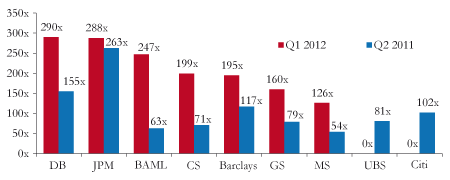
| Deutsche Bank has the highest return on value at risk in the industry |
 |
| Source: Deutsche Bank, bank financial results |
Jain recalls: “We shut down prop trading completely, scaled back on exotic derivatives and securitizations. We shuttered businesses that together accounted for one-third of our revenues but it was fundamentally necessary. Then in 2010, with project Integra, we drove much closer connectivity of the wholesale businesses, for example with combined coverage for the global transaction bank and the investment bank.”
It is not the only bank to have responded to the new normal by reducing proprietary risk and breaking down the old silos but it has executed particularly well. When Deutsche Bank formed a joined-up corporate and investment bank in 2010, it set itself the target of generating €500 million of synergies within a year. This was a formidable task yet in 2011 the bank exceeded that target.
In its most recent quarterly results, Deutsche Bank’s newly renamed corporate banking and securities division had bounced back from the near closure of investment banking markets in the second half of 2011 to show €5.2 billion of revenues and €1.7 billion of pre-tax profit, with a cost-income ratio of 65% and a return on equity of 26%.
Perhaps a more useful period to examine is the full-year 2011 for which, after a dire second half and a fourth-quarter loss, the division still managed €14.9 billion of revenue, €2.9 billion of pre-tax profit and a 16% return on equity: numbers that many of its peers would kill for.
Jain’s expectation is that his successors running the corporate banking and securities division as its co-heads, Colin Fan, head of markets, and Robert Rankin, head of corporate finance, can continue where he left off. “We are fully committed to all aspects of the investment bank,” says Jain, “and any changes will be modest. There will be short-term ebbs and flows in profitability, driven by client volumes. But what we have built will be structurally viable in a post-Basle III, post Dodd-Frank, post-Volcker world, with a return on equity target in the mid to high teens.”
Jain takes pride that the formidable intellectual firepower assembled among bankers inside Deutsche’s markets businesses in the heyday of financial innovation is now trained on solving client problems rather than devising ever more exotic derivatives for its traders.
He singles out the €12 billion longevity hedge for Aegon. “Pension funds are struggling to cope with long-term longevity exposure. That was an example of taking the financial technology we had built up over a long time and using it to create a customized client transaction. And there are many other examples.”
As well as running a more client-focused operation, all banks will now have to run much more efficient ones, and cutting costs is another focus for those smart minds. Jain says: “We have to manage expenses and so we’re taking our technology know-how and applying a lot of it to making our platforms more efficient, for example, creating algorithms that improve automated trading efficiency, rather than creating the next-generation complex product.”
 |
|
“For so long people in our business concentrated on the flow and ignored the tail risks. Now all that anyone seems to think about is the tail risk, rather than the mean. There’s a lot of good news that’s not priced in”
Anshu Jain |
Jain looks forward with guarded optimism. “For so long people in our business concentrated on the flow and ignored the tail risks. Now all that anyone seems to think about is the tail risk, rather than the mean. The US has successfully restructured its economy and the housing market there looks like it may have bottomed. Asia hasn’t slowed down that much at all. There’s a lot of good news that’s not priced in. Corporate balance sheets are very healthy and investors hold a lot of cash that they are eager to expose to a little incremental risk in order to earn a return.”
And if the markets remain slow and clients risk averse and not inclined to deal for the rest of this year? “A prolonged slowdown will further test the stamina of certain banks and raise the question for how long they can carry their less profitable investment banking divisions.” Deutsche, Jain suggests, has shown that it can pick up share in tough markets and still earn a decent return.
Robert Rankin is a relative newcomer to the tight-knit team around Jain who have worked for years building up the corporate and investment bank, converting its European debt markets business into a corporate finance leader and slowly building up in the US, traditionally the graveyard for ambitious European investment banks.
Rankin, an Australian, joined Deutsche in 2009 in Asia, having run investment banking for UBS there. While taking lead responsibility for corporate finance in the new management structure, he has an eye across the markets businesses and the strengthened links Deutsche has enjoyed with hedge fund and institutional clients, as other banks have cut back.
It delights him that of the six largest start-up funds launched by former Goldman and JPMorgan traders in the past year, four have chosen Deutsche Bank to be their prime broker. Typically as banks cut back proprietary trading and great traders set up on their own, they choose their old firm as one prime broker – new clients would probably worry if the traders’ previous employers didn’t back them – and then appoint another. Very often, these days, that other will be Deutsche. It’s a noteworthy validation of the bank’s broad trading and prime brokerage franchises, its momentum and its ability to pick up market share, especially when those traders are setting up global macro hedge funds, operating across geographic markets and asset classes, which is what many of the ex-Goldman proprietary traders, for example, are now doing.
But it is in the corporate client sphere, particularly in the US and Asia, that Rankin sees most progress at Deutsche Bank. He says: “The adjacency of corporate finance, markets and global transaction banking helps us gain new clients and win market share across all of those businesses. For instance, we can float the business of a company owner in Hong Kong, then offer the client other services like transaction banking and trade finance, which sets us apart from several key competitors in investment banking.”
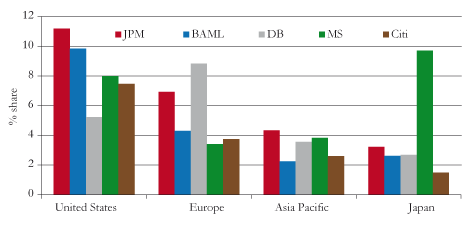
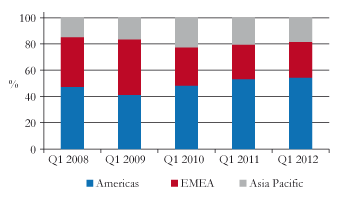
Traditionally, Deutsche Bank’s share of the global investment banking fee pool looks better when M&A, ECM and DCM volumes are higher in Europe than in the Americas and Asia. In recent quarters it hasn’t been, but the bank has still improved its market share by picking up business in the US and especially Asia.
| Top five banks by IB revenue market share |
 |
| Source: Dealogic |
In the past 12 months Deutsche Bank has been a joint bookrunner in the largest-ever IPO of a jewellery retailer globally, for Chow Tai Fook Jewellery in a $2.1 billion offering in December 2011; the largest-ever healthcare IPO in Asia, for Shanghai Pharmaceuticals, with a $2.1 billion offering in May 2011; the largest insurance IPO globally in 2011, for New China Life on a $1.9 billion offer last December; the largest-ever Reit IPO in Singapore, for Mapletree Commercial Trust, with a $764 million deal in April 2011; and the largest gaming IPO globally since 2009, with MGM China’s $1.6 billion offering last May.
Rankin points to a sign of the bank’s growing relevance as a top global investment bank in its role alongside Morgan Stanley, Goldman Sachs and Citigroup as joint global coordinator on AIG’s sell-down of $6 billion-worth of shares in its Hong Kong-listed pan-Asian life assurance business, AIA, in March 2012, with proceeds used to pay back the US Treasury.
In its own right it was a noteworthy transaction in the Asian equity capital markets. This was the second-largest accelerated bookbuild ever done in Asia. Deutsche Bank commenced wall-crossing top-tier accounts globally prior to launch to generate demand and the deal was covered inside eight hours and the books closed early to crystallize momentum, even though the Hong Kong market fell 1.4% on the day.
 |
|
“Co-heads is a proven concept at Deutsche Bank. There are some banks where, for reasons of history and culture, it just works. Judge us on how we manage, and don’t underestimate how far these businesses have integrated already”
Rob Rankin |
Rankin says there is a larger story of how the bank’s capabilities in Asia have helped buttress its position and credibility in the US. He says: “If you look back at the initial IPO of AIA in 2010, the US Treasury’s re-IPO of its AIG stake in 2011 and most recently the accelerated bookbuild for AIA, they were all landmark transactions, and we were privileged to be involved in all three. It was a global effort, and our equity markets capability across Asia Pacific, Europe and the US on the AIA IPO helped build our credibility with AIG management and the US Treasury over time.”
In the Americas, Deutsche has picked up business from some demanding clients, such as Charlie Ergen, acquisitive chairman of broadcast satellite company Echostar. “We’re come a long way in a short time but we still have some work to do in the US,” says Rankin. “For instance, we’re investing further in natural resources. And globally, we are number one in Europe and a top three investment bank in Asia Pacific.”
He’s convinced that the size of the bank’s US trading operations, double the size of those of certain top-tier US firms, will help it to continue to progress in corporate finance. “Our sales and trading platform in the US is a key competitive advantage as we continue to build out our advisory business in the region.”
As Jain, who built the business, moves into the co-CEO seat at Deutsche, is it a backward step for the bank to appoint co-heads of the business to replace him, with Rankin taking lead responsibility for corporate finance and Fan for the markets businesses?
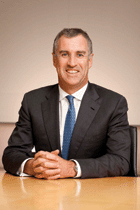
Rankin says: “Co-heads is a proven concept at Deutsche Bank. There are some banks where, for reasons of history and culture, it just works. Judge us on how we manage, and don’t underestimate how far these businesses have integrated already. We don’t want to compete separately, we want to bring them even closer together.”
While fighting for more clients, Deutsche must also wrestle with new capital constraints that reduce its capacity to extend balance sheet, for example in debt and equity underwriting and acquisition financing. Rankin says: “We want to be the scale provider with the greatest efficiency. We’re a market leader at intermediating risk globally. We’ll work with clients we can help grow, and deploy balance sheet in the expectation of decent returns on doing so. The good news for us is that more and more competitors do not offer that any more.”
The inspiration for the corporate finance effort at Deutsche remains the markets businesses that have continued to build market share, notably in the US, and to produce returns even while continuing to reduce risk-taking. This is down by 30%, as measured by quarterly value at risk, from the first quarter of 2011 to the first quarter of 2012.
| Global investment banking revenue by region |
 |
| Source: Dealogic |
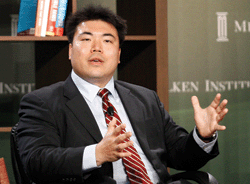
A tour with Colin Fan around the financial markets right now is a reminder how tough a business this is to be in, even for a market leader.
The proposition at Deutsche, as for many firms since the financial crisis, is that it should be in the moving business not the storing business, that it should not build risk inventory but move it on quickly for clients, assuming the least risk it can. Deutsche, as one of the big-three firms in the rates markets with JPMorgan and Barclays Capital and a leader in credit, equity and commodities, has prided itself up to this point as a provider of liquidity to clients when other firms pulled back. But its capacity to provide this is now being tested by dire market conditions.
Fan picks up the point about reduced value at risk. “We look at measuring risk in all sorts of ways. Value at risk is one useful measure but it has some limitations such as assumptions around underlying liquidity.”
A trader at different times in his 14-year career at Deutsche of Asian equities, global convertibles and structured credit, Fan is well versed in recognizing patterns in financial markets. But markets are now driven by politics and characterized by periods of frenetic activity that suddenly give way to periods of severe illiquidity. The best way for firms to ride out the high volatility attendant on low volumes is to be as flat as they can be.
“Primary dealers have reduced cash bond inventory levels to what they carried 10 years ago,” says Fan. “We’ve always prided ourselves on our ability to provide liquidity, though every market maker must face restrictions on capital and balance sheet.” He agrees that “a lot of real money investors have legitimate concerns about a lack of liquidity in the markets”.
Even in markets where liquidity looks good and Deutsche is a clear leader, such as in foreign exchange, Fan is concerned. “Volumes in FX have increased steadily throughout the last decade including through the crisis, albeit some of the liquidity is in the euro/dollar pair which has become a simple barometer for European sovereign stress,” he says. “Subtle insights into economics and relative value aren’t much use when the underlying flows are driven by reactions to the credibility of the latest political development.”
In rates markets for high-quality government bonds, such as those issued by the US, Germany and even the UK, it’s the same story as in foreign exchange. Fan says: “There’s decreasing value in analysis and all we can do is try and facilitate the market when volumes are challenged and bid-offer spreads widen.” Shareholders and credit analysts must wonder whether banks picking up share in such volatile and inconsistent markets might be better off not doing so.
Meanwhile, there is the challenge that many other government bond markets have become credit markets but cannot simply be handed over to credit traders. And the credit markets themselves are all but broken. Fan says: “The market has divided into four groups – financials, sovereigns, US corporates and European corporates – with very little relation to each other, and for which ratings and analysis of fundamental relative values are less meaningful. If you look at the secondary markets in high-yield bonds, bid-offer spreads are wider than ever, and you can barely trade $10 million in a name without moving the market.”
What about the equity markets? Trading in equity seems to have been particularly hard hit by new risk weightings at a time when the whole thrust of regulations is pushing banks to hold only government bonds or triple-A-rated corporates. Fan says: “Equity as an asset class has positive convexity on a two to three year horizon – if there is a recovery, equity will reward investors while on the downside, equity will protect against inflation and loss of confidence in fiat instruments. The problem is near-term volatility which is taken into account in current pricing.”
 |
|
“We need more normal patterns of market behaviour to resume. Assuming it does, then this platform promises great operating leverage”
Colin Fan |
Fan is clearly proud of the success of the bank’s long, slow organic build-out in the US bond markets to a number one position, which took on added urgency after the financial crisis of 2008 and 2009. Deutsche is still fighting hard in certain battlegrounds and has much more work to do in building up in cash equities in the US. Fan says: “Electronic trading is one key battleground and we’ve been trying to provide differentiated new pools of liquidity and have brought in new clients and won market share. But we still have a way to go in US cash equities. It’s the single biggest gap we have.”
There are limits to how much share is comfortable to have though. He says: “We’ve always had a gem of a business in distressed credit and are never complacent, but we have such a high share that at times it could eventually impact liquidity.”
If that tour d’horizon makes it sound like a bad time to be a flow-monster trading house, the only consolation for Deutsche is that being one is probably preferable to the alternative. Even in financial markets that are driven more by political pronouncements than economics and commercial considerations, being in the flow brings some information advantage. And rather like investors that must ride out the short-term volatility, the big trading firms such as Deutsche might find the long-term prize is well worth clinging on for if they gain significant pricing power.
“There used to be a dozen relevant global firms, now there are only half that number”, says Fan, “with a premier league of three or four that are robust, healthy and with a long-term sustainable business model. For a while, this period of regulatory change may perversely obscure differentiation between firms. But as more banks realize the necessity to transform their business models, and with the barriers to building a platform like ours high, the advantage should follow.
“We need more normal patterns of market behaviour to resume. Assuming it does, then this platform promises great operating leverage.”