On the third floor of the ultra-plush new São Paulo shopping mall JK is a Bradesco. As you enter the space (there are no doors) a little white robot whirs towards you and greets you with a blue neon smile. The rest of the concept store uses the latest touch-screen technology to tell the bank’s story about its past, present and future. “What would a bank of the future look like if the future was right now?” asks Bradesco, based on the assumption that the flagship project’s use of interactive technology along the walls and on table tops answers its own question.
Bradesco has put its branded flag into technology investment. It boasts that it is not just ahead of the retail banking competition in Brazil but is leading the way in the use of technology throughout the southern hemisphere. The programme began in 2003 and is due to be completed next year, by which time the bank will have spent a total of R$1.8 billion ($888 million) in its IT Revitalization Programme. The aim was, and is, to improve efficiency. And although the timing looks inspired, with today’s changing landscape of Brazilian retail banking placing a greater emphasis on efficiency gains than ever before, some question whether the bank’s use of technology is being sufficiently radical. Rather than using technology to make the current banking network more efficient, shouldn’t new technology be enabling banks to rewrite their entire strategy? Or to put it another way, if you looked at a bank of the future right now, would the branch-centric model, upon which the bank’s strategies now rest, be itself obsolete?
The future is still open to debate, but there is little doubt that Brazilian retail banks today face big external pressures to change. The government has long wanted a lower interest rate environment, judging that Brazil’s outlier status in terms of high real interest rates might be good for its banks but not so positive for the economy as a whole. The recent global slowdown has been used to chop the base Selic rate to 7.25%, down from the 12.5% in July 2011 after which central bank president Alexandre Tombini started cutting the base rate. Although the privately owned banks have yet to respond by cutting their interest rates in a meaningful way, the two state banks, Banco do Brasil and Caixa, have been used in what some call a macro-prudential way to begin to lower consumer interest rates. Real interest rates are now under 3% for the first time in the country’s modern history. And while many economists – although not all – predict that a rise in the Selic will be needed next year to contain inflationary pressures as growth returns, no one is seriously suggesting that banks will not have to adapt to a world with much lower net interest margins (NIMs) than in the past.
“Brazilian banks over the last 20 years made a lot of money just by buying government securities so they always made a lot of revenues,” says Mario Pierry, equity analyst of Brazilian retail banks for Deutsche Bank in São Paulo. “Then in the last eight years we saw the banks really lending because they realized the interest rates were going down – so there was a lot of volume growth and banks expanded their branch networks because the focus of that period was all about revenues. Now we are in a new phase, which is going to be much more challenging in terms of revenues, so banks will have to focus internally on improving their costs and improving provisions.”
At first glance the Brazilian banks have efficiency (cost-to-income) ratios that are solid by international standards. But according to Goldman Sachs – among many observers – the high-margin business enjoyed to date has masked the true picture of internal efficiency. Figure 1 shows operating expenses as a percentage of average assets (adjusted for repos) in 2011, which Goldman Sachs believes “is a more appropriate metric [and shows that] Brazilian banks are much less efficient than peers, partly as a result of cumbersome local labour laws.”
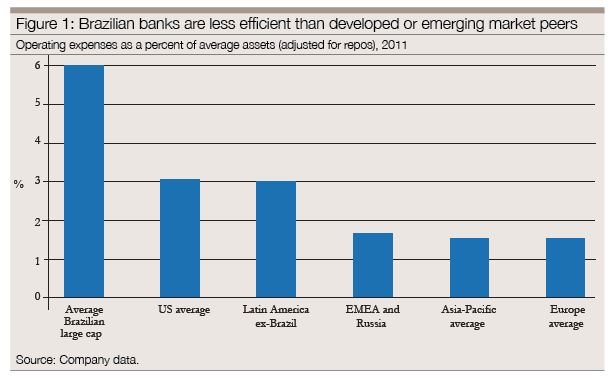 |
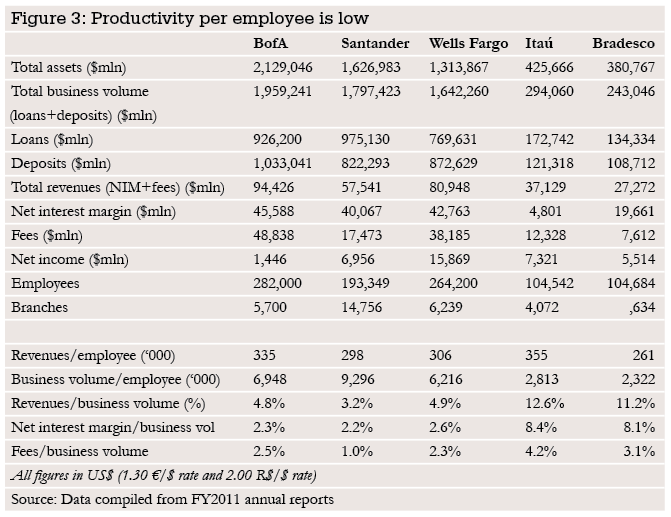
Figure 3 uses data from the 2011 annual reports from leading retail banks in the US, Europe and Brazil. It shows productivity in terms of ratios by employee using volumes to avoid the effect of higher social security costs. Despite having considerably higher net interest margins than leading banks in Europe and the US, volumes per employee are much lower. Revenues/employee for the Brazilian banks is in line with international competitors, with margins of 11%, but the Brazilians suffer from very low volumes of business per employee, demonstrating a big productivity challenge that the Brazilian banks need to grapple with, because as revenues and NIM fall these internal inefficiencies will become exposed and feed into lower return on equity.
 |
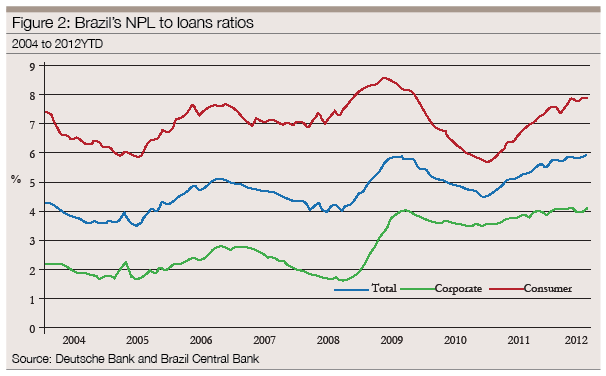
For now, the private banks are sustaining revenues by not passing on the lower interest rates to consumers, pointing to increasing non-performing loans (see Figure 2) as the main reason for not doing so. “The banks argue they can only reduce their prices if the non-performing loans ratio declines,” says Sergio Furio, founder and chief executive of BankFacil, a financial services start-up that helps consumers searching for financial products. “Brazilian banks’ high prices are the result of two effects: firstly, consumers with low price sensitivity and secondly adverse client selection that causes the high NPL rates – for an economy with full employment. With pressure in pricing, banks will need to remake their entire loan portfolios by attracting more educated clients with lower default rates. Just take the Brazilian credit card market as an example: they have been charging over 200% per annum. Consumers getting into this type of financing tend to have almost no access to other credit and, therefore, higher NPL rates. That’s pure adverse selection: your prices are high, so you attract the wrong customer – and it’s the same with nearly all Brazilian retail credit.”
 |
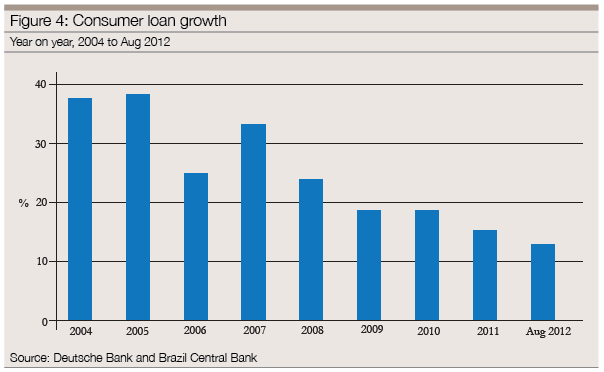
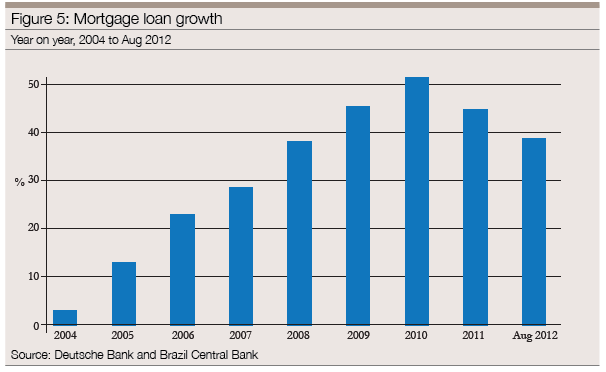
Furio argues that this adverse selection needs to be addressed by the banks in three steps: cutting their acquisition costs, lowering the price of credit and attracting those customers that today are not asking for credit because it is simply not cost-effective. “A lower cost of credit would attract a different customer: clients looking for financial flexibility – as happens in the big economies – that may find lower interest rates economically attractive,” says Furio. “In turn, banks would be better off from a net income perspective because that customer is more financially stable and will have lower default rates when the economy slows down.” Pierry agrees: “Delinquencies are much higher in Brazil than anywhere else but the very high interest rates are almost forcing people to default. Why do they charge these interest rates? Because of all the inefficiencies in the system. And it’s also a problem with the loan composition of the banks. Consumer loans in Brazil are close to 15% of GDP. In Mexico its 5%, so you have a riskier loan mix here. Going forward the growth in Brazil is not going to come from more credit cards or auto loans but from mortgages, loans to SME and infrastructure-related loans that are lower risk [as Figures 4 and 5 illustrate].”
 |
 |
Pierry says that conference calls with banks’ senior managements these days are dominated by questions surrounding the efficiency ratio. The challenge to boost efficiency – primarily by cutting costs in this new lower-interest environment – is not lost on the banks. Bradesco has set a ratio target of 39% by the end of 2014, down from 42.4% at the end of the second quarter of 2012. Itaú wants to achieve a ratio of 41% by the end of 2013. At the beginning of 2010 its efficiency ratio was 49% and by the end of 2011 it was 47.7%. If Bradesco’s stated target is seen as ambitious by many, Itaú’s is even more so. The bank recently reported that it was running behind on its objective, blaming lower-than-expected revenues rather than disappointing cost-cutting results, but its challenge on both sides of the ratio’s equation is huge.
 |
| Luiz Angelotti, executive director at Bradesco |
But it’s the prize on offer from technology that is greatest. Bradesco has been strategically driving its customers to digital platforms and away from face-to-face transactions to boost efficiency. Technology brings efficiency gains only if it is used. At Bradesco, internet transactions now account for half of all transactions. ATMs account for another 30%, with call centres handling 7% and smart phone applications 4%. In-branch personal service now accounts for 9% of all transactions. Of Bradesco’s 26.5 million customers, 25.6 million have used its ATM services; 4.3 million are active users of its internet site, 4.2 million customers have used the bank’s call centres and 1.2 million have transacted by smart phone. Bradesco aims to drive its customer base even further towards automated banking as it seeks its 29% efficiency ratio.
What is measured can be managed. However, none of the other retail banks in Brazil could or would provide Euromoney with data about the growth of use of digital transactions or the penetration of adoption of the new technological platforms by their customers. Itaú Unibanco declined a request for interview or to provide answers to these and other specific questions about its use of technology, but it was the only other bank to respond, albeit in a general way: Itaú provided information about how it had been able to save money through mailing costs and lower the cost of call-centre costs per employee. Its statement reads: “The Efficiency Project, whose focus is on creating indicators that will help us monitor the goals of increasing revenue, reducing costs and saving resources. In addition to its activity in each business area the Efficiency Project is active in corporate packages for the bank’s major expense items such as personnel, operations, IT and telecommunications, materials, cards and checks, call centres and marketing,” and ends with: “Being efficient means: displaying quality; increasing revenue; lowering costs; doing more with less; streamlining processes; having a sense of ownership.”
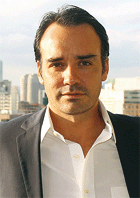 |
| Sergio Furio, founder and chief executive of BankFacil |
Such general aspirations fail to articulate the challenge and the opportunity, according to BankFacil’s Furio, who worked at Boston Consulting Group as a retail banking consultant in the US and Europe before moving to São Paulo to create the online platform. In the first instance, he says banks still have a lot of work to do in technology and operational excellence to move their performance to another level. The first opportunity is to shrink the banks’ front end. Furio says the Brazilian banking branch model needs to be slimmed down. Branches, which typically have between 10 and 15 employees, need to be leaner, with fewer sales personnel and smaller operational centres for transactions that cannot be migrated to digital platforms. “Sales people are all based in branches but they are working on the PCs or on the phone trying to reach customers who are not there,” says Furio. “Entire segments are not going to branches to buy anymore, they want to buy online or over the phone. But the banks still staff for the traditional model, in which the branches are the most important sales centre. Lower prices are going to make it really difficult to justify the expensive branch model, with premium locations and tens of people.”
However, that would mean dismantling the bank’s model that rests on branches being the individuals that make the whole. Centralizing processes would mean migrating oversight from individual branch managers and Angelotti says this is inconceivable. “In Brazil we have a strong culture that only the manager is responsible for opening accounts – they need to analyse and understand their customers if they are going to avoid problems in the future. And so the sales forces are also attached to the branches – as are the people who drive customers on to the digital platforms. The responsibility for the improvement of all these metrics is a target for the individual branch. The managers have sales targets for their branch.”
Second, according to Furio, banks should be harnessing more of technology’s potential: “In the traditional banking world they spend huge amounts of money in training staff to be able to do customer segmentation. They ensure they ask the relevant questions, to really understand who these people are. Why? Because by segmenting the clients properly you can better serve their needs, provide them with the right suite of products and therefore be more profitable.
“With a huge proportion of Brazilian banking clients moving online, banks don’t need to train people to ask the relevant questions. They don’t even have to ask questions because they can estimate the answers using behavioural science. At BankFacil we created backbone analytics in order to understand what consumers are looking for so that we can better serve their needs. Each click improves the segmentation algorithm, optimizing the customer experience.
The whole idea is to move the business intelligence online, so that the online customer experience outperforms the branch-based model by not having the random variable of human interaction.” Furio says banks need to harness the wealth of segmentation information and client intelligence that can be obtained through both clients’ usage of the firm’s own website, as well as capturing strong business leads through independent financial platforms.
Aligned to the second point is Furio’s belief that technology can reduce customer acquisition costs. Typically, banks seek new business by marketing initiatives that focus on call centres and hard-copy mailings. According to Furio, the variable cost of acquisition of one new client through these marketing channels can easily be above R$150, with conversion rates typically under 1%. And that’s just variable cost – on top of that you have overhead costs.
“It’s too expensive,” says Furio. “With super-inflated consumer prices you can do this and still be profitable. But with the upcoming reduction of bank revenues there is no way that this acquisition strategy can be profitable. Banks will need to look at potential ways to cut acquisition costs. And to do this you need to rethink the entire selling process. Today, what does a customer do when he wants to buy a financial product? He doesn’t go to a branch. He doesn’t call a bank. He Googles it. Banks should reinvent the acquisition process by understanding how consumers behave when searching for financial products.”
Deutsche Bank’s Pierry concedes that the question about the high acquisition cost of marketing “is a good one” but he hasn’t asked banks’ senior management about costs or strategy in this area. Nor does he know the rates of penetration of digital transactions within the banks’ customer base. However, Pierry is sanguine about the sector’s future, saying that Brazilian banks have lots of opportunity for efficiency gains in their traditional business. “Banco do Brasil told me that the maintenance cost of their 40,000 ATMs is R$1 billion a year,” says Pierry. “They say that in the past no bank was under pressure to share but eventually they will all share ATMs. Another example: cheque clearing in Brazil is done overnight while in any other developed market it is three days. There are lots of inefficiencies that they have never had to tackle and they will. The thing that makes me comfortable is that when you look at banks across Latin America – in Mexico, Chile and Colombia – they are all delivering 20% ROE in a single-digit rate environment. So why shouldn’t the Brazilian banks?”
Pierry says that in the short term banks’ ROE will probably dip to an average of about 17% as revenues come down faster than the banks can react with lower costs or lower provisions. But he is confident that as the second two factors will catch up with the first, ROEs will return above 20%. “Never underestimate the management teams,” he says. “The banks have adapted many times in the past and they are adapting again – they are changing the banks. Mortgages are growing, and when US banks were growing mortgages they were generating ROE of 20%. Mortgages are a great product: they allow you to cross-sell; they have a low delinquency and good collateral. So there will be a natural evolution in the system.”
Whether by Pierry’s natural evolution, or Furio’s technological revolution, Brazil’s lucky few large retail banks seem set to thrive again.