 |
| Return to the 2011 Awards for Excellence index page |
For someone who had no great ambition to enter banking when he was a student, Adel El-Labban has carved out a remarkable career as one of the most effective chief executives of his generation. The leadership he has provided at the helm of some of the Middle East’s most successful banks, whether in Cairo, London or Manama, has been instrumental in raising the bar for banking in the region.
After graduating in economics at the American University in Cairo, El-Labban spent his early years with Arab Banking Corporation in Bahrain. He first appeared on the global radar as vice-president of corporate finance at Morgan Stanley’s investment banking team in New York. His success was picked up back home and he was swiftly brought back to Cairo to become chief executive of Commercial International Bank.
In the early 1990s Egypt was emerging slowly from a series of crises and economic stagnation. The country needed a new generation of financial leaders to restore stability to one of the key markets in the region; El-Labban’s role in Egypt’s return to prominence is one of the great success stories in the developing world.
After restoring profitability to the bank, he spearheaded the banking sector’s much-needed privatization process when CIB offered the public 1.5 million shares owned by its government-run parent, the National Bank of Egypt.
El-Labban says the IPO was spurred by his belief that the bank had to become a financial supermarket if it was to continue to thrive. “The first thing was the vision,” he says. “Then we required capital. NBE couldn’t put more capital in so we had to find other sources.”
 |
|
|
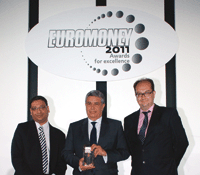
Adel El-Labban receives his award from Clive Horwood (r) and Sudip Roy |
By good fortune, the government was seeking to reform the stock market at the time. But launching the IPO was a far from straightforward process – the authorities had to structure and then implement a framework for stock market listings. CIB finally launched its public share issue in September 1993. In the transaction NBE reduced its stake to 43%, while CIB and NBE employees became the owners of 16% of the bank’s capital in a parallel employee ownership plan. The remaining 41% was sold to the Egyptian and Middle Eastern public, as well as to the International Finance Corporation, the private-sector arm of the World Bank.
“The deal launched the Egyptian equity market,” says El-Labban. “I am extremely proud of it.”
CIB then became the first Egyptian institution to be listed and traded internationally, when half the remaining stake held by NBE was floated as global depositary receipts on the London Stock Exchange in 1996. “On the day the GDRs were listed I had a great feeling,” says El-Labban. “It was a sign that Egypt was back.”
A solid platform enabled El-Labban to expand the bank and form an investment banking arm, an international brokerage house and asset management and private banking divisions; a model familiar to banks in the region today.
He left the bank in 1999 after nearly a decade at the helm. What remains is an institution that is still in excellent shape today. For El-Labban, the future had a different challenge.
From his key role rebuilding a sector in crisis in Egypt, his task was now to build something new. He joined United Bank of Kuwait with the simple remit of creating a truly regional bank in the Middle East. Not an easy task at an institution that at the time had big ideas for expansion but was struggling to deliver.
His vision was to achieve this through mergers and acquisitions, a strategy he called ‘connecting for growth’. One of his first steps was to unite UBK with Al-Ahli Commercial Bank in Bahrain, creating Ahli United Bank and establishing its new headquarters in Manama, where the regulatory framework would go hand in hand with this acquisition strategy.
Further acquisitions followed in Kuwait, Qatar, Iraq and Egypt as AUB began to develop a regional framework from which to serve its existing clients while targeting newer and bigger clients who wanted a bank that could serve their cross-border needs throughout the region. Ahli United has also successfully introduced organic growth to build one of the few truly regional banks in the Middle East and North Africa. “We started the regional trend,” says El-Labban.
He adds: “We can service clients across a multiplicity of markets; and we’ve chosen markets where there is tremendous cross-border business.”
The bank has a presence in four out of the six Gulf Cooperation Council countries, together with Egypt, Iraq, Libya and the UK. In its core markets it seeks a 10% share of clients’ liabilities, which it believes is the best proxy for profits. The strategy now is to buy, if possible, in Saudi Arabia, Iran and the UAE. Ahli United also hopes to establish a Swiss operation to expand its private banking business.