 |
| Transparency key to success |
| Overall results |
| Methodology |
UNDERSTANDING CUSTOMERS AND transparency is fundamental to successful management in the Middle East. Companies that scored the highest in Euromoney’s recent survey of the best-managed firms in the Middle East were not just the traditionally successful oil companies. Indeed, understanding the regional market during a period of great political change has been essential to success in the Middle East within all sectors.
Sabic, the most profitable industrial conglomerate and winner in the oil and natural gas section of the survey, is one such example here.
“From its inception, the company was always driven by a huge commitment to its customers and to serving their needs,” says Mutlaq Al-Morished, CFO of Sabic. “Through a deep understanding of our customers’ commercial ambitions, we apply our technical expertise to tailor material solutions that power their competitive advantage for the long run.”
Almarai, the region’s premier supplier of dairy and juice products, is another example, having come out on top as one of the Middle East’s best-managed companies in the survey.
|
“Although large global multinationals do compete and have a presence in the region, we are closer to our consumers in understanding their needs and catering for their requirements” |
|
|

“Although large global multinationals do compete and have a presence in the region, we are closer to our consumers in understanding their needs and catering for their requirements,” says Georges Schorderet, COO at Almarai. Being close to customers requires high levels of transparency for companies in a region not well known for accessibility of information.
Sabic is exceptionally transparent. “Corporate finance provides periodic and accessible updates on Sabic in various forums, including an annual bankers’ day organized by the company,” says Al-Morished. “As well as this, Sabic Capital, which is based in Amsterdam, engages regularly with analysts and its investor base to provide updates on developments within the Sabic group.”
For those who want quick access to information, Sabic’s corporate website has an investor relations section, which presents information and data relevant to financial and operating performance.
The survey revealed that all of the top-performing companies in the Middle East have accessible information on their performance via their websites, and hold frequent events for customers and investors.
“Being a public and rated company, Emaar [the Middle East’s premier property and real estate company] adheres to high standards with respect to financial reporting, corporate governance and updates on operational developments to the market,” says Franck Nowak, a Dubai-based analyst at Moody’s.
Mobily follows a similar model. As the Middle East’s best-managed telecoms company in the survey and a subsidiary of Etihad Etisalat, Mobily is also considered highly accessible to researchers. “Compared with other Saudi companies, Mobily is one of the most transparent,” explains Marise Ananian, a Saudi-based analyst for EFG-Hermes.
The company holds regular presentations for analysts and investors to highlight the company’s progress and development. “I cannot complain about the accessibility of data that I request from them,” says Ananian.
When Aramex floated on the Dubai Financial Market in June 2005, the Middle East’s leading transport and shipping company returned to public markets after three years as a private company, following its buyout from Nasdaq. Connected to its ambition to become an international company is transparency and investor-relations access.
“Indeed, because of this greater exposure, it wouldn’t benefit Aramex to be opaque in its actions,” states Abid Riaz, director of research at EFG-Hermes. As a result of this, Aramex has become an even more accessible company.
Disclosure
But analysts point out that some companies are not as forthcoming as others when it comes to disclosing information. Jarir Marketing, the Middle East’s best-managed stationery and electrical equipment supplier in the survey, was not always forthcoming with the information analysts requested.
Wafaa Baddour, research director for consumers and industrials at EFG-Hermes, highlights: “We run into difficulty when we try to get detailed breakdowns of information such as revenue by product category [for Jarir Marketing].”
But this is the company’s prerogative: what it discloses is its own choice, especially in competitive environments. “Like many other companies in the Gulf, Jarir withholds some information from analysts and researchers,” adds Baddour.
Internal governance was not the only factor affecting the scores of the survey. While political instability, revolution and protest swelled throughout the Middle East, ability to exploit stable markets in the region also affected business performance.
The Arab Spring, with its flood of demonstrations and protests, created a turbulent environment for business in the Middle East. Indeed, the struggle for democracy knocked economic growth in places such as Egypt and Bahrain.
But business continued apace for companies with strong footholds in relative safe havens in the Middle East, for instance in Saudi Arabia and Dubai.
Government initiatives by Saudi officials affected business development and growth in the region. To a large extent, business in Saudi Arabia has been able to offset losses in politically and economically unstable countries in the Middle East.
During the past year, the Saudi government has raised government employees’ salaries and awarded employees with two months’ worth of bonuses on top of that. These policies were copied by many private companies as well. “What followed was increased amounts in consumer spending in Saudi Arabia,” says EFG-Hermes’ Baddour.
As a result, companies such as Jarir Marketing and Aramex with strong footholds in Saudi Arabia have done well during the past year, despite business losses in Egypt and Bahrain.
Jarir Marketing, traditionally known as a stationery supplier for offices and schools, has expanded its product base to provide laptops, smart phones and cameras to fulfil growing demands of consumers in Saudi Arabia.
Aramex was expected to be hit hard by the political unrest in the Middle East, but this was not the case. While trade and tourism turned its back on countries such as Egypt and Libya, Aramex’s key markets in the United Arab Emirates (UAE) and Saudi Arabia remained robust.
“Aramex has a very diverse spread in the MENA region, which means that in regions where the business has been affected, business has thrived,” says EFG-Hermes’ Riaz.
Consequently, company performance was a lot better than expected. “Shares have held up better than many other companies in the region and have stayed flat over the past two to three months,” adds Riaz.
Paul-Louis Gay, Almarai’s newly appointed CFO, says: “Almarai has seen a slowdown in consumption in places such as Bahrain and Egypt.” But despite these drawbacks, the retailer has continued to thrive in Saudi Arabia, where the company is based. “The domestic market is by far our strongest,” he says.
But not all political initiatives to maintain stability in Saudi Arabia have had a positive effect on business in the Kingdom. Specifically, the government’s role in price setting has been one obstacle for business during the past year. This politically driven move was an indirect consequence of the Arab Spring.
One of the main obstacles for Almarai has been the inability to increase the prices of some of its dairy product lines. “This has affected our margin negatively,” says Gay.
“We cannot predict when we will be able to increase our prices again, thus we need to be creative in managing our expenses and procurement costs to offset the increase in the commodity prices.”
Regional expansion
Business innovation and regional expansion were also overarching features that characterized the best-managed companies in the Middle East in the survey.
Almarai’s CFO says one of the company’s main achievements was its “ability to develop our poultry and infant nutrition business while continuing to deliver on our core dairy business”. Almarai has continued to develop its original business in dairy products and juices while introducing new products, such as poultry and infant nutrition. “Almarai doesn’t compromise one of its products for the development of another,” says Gay.
For Almarai’s most recent business venture, the company is collaborating with Mead Johnson Nutrition, and the partnership has launched a range of Almarai and Enfa-branded products available throughout the Kingdom. “But this is only the start,” says Almarai’s COO Schorderet. “We are constructing the region’s first infant formula plant, which will commence commercial production in 2012 and we will expand distribution throughout the Gulf Cooperation Council.”
This collaboration will combine Mead Johnson’s understanding of the paediatric nutrition industry with Almarai’s “deep knowledge of the local market, highest-quality dairy and an extensive distribution network”, says Schorderet.
The joint venture is expected to create a situation benefiting the companies as well as the people and healthcare community in the GCC.
As well as coming out on top in Euromoney’s survey, Almarai has been listed by Credit Suisse among the Great Brands for Tomorrow and by the Financial Times as one of the next global brands. Schorderet attributes this to the company being a “strong, trusted and well-recognized brand”.
But being the next global brand is not Almarai’s concern at the moment. “Almarai’s ambition is to remain a regional leader in food and beverage products,” says Gay. For the new CFO, Almarai is a leader in the GCC, but he wants to further expand in the MENA region, particularly in Iraq.
“Our ambition is not to be a global leader, but to focus on delivering the best-quality products to consumers closer to home,” he adds.
|
|
“Such partnerships exemplify an important element in Sabic’s future strategy: ever closer relationships with key partners, pooling resources, ideas and expertise” |
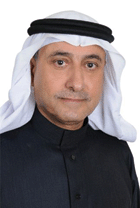
For Sabic, innovation is central to successful business development too. In 2010, Sabic’s Innovative Plastics SBU fulfilled a five-year partnership with one of China’s leading motor manufacturers, as well as working with global leaders to co-develop materials for aircraft interiors. Al-Morished, its CFO, says: “Such partnerships exemplify an important element in Sabic’s future strategy: ever closer relationships with key partners, pooling resources, ideas and expertise to meet common goals more effectively – and swiftly – for mutual benefit.” Sabic considers innovation to be key to successful business development.
Indeed, Sabic’s business aspirations are spelled out in the company’s vision to be the world leader in chemicals. To achieve this, it is committed to “manufacturing excellence, innovative solutions and delivering superior returns to our stakeholders”, says Al-Morished.
Market competition
Meanwhile, key to Jarir’s successful business model was seeing an opportunity in the Middle East that had not been successfully exploited. “At the moment, no other companies in the region offer such a wide product set as Jarir,” says EFG-Hermes’ Baddour.
As a result of a broadening in Jarir’s product portfolio, as well as high consumer spending in Saudi Arabia, earnings growth has been exceptional at 30% in the first nine months of the year.
Moreover, as the company depends on importing products for its business, and there have been no changes in trade regulations and agreements that have affected imports so far, “the company’s growth is relatively safe”, explains Baddour.
But market competition from smaller, more specialist retailers is beginning to grow. “It is the competition that may develop in the medium to long term that could affect market shares,” says Baddour. [As a result], what may be a problem in the long term for Jarir is its ability to maintain its profit margin.”
Mobily also exploited a similar opening in the market in Saudi Arabia. Initially, when the telecoms company was developed, STC and Zain – its two competitors – provided little competition for the company.
“STC was a lazy competitor in comparison to Mobily, and Zain faced myriad problems as a telecoms business,” says EFG-Hermes’ Ananian. “Mobily was able to take advantage of this gap in the market, making it one of the most successful companies in the Middle East.”
Although competition in the telecoms sector is growing, analysts predict continued success for the telecoms company. “For more than four years, Mobily has been outperforming analysts’ estimates in per annum growth,” says Ananian. This is in part due to its exceptional management, its commercial-driven market and its “ability to tap areas of growth that other telecommunication companies have been unable to exploit, data being one of the main examples”.
However, the future growth and development of some high-scoring companies in the survey is not all that certain.
For example, analysts still question the future stability of Emaar’s growth, even though a better performance by the company this year prompted Moody’s rating agency to upgrade it to Ba3 from B1.
“Moody’s recognized three main themes that prompted the upgrade,” explains Nowak at Moody’s. Firstly, Emaar sustained an improvement in operating and financial performance over 2010 and the first six months of the year, particularly in its recurring-revenue segments that offer “greater visibility in terms of cashflow generation compared with property development activities,” says Nowak. Secondly, Emaar extended its debt maturity profile through multiple refinancing steps. This improved Emaar’s overall liquidity.
But lastly, there does remain a generally high level of execution risk attached to international developments. Emaar has decreased residential projects in Dubai and has increased developments abroad. In countries experiencing political issues, such as Pakistan and Egypt, there is a lack of track record in delivery and collecting return. “[However], improved liquidity provides some cushion against that risk,” explains Nowak.
Despite the problems it may face, Emaar will continue to develop beyond the UAE, but its scope will be focused in MENA.
Successful businesses in the Middle East wish to understand specific needs of regional customers. As well as this, customers and investors in the Middle East want regional companies to offer a transparent service. The successful combination of these factors characterize the best-managed companies in the Middle East.
Indeed, smart regulation across the region, and a clear and transparent legal framework will have positive repercussions for business in the Middle East. As Sabic’s Al-Morished concludes: “When it comes down to stimulating business growth across the region, having a transparent framework is very important.”