 |
| Competitive choice for those who think differently |
| Overall results |
| Sectoral results |
| Methodology |
WITH MARKET UNCERTAINTY on the increase in Europe and the US, many investors are looking to other markets. And while the Arab Spring has made investors edgy, to rule out the Middle East because of recent events risks ignoring the opportunities the region presents. “Things are looking good in the Middle East,” says Wael Ziada, head of research at EFG-Hermes – the investment bank that took top place in Euromoney’s Best Middle East research house survey. “Europe has austerity, China has inflationary pressure and other emerging markets are far more dependent on the commodity cycle than the region.”
With political turmoil plunging several countries in the region into chaos, and economic problems troubling the oil-importing countries of the West, one might be surprised at such a positive evaluation of the Middle East.
However, experts dealing with the region are confident it offers opportunities to investors. Some of the countries in the region are relatively free from the economic turmoil that has afflicted Europe and the US, and some of the issues associated with emerging markets.
“It’s all relative,” explains Farouk Miah, head of equities research at National Commercial Bank – which took second place in the research house survey, topping the tables for research in the consumer goods, cement and agriculture sectors. “The financial situation is very strong in comparison to other areas.”
At a time when austerity is a buzzword in Europe, many of the Middle Eastern states are seeing government spending rise. Saudi Arabia and Qatar, in particular, have boosted government spending, with wage increases for state employees and increased infrastructure spending.
|
“More money is being funnelled into local investment, which will help improve infrastructure development and economic growth in coming years, and will create employment opportunities” Faisal Hasan, Global Investment House |
|
|
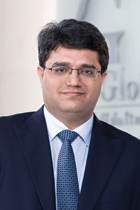
“More money is being funnelled into local investment, which will help improve infrastructure development and economic growth in coming years, and will create employment opportunities,” says Faisal Hasan, head of research at Global Investment House, which performed strongly in the banking research section of Euromoney’s survey. Strong oil prices have given the governments of the oil-rich nations in the Gulf Cooperation Council (GCC) the ability to expand their spending. This should lead to increased employment levels – and increased consumer spending – along with infrastructure improvements that are likely to improve the ease of doing business.
“High oil prices give the government added comfort when injecting cash into the economy,” says Raj Sinha, head of Mena equity research at HSBC. The global bank’s research in petrochemicals and economics gave it top position in those sections of the survey.
Cyclical nature
Traditionally, when an investor thinks about the attractive sectors in the Middle East, the mind turns to petrochemicals.
“There are a lot of upcoming projects in petrochemicals,” says Hasan. “And the operating margins of the Middle Eastern companies are more favourable than those of their international peers.”
However, there are concerns that, with economic downturns prominent in Europe and the US, oil prices will crash and take petrochemicals with them.
In 2008, oil prices slumped dramatically in response to the financial crisis, and this could happen again if the eurozone crisis deepens. While oil is trading high at the moment – partially in response to the revolutions in Egypt and Libya – it previously peaked just four months before its late-2008 trough.
“Petrochemicals might come under pressure in the coming year due to its cyclical nature and concerns on the global economy,” concedes Miah. “Maybe the next year is for the banking sector.”
Indeed, although the banking sector was hit hard in 2008, it has bounced back in the intervening years. “We’re seeing a slow recovery in the credit environment,” says Ziada. “It’s nowhere near its 2006/07 high, but it’s getting better. Qatar’s financial sector never saw the same slump that other countries’ did, and Saudi Arabia and Kuwait are both doing well. Even Egypt’s banking sector has been resilient.”
But investor confidence might be slow to return to a sector that was ravaged in the financial crisis – and the banks might have to work hard to earn back some of that trust.
“Investors are still sceptical about many banks’ asset quality,” says Hasan. “They’re afraid there are skeletons in the account books, and that the banks are going to need more provisioning. However, many banks are showing good growth, are well capitalized and are undervalued.”
The Arab Spring will affect investor confidence and financial performance, particularly in the countries that have undergone large-scale political unrest or full-scale revolutions.
While several countries in the region have been racked by political and economic instability due to the Arab Spring, the nations in the GCC, with the notable exception of Bahrain, have demonstrated stability. The GCC acts as a safe haven within the region, offering the stability investors crave, while increased spending has had the effect of reducing popular discontent within the Gulf states.
Positive effect
Also, while, for example, Egypt might have been a poor choice for investment recently (the EGX 20 has dropped by more than 40% in the past year) the liberalization and reform that the revolutionary movements hope to bring might have a positive effect on investment prospects in the country in the near future.
“Egypt will benefit in the long run,” says Ziada. “The weak liquidity on the exchange suggests the market has bottomed out, so things are unlikely to get much worse. The country has fantastic demographics and the changing landscape offers many opportunities.”
In the short term, though, Egypt’s stability looks shaky – a fact acknowledged by Standard & Poor’s on October 18, downgrading Egypt’s credit rating to BB-. The ratings agency rationalized that increased risks to macroeconomic stability stemming from the transitional period warranted the downgrade, but predicted improvement during the next two years.
Prospective investors should note that dividends are a far more common feature of Middle Eastern equities than in some areas of the world. They are common both in the Gulf and in the rest of the region, but for different reasons. “The widespread nature of dividends means the Middle East and North Africa add a more defensive element to a portfolio than other regions,” says Ziada.
Shares in the GCC area are trading below traditional expectations. The GCC 200 index stands at around 55, compared with heights of around 105 in January 2008. Some experts are hopeful of a return to previous highs, suggesting that the lower-than-average prices are mainly a symptom of investor concern rather than any tangible problems with corporates in the region.
“The GCC markets have historically traded at a premium to other emerging markets,” says Hasan. “Now it is at a discount. This means there is good potential, as the discount is driven by sentiment and not fundamentals. When investor confidence is back, we will see trading activity rise, as investors will take new positions and we expect the market will improve.”
However, there is concern that share prices might not return to their previous levels – and even if they do, there is no guarantee that the move upwards will happen quickly. “Valuations are good,” says Miah. “It’s sentiment that is stopping the stocks from moving. However, it’s going to take several months and positive global news before we see a real improvement.”
And it will take a big change in investor opinion before such resurgence occurs. “While intrinsic values of many companies offer attractive upsides, investors may shy away from these opportunities in the wake of uncertainty that persists,” says Hasan.
Spending glut
Analysts agree that several sectors stand to benefit from the glut of government spending in the region in the past few months.
With government spending on the rise in many states, experts believe investors would be wise to target industries likely to benefit from this enhanced input.
The construction and real estate industries can expect to benefit from expanded social housing programmes in Saudi Arabia, and given that these industries almost exclusively target the domestic markets, they are unlikely to be hit hard by economic downturns in developed economies. “There aren’t many markets where the cement industry has a 90%-plus utilization rate,” notes Sinha.
Telecommunications, in particular, seems to have the attention of regional experts. Broadband take-up his high in the region, and firms involved in its roll out are likely to make a good profit.
“Telecommunications is a high-margin market, and broadband is the next big growth area,” says Hasan.
Telecommunications is also one of several sectors that looks to benefit from the strong demographics seen in several countries in the Middle East, most notably Saudi Arabia. Arab countries, particularly in the Gulf, have a tendency towards youthful populations with a relatively high GDP – prime demographics for the telecoms sector.
That also leads to nice predictions for the consumer retail sector. The prevalence of young adults with disposable incomes suggests good growth prospects for the sector – particularly luxury goods such as electronics. Young Saudis are notoriously keen to pick up the latest gadgets. “Companies dealing in electronics can rely on the high-income bases and young demographics in Saudi Arabia to support demand growth,” says Miah.
The uniting theme of most of these promising sectors seems to be that they are targeting the domestic markets rather than the international scene – telecoms, construction, real estate and retail all rely on local consumers. The Middle East’s main extra-regional dealings are in oil, so petrochemicals have a mixed outlook.
Saudi Arabia boasts a particularly strong domestic market. “There aren’t many emerging markets with a strong domestic retail base,” says Sinha. “It’s a very liquid market and, while access for foreign investors may not be great, that will hopefully improve.”
It seems experts in the area are concerned about economic downturns in the developed economies, and think the smart picks are in those sectors that will be unaffected by a deepening eurozone crisis.