In August, Federal Reserve chairman Ben Bernanke disappointed markets when he declined to launch a new round of monetary easing to support the global economy, which is showing signs of stalling.
US growth has returned to what I have called the long grind, meaning a sub-2.5% pace. There are two drivers: fiscal contraction and deleveraging in the private sector to compensate for excessive leverage in the public sector. Fiscal and monetary splurges used to offset the aftermath of the credit crisis produce unsustainable increases in public debt and central bank balance sheets. But they do not produce sustainable increases in GDP to pay them off.
The US is not alone. The eurozone has also failed to recognize the nature of its own crisis. First, liquidity is still seen as the cause of the euro debt crisis when it’s all about solvency. So the Greeks’ debt burden has not been reduced, except by a token amount. Second, there is a political denial that the geographical reach of the crisis will eventually include Italy and Spain. And this is the battlefield where the fate of the euro will be decided.
|
Getting on the radar |
|
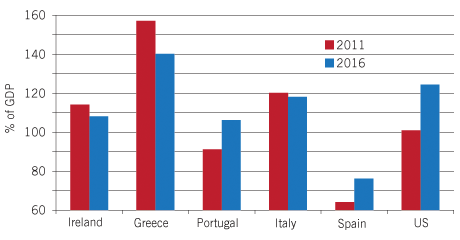
Gross government debt projections |
 |
|
Source: IMF, Independent Strategy |
Finally, it is not yet accepted by Europe’s politicians that the euro requires fiscal integration or there will no longer be a euro. This denial is evidenced by the failure to raise the agreed size of Europe’s emergency funding mechanism, the EFSF. It remains woefully inadequate to provide a dissuasive buffer for Italy or Spain against bond speculators. The US debt deal did not confront the issues it should have dealt with. The cuts in spending are too small and their implementation is too tardy to stop debt rising and breaching the limit of US debt sustainability. Without further measures, US gross sovereign debt as a percentage of annual output will by 2016 be higher than that of Italy and by 2018 that of Greece.
So the US has now appeared on the radar screen of sovereign debt crises. Its failure to deal with its debt crisis adds to the general discredit of its political class. US creditworthiness and hence the role of the dollar as the global reserve currency has been so tainted by the fragility of its governance that the crisis and its solution have been brought into stark relief. This devaluation in the perception of the US will not go away.
The world economy, instead of tiptoeing gingerly through an ephemeral soft patch, is converging into a long-slog growth path dictated by continuing deleveraging in both private and public sectors.
There has been no global deleveraging since the credit crisis. The increase in global public debt has outweighed the decrease in private debt. In the US, since 2007, the decrease in household debt is worth 3% of GDP but the increase in public debt is equal to 35% of GDP. US households won’t start leveraging up and spending again, despite debt service burdens being back to low levels, because they know they will now have to pay down government debt in addition to their own.
So Bernanke needs to ride to the rescue of a very weak economy within a few quarters at most. The implication of Fed monetization of public debt is that the US cannot have a classic sovereign debt crisis (yet), at least not one like Greece, driven by yields. But it can have a currency crisis. Confidence in dollar assets is the one thing the Fed cannot fix.
The US is not alone in its sovereign debt travails and holds no monopoly of denial. In Europe, the debt crisis is still not recognized as one of solvency. This is true because Greek sovereign debt was not meaningfully reduced in the recent bailout package. Second, the geographic reach of the euro debt crisis was not dealt with. This is shown by the failure to commit to expanding the size of the emergency financing mechanism, the EFSF, to at least €1.5 trillion to defend Italy and Spain. Third, fiscal integration was not seen as vital to the euro.
So we are now in a real battle for the survival of the euro in its present form. Creating the funds to defend Spain and Italy will be a de facto big step towards eurozone fiscal integration. This is the missing link in the euro’s architecture. Fill the fiscal gap and the euro will survive. Don’t and it won’t.
David Roche is president of Independent Strategy Ltd, a London-based research firm. www.instrategy.com



