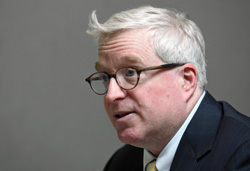
CHIEF INVESTMENT OFFICERS of sovereign wealth funds are, by definition, a rare breed. Despite the $3 trillion to $4 trillion of global capital they manage between them, there are only about 40 such funds. Scott Kalb is something even rarer: a CIO who is not a national of the fund’s country. Kalb works at one of the newest sovereign funds, the Korea Investment Corporation, which was founded in July 2005 and only started putting money to work in November 2006. Kalb was not there at the start – he replaced Guan Ong, another non-Korean, as CIO in April 2009. Nevertheless he has been instrumental in shaping one of the sovereign funds that is most animatedly discussed by the fund managers that pitch them for business.
KIC is one of a cluster of sovereign funds that come with a somewhat nebulous mandate. Unlike the sovereign funds of Abu Dhabi, Kuwait, Qatar or Norway, it does not have to invest the proceeds of a depleting single commodity asset such as oil and gas. Unlike the Government of Singapore Investment Corporation, it does not have overall responsibility for a country’s foreign exchange assets. Unlike Australia’s Future Fund, it does not set out to meet a clearly defined need such as an unfunded pension liability.
Instead, like fellow newcomer the China Investment Corporation, it has no liabilities and no obvious mandate, bar protecting and generating a return on sovereign wealth for some as yet unspecified future need. “We don’t have a liability stream, so our job is to protect and grow this capital for the benefit of future generations in Korea,” Kalb says in Seoul. “They haven’t yet defined how this money is going to be spent – we hope it will be spent on positive social infrastructure or other things that will benefit the people – but in the meantime our job is to protect it and grow it.”
Trying to compare sovereign wealth funds, with their wide range of mandates and attitudes, is “like a blind man trying to describe an elephant by touching it,” Kalb says, and the constituency of sovereign funds without liabilities is a small subset of the sovereign wealth world. The lack of that liability stream ought to mean a greater freedom in investment approach. Since his arrival Kalb has been trying to develop an investment policy that takes advantage of that. “When I first came here we were 100% in publicly traded fixed income and equity – 70% of it in fixed income,” he says. He and his team then moved that to 50-50, then in June 2009 introduced an alternative investment programme, which meant investing as a limited partner in private equity, hedge funds and real estate. Next came commodities and inflation-linked bonds, then strategic investment.
“The first thing you’ve got to do if you want to create a bulletproof portfolio is to diversify,” Kalb says. “You want uncorrelated return streams. And if you are a sovereign wealth fund without a liability stream, one of your biggest advantages is a long-term investment horizon.”
 |
|
“Being a long-term investor doesn’t mean you can be a blind investor, but it is a great tool to have in the toolbox and it can help free an asset allocator to look for and collect attractive risk premiums” Scott Kalb, KIC |
But that doesn’t fix all your problems. “Being a long-term investor is no magic bullet,” he continues. “Just because you can invest for the long term doesn’t mean you are always going to make money: if you invested at the top of the market in 2007, even though you are a long-term investor, you may never get your money back. Being a long-term investor doesn’t mean you can be a blind investor, but it is a great tool to have in the toolbox and it can help free an asset allocator to look for and collect attractive risk premiums.” Carrying this out has meant a steadily increasing exposure to alternative assets, and this is the reason KIC is being so excitedly talked about in asset management circles despite total assets (about $37 billion at the end of 2010) that are modest by sovereign wealth fund standards. When last disclosed in the 2009 annual report, alternatives occupied just under 7% of the portfolio; today, in terms of committed capital, they are a little over 10% (although the precise figure won’t be disclosed until the 2010 annual report appears). And Kalb isn’t finished there: he thinks 20% is a logical ceiling. “Attractive risk premiums arise in areas that are beaten up, where there is mispricing, or a lack of investors or liquidity; often they are things that may take some time to work,” he says.
Similarly, KIC launched a strategic investment programme last June, allowing it to take direct stakes in companies, notably Chesapeake Energy. Again, full-year returns won’t be clear for a while but Kalb is clearly pleased so far. “Normally when you do alternative and strategic investment there’s a J-curve effect: it takes a while to see your performance, and your costs are front-loaded. But we’re ahead in all of our alternative and strategic programmes, and it’s all making money even on a short-term basis. That helps in expanding those businesses.”
It’s useful to be able to demonstrate good news, because although Kalb has the benefit of working without the hindrance of liabilities, he faces some distinct challenges.
Contrasting views
One challenge is the fact that the KIC is funded by two separate sponsors: the Bank of Korea, Korea’s central bank; and the strategy and finance ministry. Most of the initial funding came from Bank of Korea; the finance ministry has provided most of the subsequent funds in blocks of $2 billion or $3 billion apiece in the meantime. This year, there will probably be about $8 billion more in contributions, this time split between the two sponsors.
This would be fine if the two brought the same attitude to risk and investment, but they don’t. The central bank is naturally conservative, the ministry more inclined to take risk for returns. Some say the discussions over how these interests should be represented in the portfolio can get heated.
For his part, Kalb says: “As you’d expect, the money you manage for the central bank is more conservatively managed because that’s their job. We try, within their frame of reference, to be a little creative and to deliver returns for them. The ministry is a bit more flexible in their capital and a bit more risk-oriented, which makes sense: it can afford to be more strategic and have a longer vision, which gives us much more flexibility.”
He says, though, that positive returns so far have led the central bank to gain comfort in KIC’s approaches: “We’re an important conduit for them to invest capital in areas other than treasuries and fixed income. They can take the money they don’t need for policy purposes, and are comfortable allocating and placing it with us.” In this context the likely commitment of Bank of Korea funds this year – the first new allocation since the original $17 billion funding – is substantial.
Asked if it’s possible to keep both sponsors consistently happy, Kalb says: “Nobody’s happy all the time. In a variation of what president Lincoln said, you can keep some people happy some of the time but you can’t keep all people happy all of the time.” He says KIC reports to its sponsors on a segregated basis and “in terms of managing these disparate interests, that’s our job”. The big areas of overlap in the portfolio are managed collectively or on a pari passu basis.
Another, related, challenge is that Kalb works in one of the few big sovereign wealth funds that exists in a vibrant democracy with a lively parliament. If we accept that Singapore – which is nominally a democracy but one that could hardly be called vibrant – is a separate case, then out of the biggest funds only Norway and Kuwait (which has a vigour of parliamentary debate that surprises outsiders) are structured for direct public scrutiny of their behaviour. Norway’s vast sovereign fund is a case in point: after almost flawless returns for decades, the fund had one bad year and faced a parliamentary inquiry. Similarly KIC has undergone investigations and public fury over its $2 billion investment (before Kalb’s time) in Merrill Lynch, still heavily underwater today.
“This is a very important part of the democratic process,” says Kalb. “People have a right to know how their money is being invested, what it’s doing and what the thought process is behind it. I believe in it, the institution believes in it and we want to support it: it’s good for transparency.”
He says the only disadvantage is getting caught in “the political winds that may be blowing”, not in terms of specific investments – which nobody has the legal right to force KIC to make – but in such things as new hires and salary ranges. “That’s part of my job, to help the organization become much more like a global private asset management company, even though it is 100% government owned.” The Merrill investment, he says, “remains a thorny issue… but it’s history. I came here to manage the portfolio on a forward-looking basis. You can’t manage money from a position of regret.”
Hedge fund background
|
“Kalb’s view is that they will use the BOK money as beta exposure, and offset that with high alpha using the MOF money” |
Kalb was an interesting selection in a country that tends to be hands-on with its state vehicles, especially given this level of public scrutiny. Quite apart from being a US citizen, Kalb has a background steeped in hedge funds: he was principal and chief executive of Black Arrow Capital Management and a senior equity portfolio manager at Tudor Investment, as well as having worked at places including Citigroup and Drexel Burnham Lambert. It’s not quite as out there as it seems: Kalb spent much of the 1980s in Korea and three years working for the government’s economic planning board, subsequently merged into the finance ministry. He speaks Korean and considers the country “a second home”. But nevertheless it was a bold appointment. “It’s to their credit that they are willing to bring in an outsider to this kind of key position,” he says. “There are many foreigners working in lots of the sovereign wealth funds, but I don’t know any that are in this kind of position; that speaks volumes about Korea’s intentions to put best practices in place, to adhere to global standards and to be willing to tolerate some potential discomfort to achieve those objectives.”
Foreign fund managers talk effusively about the KIC, far more so than they do about the country’s National Pension Service, despite the fact that the NPS has a vastly greater pool of assets to target. “KIC are ones to watch,” says one.
“When they were first announced, they were the institution everybody had to work with, even though in the grand scheme of things they are still pretty small,” says another.
There is a lot of chat about the relationship between the two sponsors and the impact that this has on the fund’s overall mandate.
“Kalb’s view is that they will use the BOK money as beta exposure, and offset that with high alpha using the MOF money,” says another fund manager. And there is just as much chat about the manager being particularly tight on fees. But people want to be involved with the fund.
“Kalb says he wants managers to visit him only if they have a true sustainable alpha capability,” says one manager. “He is not willing to pay for beta generation.” Another echoes the point. “When you approach them they are very clear: they will not set an appointment unless you have a clear alpha-generating capability.”
And they’re right. Kalb hates paying for beta, and so the sophistication he has brought to the place comes with disadvantages for external fund managers. Between 2008 and 2009 the proportion of funds that were outsourced to external managers fell from 60% to 35%. Kalb says it’s likely to stay around that level.
Kalb is a believer in what he calls “beta architecture”. When you manage a portfolio with a 5% real return target, he says, 3.5 to four points of the return are likely to come from beta, just one to 1.5 from alpha. “Alpha is very elusive and it’s a zero-sum game; beta is what you get in the market,” he says.
Initially, a lot of that passive beta exposure was outsourced, but as the KIC has built ability in different asset classes it has brought that exposure back in-house. “There is no reason to pay for enhanced or passive fund management if we can do that ourselves, and we can,” he says. “When you give a passive mandate out, you’re throwing in the towel on any kind of alpha. You’re saying: ‘I give up, I just want the beta’. You wind up getting the beta minus cost.
“So the idea for externals is that we want guys that can really deliver, I want to focus my risk budget on guys who can give me alpha, not just market returns.”
Other changes are under way at KIC: one example is an increased benchmark emphasis on emerging markets so as to better reflect their contribution to the world economy rather than world capital markets. “If you don’t make that adjustment, you will constantly be behind the trend, trying to catch up,” says Kalb. Another is increased exposure to credit. But in particular Kalb is seeking to change the way asset allocation is thought of, a discussion that starts with risk tolerance.
“Benchmarks are very useful in terms of monitoring performance and controlling your direction,” he says. “They are very poor in terms of risk control. The assumption is that your risk-free position is to be neutral to the benchmark. In real terms that’s not risk-free at all, it means you have 100% benchmark risk, and we all learned in 2008 what can happen when you do that.”
He adds: “It’s risk-adjusted returns, that’s the name of the game, and the object is to sit down and have that risk discussion first. Then we can design a portfolio that makes sense.”
Asked if he feels that’s where KIC is up to today, he speaks of dialogue and progress, but his emphasis is on a work in progress – for everyone in the enterprise, from sponsors to management to himself.
“We’re continuously adjusting as we go along,” he says. “It’s all a growing experience.”