 |
||
| Results index | ||
| Buy side excited by multiple choice | HSBC raises its game | |
| Banks take fight to the algo traders | Methodology | |
AS THE RESULTS of this year’s Euromoney foreign exchange survey show, market share is broadening out among the top-six FX banks. Last year’s leading banks, Deutsche Bank, UBS and Barclays Capital, have all had their market share eroded by a chasing pack of three: Citi, JPMorgan and HSBC. This has occurred amid the increasing use of electronic trade execution, which is up almost 25% year on year. That suggests that the latter three banks are delivering on their promise by rolling out new improved electronic execution platforms to match the market leaders: Deutsche’s Autobahn and Barx from Barclays.
But this is just part of the story. First, not all of the top-six banks have delivered their new platforms to customers. And these customers are more and more proclaiming a preference for dealing on multi-dealer platforms (MDPs). Single-dealer platform volume still outstrips MDPs, but there is a regulatory change occurring where MDPs
seem to be the preferred model for execution because they are more likely to qualify as swap execution facilities (SEFs). This year’s survey indicates that the multi-dealer platforms are gaining support, and banks are improving their price provision to them to suit client demands. It has led to better liquidity and competitive pricing.
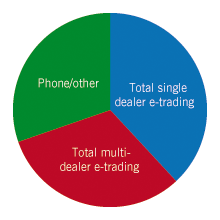
| How corporates traded FX last year | |
| 2010 non-financial corporate FX trading by execution method | |
 |
|
| Source: EuromoneyFX MarketData |
“You can’t really get better pricing than multi-dealer platforms,” says Mark Hewlett, London-based partner at Anello Asset Management. “I’ve sat down with plenty of banks that say, ‘We can give you a better fill,’ but I’ve yet to find one who can deliver.” Nonetheless, Hewlett adds that there are pitfalls with the MDP model. There is no phone broking for instance, so price slippage can occur. Nonetheless, that isn’t really a problem during busy US sessions and peak times, he says. Other buy-side participants who spoke to Euromoney say most platforms are now pricing out to five decimal places. According to Dave Sellers, head of sales at Hotspot FX in London, the increasing provision of pricing into MDPs is now broad based. “Banks weren’t always plugged into all the MDPs, they were maybe put into two or three, but now they’re plugged into four, five, six,” he says. “That now gives them other avenues for them to enter and exit trades.”
For some banks, increasing price provision has been a tactical move – as they seek to upgrade existing platforms – to compete with the top platforms on the street (see Euromoney FX survey 2011: HSBC raises its game), while also using it to tap into a new source of liquidity. “The practical reality is that it’s much quicker and easier to hook up lots of clients via the multi-dealer platform than it is to get them to move from one single-dealer site to another single-dealer site,” says Chris Leuschke, global head of FX sales at Royal Bank of Scotland. “It’s about the client; usually we’ll join when a client calls us and says, for instance: ‘Why aren’t you guys supplying volume on Hotspot to us’. So when a client asks us, we’ll do our best to oblige.”
That isn’t the case with all banks though, say buy-side participants. “Some banks will just say: ‘No, if you want our volume you’ll have to link up to our platform’,” one fund manager tells Euromoney.
While RBS has fallen two places to seventh in this year’s poll, its overall market share is little changed, although it has jumped from 10th place to fifth place in terms of electronic market share, after doubling its electronic volumes over the past year. Tim Carrington, RBS’s global head of FX, says MDPs still have a vital role to play in the market, because on peak volume days MDP peaks are generally higher than on internal platforms. “People want the liquidity, they want to know they can get it, and they want to go somewhere they can source it,” he says.
In March for instance, Barclays Capital briefly stopped quoting yen after the tsunami struck Japan, although the bank says this was simply because of a regular shutdown to service the site. “A multi-dealer isn’t going to do that,” one asset manager says.
While the merits of providing consistent liquidity cannot be overestimated, leading FX providers argue that content and price provision across several asset classes mean that the single-dealer platform can always deliver more. “If I look at the top 200 clients for our FX business, 75% of those deal with BarCap in four other products,’’ says Nick Howard, global head of FX sales at Barclays. “It shows we’re a well-integrated business.”
While MDPs have become a bigger share of the market, up from 7.8% in 2007 to 20% in this year’s survey, single-dealer platform volumes continue to dwarf MDPs because much of the electronic volume is driven by regional and smaller-sized banks. These make up 38% of this year’s volume and have effectively partnered with the larger platforms. Many execute using a new generation of time-splice algorithms that allow them to execute in small sizes all day long. Still it’s a market that the MDPs are looking to benefit from.
FXall, the largest of the MDPs, says it is providing more white-label services to smaller banks, and increasingly single dealers are looking to it to service their clients and source liquidity from them. Hotspot FX, which has more than doubled its market share year on year, has introduced a new service called sponsored bank access, where via two of its larger prime brokers, regional banks in eastern Europe and Asia are able to access Hotspot. “It’s a quick way to make the platform available and the on-boarding process has been streamlined. To date, we’ve brought a few banks on and the program is proving to be highly successful,” says William Goodbody Jr, a director at Hotspot.
 |
|
|
“Algo trading, for the bigger players, is definitely worthwhile – especially on volatile pairings, but if we’re using them, they have to be consistent. Good reporting will tell you what millisecond you got a deal” |
Nonetheless, some large-scale buy siders say that advances in execution technology make the single-dealer platform a preferred venue. “We’re getting increasingly involved in algo trading,” says Paul Downie, head of market execution at Shell. “I think we were among the first corporates to use them.” Price provision will come from one bank’s algorithm and is generally executed on the same bank’s internal platform. Best execution
While large corporates say that algos are a service that banks can best provide, it doesn’t lessen the importance of the MDP. “Currenex remains a key FX dealing tool,” Downie stresses. “We’ve got 20 banks streaming live prices. But you start moving away from that with algos, of course, so we’ll run both in parallel, and assess our dealing strategies to determine which tool is best for different circumstances.” For sophisticated buy-side clients, studying the metrics is all part of a big push to determine best execution, and a way of cutting transaction costs.
“Algo trading, for the bigger players, is definitely worthwhile – especially on volatile pairings, but if we’re using them, they have to be consistent. Good reporting will tell you what millisecond you got a deal,” says Downie.
Cost and processing efficiency is becoming more important for clients from front to back. FXall became the first to offer real-money clients a link to direct settlement for the Swift network which gives them access to that whole network and enables them to confirm trades seamlessly and deal with the exceptions rather than all the deals. “FXall’s been a major result for us, particularly the straight-through-processing side,” says Lee Sanders, Axa Investment Managers’ head of foreign exchange and fixed-income execution. “It lets us process huge volumes with decreased settlement risk. Pricing and execution have been better too.”
FXall retains its top spot for independent trading platforms, while FX Trading on Bloomberg is storming up the league table, to third from sixth, after moving from 10th the previous year. Following last year’s acquisition of LavaFX from Citi, FXall now has a market share approaching 30%. Other buy-side participants say 360T has made big progress in gaining share, although its overall position in fifth is unchanged. Meantime Currenex’s market share has collapsed by more than half. Hotspot FX rises one place to seventh.
While the MDPs have exhibited volume growth in spot markets, and further entrench their buy-side constituency, they are also moving to a sweet spot as market regulation, which will result in mandatory clearing and execution on currency options and non-deliverable forwards, moves closer to implementation. The effects are already visible: NDF volumes for emerging market currencies on FXall were up 120% year on year in the first quarter. Meanwhile, single-dealer platforms are staying one step ahead in emerging currencies. BarCap and Deutsche, this year’s top two, have rolled out full suites of offshore renminbi spot, forward and option products on Barx and Autobahn in recently. Having investment muscle behind you might be enough to give single-dealer platforms an edge – for now.
Some MDPs are now gearing up to become swap execution facilities to provide pricing in NDFs and currency options. It’s set to be a big opportunity, because banks will no longer be able to trade them on their single-dealer platforms or trade with each other. “We tick a lot of the boxes that look like what you’ll need to be a SEF,’’ says Mark Warms, head of FXall in Europe. “We’re one of the few firms with order book functionality, and a request for quote. We’re already doing NDF’s RFQ and so we feel we’re already in a good position to get to market early. On options we’ve known there’s urgency from our clients and the banks that are really looking to us to work with them and solve that problem.”
While the FX market has worked hard to convince regulators that it shouldn’t be regulated, one cannot ignore the rising prominence of multi-dealer platforms, as they proliferate across the financial markets as a result of regulation. It places FX MDPs in an advantageous position. It leads one to ask how long the FX market will remain bifurcated in terms of price provision. “The market may be OK with that, but the consumers, and certainly a subset of the consumers, will want to have a similar experience across the board,” concludes Hotspot’s Goodbody. That may be some time off but the genie is now out of the bottle.