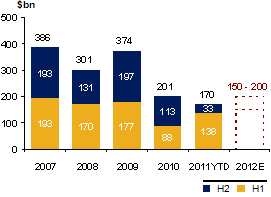
Craig Coben, head of EMEA equity capital markets at Bank of America Merrill Lynch, and Oliver Holbourn, head of equity syndicate, presented the firm’s forecast for the business in 2012 today. The volume charts paint a disappointing pattern. EMEA equity capital markets volume was $301 billion in the first full year of the financial crisis in 2008; it rose to $374 billion in 2009, as banks and corporations repaired balance sheets; volume declined to $210 billion in 2010 and looks on course for barely $180 billion for 2011.
| Historic EMEA equity issuance |
 |
| Source: Dealogic, Bank of America Merrill Lynch |
The short-term trend is even more alarming with just $33 billion raised in the five full months from July to November 2011. Annualize that and the outlook for next year would be a pitiful $80 billion of equity raising volume. The firm projects volume of between $150 and £200 billion next year but that’s just a guess. “In all honesty, no-one has any idea,” says Holbourn. He adds: “It’s hard to see the market for equity issuance recovering until investors see a credible plan for resolving the eurozone’s sovereign issues.”
Equity is a bottom up, stock-picking game. With the equity markets dominated by macro fears related to the eurozone sovereign debt crisis, all financial assets highly correlated, economists sharply cutting growth forecasts and 72% of fund managers that BAML surveys expecting an EU recession in 2012, conditions couldn’t be much worse for raising equity.
|
“At an asset allocation level, almost no-one is devoting more money to European equity. Even if investors do want to buy something, they have to sell something else first” |
|
|

Holbourn points out that, even with institutions heavily underweight European equity and mindful they could miss a sharp rally if eurozone leaders finally come up with a grand plan this week, institutions are long cash and not putting money to work yet. Rather they have hedged themselves by buying out-of-the money call options on liquid indices during periodic relief rallies. The rallies have usually run out of steam. “At an asset allocation level, almost no-one is devoting more money to European equity,” points out Coben. “So even if investors do want to buy something, they have to sell something else first.”
In a slow year for equity raising in 2011, the busiest stock market sector has once again been financial institutions, as it also was in 2010 and as it regularly is. But for how much longer? As of December 2 this year, European bank stocks had lost 32.2% of their value in 2011. “A number of peripheral banks are uninvestable,” says Holbourn. “And don’t forget that the European bank sector ex-UK is now quite small. It has a market cap of just €240 billion and, with the wholesale financing market closed to banks, banks would have to reduce assets by circa €2.8 trillion to get to their loan to deposit ratios down to 100%”.
The question arises therefore: what on earth possessed the firm to underwrite the €7.5 billion rights issue for UniCredit last month when ten-year Italian government bonds were yielding 7.5%. The firm is on the hook for the right issue whose terms won’t be set until mid January, after which there will be a three-week subscription period, followed by an auction of any rights not taken up by existing holders of the stock. It won’t be until mid-to-late February before the firm will know if it is to be the proud owner of a chunk of UniCredit stock. Anything less than a 98% take up will count as a failure.
Last month showed the risks for underwriters when Banca Popolare di Milano’s delayed and reduced €800 million rights issue limped to completion with the share price below the underwriting price, a mere 81.7% take up of the deal, and underwriters left holding a significant block in a small and illiquid stock.
The firm obviously thinks it has made a reasonable bet on UniCredit, a long standing client of BAML’s historically strong FIG franchise, because the Italian bank trades so cheaply on a book value multiple that its overwhelmingly Italian institutional and retail shareholders – most foreign investors sold out months ago – will prefer to stump up cash and support the deal rather than surrender ownership at distressed levels to international investors sniffing a bargain. Presumably the firm has gained some insights into the intentions of core shareholders.
Investors won’t give too much credit before they see delivery to UniCredit’s turnaround plans to deliver a 12% return on tangible equity by 2015. But this is a bank with potentially valuable franchises in emerging Europe and a new CEO who understands the importance of restoring the profitability of the Italian business. It is one of the most systemically significant banks in Europe, with leading positions in Poland, Austria and Germany, as well as Italy.
Every ECM banker and indeed every bank in Europe will be following this deal. Many banks have boldly declared their intention to improve capital ratios by deleveraging. With equity markets closed to them, they can say little else. But unless they intend to sell off good assets – which are the only ones for which there are buyers – retain the bad and go into run off, they will eventually need to raise equity to meet the costs of selling weaker assets.
They are all hoping for a credible outcome from the latest summit to save the euro later this week, an end to the periodic post-rally sell-offs and a successful outcome for UniCredit. “There are probably 15-20 banks in Europe that would like to raise equity, just not at these values,” says Coben. “Many will formalize their plans once they see the outcome of UniCredit. There have been plenty of bigger European equity capital market deals but never one that has been followed so closely or that will be such a significant litmus test.”