|
Real estate: The dragon and the stagnant pond Awaiting resurrection: CMBS It’s all about Asia Real estate survey 2010: Full results Real estate survey 2010: Methodology |
 |
THE CHASM THAT separates the real estate industry’s immediate funding need from the banking sector’s appetite to finance it will haunt commercial real estate markets in the US and European markets for years. Although refinancing is available, deleveraging and conservative underwriting criteria have reduced the amount of senior debt in the system. At this stage, it is not clear when capital availability will return to pre-crisis levels, or if it ever will. Moreover, the market forces that accelerated the last transatlantic CRE recovery and drove spectacular wealth creation for private equity real estate investors up until 2007 are unlikely to be a factor this time around. Despite being better able to absorb CRE write-downs now than they were two years ago, banks continue to frustrate the opportunistic money waiting in the wings.
The basic difference between now and then is that present government support has afforded US, UK and European lenders greater strategic scope in dealing with balance-sheet impairments. After years of loose monetary policy, trillions of dollars in publicly funded asset protection schemes and nationalizations, regulatory concern seems now to have peaked. In the UK, for example, where bank lending to the commercial property sector grew from about 20% of all non-financial corporate lending in 2000 to 40% in mid-2007, the authorities were quick to recognize the urgency of the issue. Eric Adler, chief executive Europe at global real estate investor Prudential Real Estate Investors (PREI) in London, has accepted that history probably won’t repeat itself. “In the late 1990s banks sold off their distressed CRE portfolios at 25 cents on the dollar and saw funds make off with the lion’s share of the reward,” he says. “With a problem as big as it is this time, banks can’t afford to externalize today’s value. We are seeing pragmatism from them this year.”
Main street stagnates
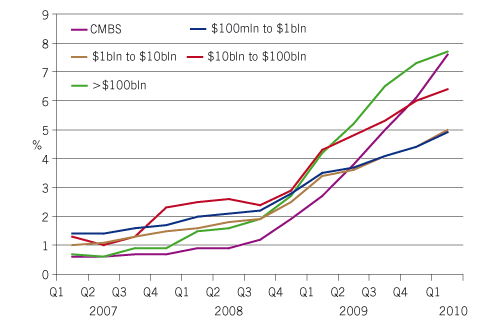
Nowhere is pragmatism at a greater premium than in the US, where CRE exposures have laid low hundreds of regional and community banks, and threaten hundreds more. Data collected by Foresight Analytics show that US banks of all sizes remain heavily exposed to CRE as a proportion of tier 1 capital despite recent capital-raising efforts and asset disposals. Total CRE loan exposure, including loans for construction and land acquisitions, has shrunk by $200 billion from $1.8 trillion in the first quarter of 2009 to $1.6 trillion in the space of a year but still leaves the banking sector with an average exposure of 125% of tier 1 capital. Banks with more than $100 billion of total assets are the least exposed, at 73% of tier 1 capital, while banks with assets from $100 million to $1 billion are most at risk, with 278% of tier 1 capital exposed to CRE.
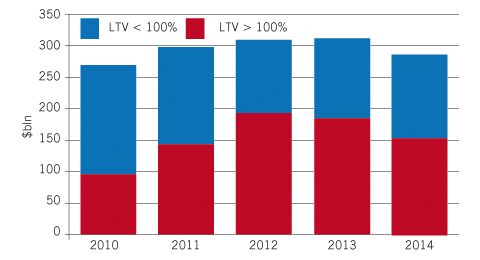
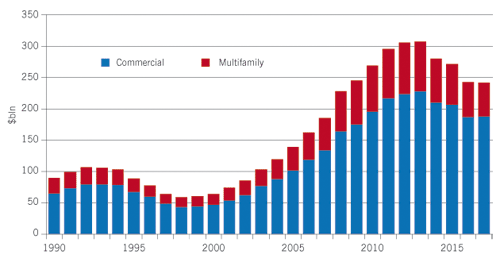
Moreover, US lenders must refinance as much as $1.4 trillion of CRE debt before 2014, including loans that were securitized in CMBS transactions. Some $270 billion expires this year alone, with $300 million due in 2011. The industry-wide practice of quietly modifying problem loans that can’t be refinanced economically is by now well known, and has been adopted by banks globally. US banks are holding on to $186 billion of loans that are currently delinquent or in default. More than half of these are in negative equity. Provisional data for the second quarter show that US banks have extended 60% of the loans due between 2010 and 2012 despite a 5.7% rise in commercial mortgage delinquencies. “One might be tempted to conclude that the market is turning a corner – that would be a mistake,” says Matthew Anderson, managing director at Foresight. “Although loan quality is not deteriorating as fast as it was, it is too early to say that the quality of these assets is improving,”
Overshadowed by this gargantuan restructuring task, the US funding market is now bifurcated into a small lending market and an ever growing restructuring and workout industry. Notwithstanding balance-sheet pressures, a handful of banks, life insurance companies, Reits and equity investors are gradually increasing financing activity across the capital structure, according to the Mortgage Bankers Association, although the overall lending market is a shadow of its former self. Invariably, fresh funding is only available for the highest-quality collateral. Instead, banks, brokers and advisory organizations that were once focused on originating new assets are now mostly preoccupied by restructuring, working out or divesting old ones, a workload that will keep the market busy for the next three to five years at least, according to participants.
The Obama administration has made extensive use of federal funds to patch the wounds. Alongside equity recapitalizations, Tarp and Talf, the Federal Deposit Insurance Corporation’s Structured Sales has become a vital conduit for federal subsidies. The programme provides attractive seller-financing to investors to take whole portfolios off the federal balance sheet in return for a share in any recovery upside. Industry sources suggest that, within the subsidized market, non-performing loans are trading for 30/40 cents on the dollar while performing assets are fetching 60/70 cents.
| Performance Comparison: CMBS and Bank Loans |
| Delinquency rate (30+ days past due) |
 |
| Sources: Trepp, FFIEC, Foresight Analytics |
As the largest buyer of legacy loans from the FDIC’s asset sales programme, Los Angeles-based private equity fund Colony Capital has emerged as an instrumental player in absorbing the inventory of troubled loans from defunct US banks, purchasing some 3,200 loans from the FDIC with a principal balance of more than $3 billion. In its latest acquisition, a $1.85 billion portfolio of 1,660 loans sourced from 22 failed banks, Colony paid $1 billion (59 cents on the dollar) to gain a 40% equity stake. Fifty percent of the initial capital outlay was provided by the FDIC in the form of a seven-year interest-free loan, leaving Colony to find just $200 million from its own pocket for its equity stake.
Paul Fuhrman, a principal at Colony, describes the pricing of the firm’s recent purchases: “We paid 44c and 59c for the last two structured FDIC portfolios we bought. As bottom-up underwriters we aim to understand the fundamental performance of the loans we are buying,” he says. “If we buy a loan at 60c on the dollar and restructure it at 80c/90c then there is significant upside in that transaction for us and the borrower.”
Online success
While the subsidized divestment market ticks over, the private market has been slower to move as larger banks have taken advantage of loose monetary policy and other federal funding programmes to hang on to loan portfolios. Bart Steinfeld, managing director and head of Jones Lang LaSalle’s US investment banking operation, is focused on accelerating this process and has placed some $900 million of low-balance assets this year. He expects sales of a further $600 million before the end of the year.
In addition to private equity buyers, US high-net-worth accounts are emerging as an investor base for troubled CRE assets. JLL is using an online auction platform to source individual buyers for both non-performing loans and foreclosed properties. In May this year, for example, individual investors bought 104 loans with an unpaid principal balance of about $223 million from 12 separate sellers including special servicers, money centre banks, community banks and a high-yield debt investor. The auctions allowed sellers to recoup a recovery rate of approximately 54% of the aggregate unpaid principal loan balances.
Clearly, the NPL prices achieved by JLL’s online auction represent a big premium over those achieved in the FDIC auctions and reported by other wholesale players. Are retail investors likely to pay more to own these assets? Steinfeld acknowledges this dynamic. “We are more successful at achieving premium pricing by selling directly to retail investors,” he says.
The poor performance of debt-based private equity platforms in the US has created an opportunity for real estate investment trusts to become a component of the restructuring effort. Brad Case, chief economist at the New York-based National Association of Real Estate Investment Trusts (Nareit) says that Reits’ access to both equity and debt capital markets throughout the crisis has made them better able to weather the storm. While the bank lending and CMBS markets froze, US Reits have been able to tap both equity and debt investors. In 2009, US Reits raised $21.2 billion from secondary equity offerings, $3 billion from IPOs and $10.4 billion from senior unsecured debt investors. Already in 2010 Reits have issued $9.3 billion of secondary equity and $10.9 billion of unsecured debt, according to data collected by Nareit.
Case says: “There is no question that Reits will be a key provider of financing in the CRE recovery, the only issue is how much capital can it provide? We expect growth to come from acquisitions, but properties are not yet available on the market although debt maturities will trigger this.”
Furthermore, performance data comparing average private equity and Reit returns over the past cycle (17.5 years) suggest that Reit players may be capable of generating better returns than their private equity competitors this time around. Measured over this long time horizon, Reits delivered a compound annual return net of fees and expenses of 13.4%, outperforming the 7.7% achieved by private equity core funds, the 8.6% delivered by value-added funds and the 12.1% returned by opportunity funds.
| A looming negative equity crisis? |
| Underwater mortgages by maturity year |
 |
| Source: Foresight Analytics |
“Property values will soon be at, or close to, the lowest point, especially in the secondary and lower-quality properties,” Case says. “This dynamic will drive increased market share for publicly traded Reits and their stream of earnings is going to grow very strongly, an expectation that investors are already responding to.”
Europe’s smaller problem
As in the US, in Europe imminent expiration dates and a lack of refinancing options are forcing the issue. In the UK bankers estimate the refinancing requirement to be some £120 billion ($185.6 billion) of loans over the next two years, and £300 billion over the next four. CMBS debt accounts for some £50 billion of this volume. With so much of the pre-crisis lending market in deep freeze, is there enough capital in the system to refinance these assets?
The UK government was ahead of the curve in forcing banks to acknowledge the problems with CRE exposure and took action to support these portfolios. As a result UK banks took some of the harshest mark to markets in the world and are now better positioned either to recapitalize or carve out bad assets, or both.
With the exception of a window that opened briefly at the end of 2009 where investors picked up a few small chunks of European CMBS and Reit senior debt at extraordinary discounts, there has been little evidence of a wholesale market in non-performing or distressed CRE loans in the UK. “The distressed story in the UK has yet to play out. There is a significant volume of bank debt that is struggling but actual workouts have been largely symbolic, rather than material,” PREI’s Adler says.
German-led recovery
Although some semblance of normality is returning to the London lending markets, the volume of available capital is far lower than before, with far fewer participants and generally more conservative underwriting standards. “There is a senior lending market in the UK, but it is restricted to prime assets in core urban markets. Where senior debt was previously available up to 85% to 90% LTV at the height of the boom, no bank will provide senior debt above 65% LTV in the current market. We should not expect the debt market to come back to where it was in 2006 for at least a few years,” Adler warns.
In this anaemic landscape, German banks have emerged as the leaders of the European recovery, with working capital driven by access to the Pfandbrief refinancing market. Less than $3 billion-equivalent in the US and Europe contrasts sharply with more than €120 billion of covered bond and Pfandbrief supply so far this year.
|
“The Pfandbrief market has a natural appetite for prime, income-producing, long-leased collateral with generally good covenants” Barry Osilaja, Jones Lang LaSalle |
|
|

Barry Osilaja, a director in Jones Lang LaSalle’s European corporate finance group, highlights the statutory collateral requirements of the German Pfandbrief law which, he says, are aligned with market conditions in the European credit markets. “The Pfandbrief market has a natural appetite for prime, income-producing, long-leased collateral with generally good covenants,” he says. “These lenders are therefore focusing on core asset classes in western Europe with occasional incursions into central and eastern Europe.” Osilaja estimates that a large senior loan secured against prime, core-European collateral at 65% LTV should cost a borrower around swaps plus 170/190 basis points in the current market. Other market sources suggest that the number of banks able to provide loans greater than £100 million on these terms is around four.
With current CRE loan origination capacity in Europe running at about 20% of pre-crunch levels, new sources of cash will be crucial to restructuring the existing debt pile. The cap on leverage in the senior markets has forced borrowers to seek this risk appetite elsewhere. Mezzanine lending should grow the most as assets come up for refinancing, Adler predicts. “After several years of near irrelevance, there may be a real story to play in European mezz,” he says. Despite the launch of many new funds in recent years, there might be only a few players capable of taking advantage of the opportunity. “Funds need to be credible enough to raise money in a hard environment as investors are gun shy of purely financially driven players,” he adds.
Moreover, fund investors are not prepared to wait around indefinitely while banks decide whether or not they want to restructure. The $500 million-equivalent of mezz capital that Adler estimates is available to lend against LTVs in the 60% to 80% range in Europe presently only has a window of three or four months to find suitable investments capable of generating double-digit returns, otherwise it must be returned to investors. “There are many fund sponsors that need to start putting money out but they are hard pressed to find assets. Big players with multiple funds and revenue streams have more flexibility to do that than the mono-funds, but you can’t make deals out of nothing,” he adds.
To the extent that debt alone can’t get the job done, fresh equity will be a big component of any recapitalization or restructuring of the sector. Again, however, there is a cap on the level of available equity capital. JLL calculates there to be some £50 billion-equivalent looking to play in the UK, most of which will be allocated to other sectors. Moreover, the traditionally fickle equity investors could become more flighty in their chase for 20% returns. As names such as MSREF, Whitehall and Fortress divest, Asian and Middle Eastern sovereign wealth funds have moved in to to fill the capital vacuum.
| Crest of the refinancing wave approaches |
| Commercial and multifamily mortgage maturities by year |
 |
| Source: Foresight Analytics |
see also:
Real estate: The dragon and the stagnant pond
Awaiting resurrection: CMBS
It’s all about Asia
Real Estate Poll 2010: Results
Real Estate Poll 2010: Methodology