
The New York-based global head of FX and commodities institutional sales at National Australia Bank (NAB), Jonathan Prince, says there was strong interest in Australasia because of “strong domestic growth, rising yields, a sound and safe banking system, and increasing terms of trade. The region is also seen as a good way of participating in the Asian growth story, in markets that are liquid and well regulated.”
Thanks to the Australian government’s wholesale lending guarantee, Australian banks came through the banking crisis with their balance sheets intact. Both Commonwealth Bank (CBA) and Westpac are now in the global top-20 banks by market capitalization.
Rod Lewis, global head of trading at CBA, can see the strength of the Australian economy since the crisis. Its geographic position makes Australia “more relevant” he says.” Demand for our research, which is largely focused on Australasia and Asia, has grown enormously this year,” he adds.
Asia is now the key market for Australian banks and ANZ’s ambitious growth strategy in Asia has accelerated. Luke Marriott, ANZ’s global head of FX options, tells Euromoney that it is continuing to expand its products and teams: “Our team in Hong Kong has grown from a team of nine people in 2008 to 80 people in 2010. The acquisition of RBS’s Asian assets and the successful integration of this business is already underpinning further growth and penetration within the area.”
|
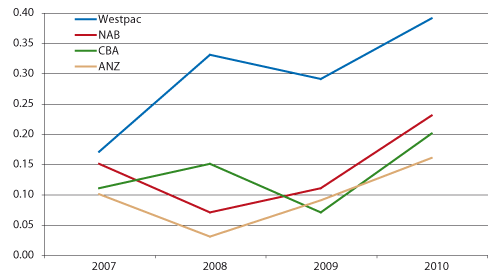
Aussie banks on the rise |
|
Share of overall market, 2007 to 2010 |
 |
Not least among these was the RBS business in Taiwan. “This has extended and transformed our capability to offer the widest range of derivatives products to financial institutions, corporate and commercial customers in Asia-Pacific,” Marriott adds. Lewis has overseen good investment in CBA’s core FX systems and, with the bank consolidating its position in the Asia-Pacific region, believes “it is time for CBA to increase focus on North America and Europe”.
Westpac has also broadened its geographical focus. Hugh Killen, Westpac’s head of institutional sales, based in New York, says: “Westpac has historically been a leader in FX amongst its peers in the corporate and institutional space. We have the dominant market share in Australasia and to maintain this we have invested heavily, and continue to invest into our northern hemisphere operations.”
Financial institutions are also a core franchise for NAB. Jason Garrett, the bank’s global head of financial institution sales and markets research, says: “This client segment is increasingly important to the financial system as we have seen over the last 18 months. We believe we have a role to play in its development.”
While it is likely that most of NAB’s growth in this sector will, like Westpac’s, come from the northern hemisphere, the local market continues to provide good opportunities.
“Australia has a compulsory pension scheme; funds recently topped A$1 trillion [$928 billion] and we are seeing increasing allocations to foreign assets, thus giving rise to FX exposure. As a large player in wealth management, asset servicing and asset consulting this is a space that we understand well,” says NAB’s Prince.
The value of research is not to be underestimated, says NAB’s Garrett. “Research continues to play a differentiating role for this client segment and we are committed to delivering a quality and thought-provoking value-added service.”
NAB has also amended its strategy, integrating wholesale banking more closely with the rest of the NAB Group. This, it says, will help to achieve incremental and sustainable growth within the FX business.
Westpac is equally bullish for growth. Killen says: “We have built out and invested heavily in technology to have genuine market-best post-trade capability. We have added staff in New York and London, including the addition of Richard Attrill as the head of FX and commodities for the UK and Europe.”
ANZ is keen to deliver on its “super-regional strategy” and to that end hired Steve Bellotti in March this year, as managing director of global markets. Bellotti is a former executive at Dresdner and Merrill Lynch.
“We can do better, there’s a lot more to come,” says Lewis at CBA. “There will be further progress over the next couple of years.”
It’s a sentiment that all Australian banks are echoing.