Germany has quietly enshrined in its constitution the requirement that a near-balanced federal government budget be achieved by 2016 and sustained thereafter. As Germany is the most powerful economic and political entity in the eurozone, it will insist that other eurozone members apply fiscal probity as well. This means a fiscal and monetary war.
That war has begun. The new Greek government is in big trouble. It has inherited a massive 12.7% of GDP budget deficit and an 11% of GDP current account deficit. Public sector debt is heading towards 130% of GDP.
The European Commission has given Greece 30 to 40 days to implement a budget plan that will eliminate excesses. If it does not comply, the EC will make it clear that the clauses in the Maastricht Treaty establishing the euro and the European Central Bank forbid sovereign bailouts and that this rule will be strictly applied to Greece. The Germans want to use the Greek economic mouse in a controlled laboratory experiment to demonstrate that fiscal orthodoxy can be successfully imposed within the eurozone – in a clear message to other fiscally profligate member states.
Germany has emerged from the global financial crisis as a bedrock of stability in the eurozone. Its economy has suffered from the decline in demand for its capital goods and vehicles but the economic model is unquestioned by its people. Its financial system, despite the Anglo-Saxon media’s prediction of its impending collapse, is relatively unscathed and has been in less need of Anglo-Saxon-sized bailouts.
Germany is the only country in the world with an exit strategy from the current explosion in government debts and deficits – one that is now set in constitutional stone. Germany has made fiscal stability a priority policy goal. It has enshrined the virtual elimination of structural budget deficits in its constitution.
The Germans now want to replace Jean-Claude Trichet with a German as president of the ECB when the Frenchman’s term ends in November 2011. In this way they plan to control both monetary and fiscal policy in the eurozone in a de facto new Stability and Growth Pact, now that the previous one has been rendered moribund by the economic recession.
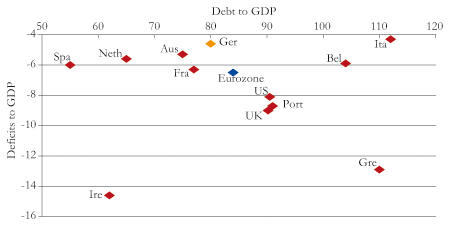
A look around the eurozone shows Germany in splendid and virtuous fiscal isolation, near the bottom of the debt and deficit matrix. It won’t allow fiscal divergence to continue. It would mean Germany would experience fiscal deflation, while everyone else had a party. The Germans would simply refuse to pay for it and the real exchange rate of Germany versus the partying countries would diverge at an alarming rate.
|
Government deficits and debt |
|
As a percentage of GDP, 2010 |
 |
|
Source: ECB, IMF, Independent Strategy |
When the battle heats up, many will think that this is the beginning of the end for the euro. Bond yield spreads over Bunds and CDS premiums will gape again for the usual weaker candidates. But, ironically, these markets are the doomsday machine that will whip the fiscally profligate states such as Greece, Ireland and Spain into line. There is no policy option to do so, as there is no clause in the eurozone treaties that allows for ejection of member states that run lousy economic ships. So the markets will do the job instead.
There is no way to reduce structural budget deficits and excessive levels of government debt in the eurozone by increasing taxes. It has to be done by shrinking the role of the state, particularly in areas related to social security and the work force. European governments already spend close to 50 cents of every euro of national income. That is obviously bad value. So spending has to be reduced, rather than taxes increased.
If governments were to spend less the private sector could spend more – and spend more productively. Moreover, the state’s withdrawal from specific sectors creates opportunities for others to fill any real needs there (for example, running crèches when parents go to work, rather than living and breeding on unemployment benefit). Finally, the retreat of the state also shrinks its legislative reach over the economy and, in particular, over work practices. This empowers the setting-up of small entrepreneurial companies unencumbered by restrictive labour laws and other legislation.
The creation of a more dynamic eurozone economy can be empowered only by the shrinkage of the state. And that, inadvertently or maybe just intelligently, is what Germany has set in motion for the whole eurozone by enshrining fiscal responsibility in its constitution.