INTERNATIONAL BANKS ACTIVE in Hong Kong and China have been delighted with recent foreign exchange liberalization moves from the Chinese government – particularly those that had hoped for change and invested a lot in getting ready for it. “We’ve been predicting this for about four years and we’ve built a cash and trade system with renminbi [RMB] settlement capabilities that is now in every country in Asia,” says Mike Rees, group executive director and chief executive of wholesale banking at Standard Chartered. “We’re very relieved something’s happened. We’d have looked a bit stupid otherwise.”
Standard Chartered and others spent the money to get ready for these developments because of a deep belief at the highest level of these institutions that the changes, when they came, could be transformative. “The potential is going to be huge,” says Rees, arguably the second most senior person in his bank worldwide. “If you believe in economic power in the east and the power of the Chinese, then you therefore believe the RMB as an offshore tradable currency is a very big thing – potentially one of the biggest things that will happen in this region over the next 10 years.”
So what has changed? To answer that, it’s useful to take a step back to see where liberalization has come from.
The Hong Kong Monetary Authority (HKMA) first announced the launch of renminbi business in Hong Kong on a trial basis in December 2003, to little immediate effect: all it meant was that renminbi could build up in low-yielding retail bank deposits and that some personal renminbi services could be offered in restricted form. It was four years before anything else of much consequence happened. Then, in 2007, mainland financial institutions were permitted to issue renminbi bonds in Hong Kong targeted at retail investors there to create more uses for renminbi deposits. In subsequent years the scope of permitted issuers expanded, and several big deals have been launched from issuers including Bank of China, Bank of East Asia, HSBC and the Chinese government itself.
Two important things followed in 2009. In January the People’s Bank of China (PBOC) and the HKMA signed a currency swap agreement to provide renminbi liquidity of up to Rmb200 billion ($30 billion), with a renewable term of three years. (It has never been used but was still an important move.) Then, in June, the PBOC launched a pilot scheme for renminbi settlement of cross-border trade, involving Shanghai, four cities in Guangdong and Hong Kong. This was a big step, reducing the foreign exchange risk for importers and exporters, and was swiftly taken up. It was followed in February this year by new rules from the HKMA allowing participating banks to develop renminbi business provided the funds didn’t flow back to the mainland; one effect of this was to open the renminbi bond market to any issuers eligible to issue bonds in Hong Kong.
|
“China is the world’s biggest trading country. It’s reasonable to expect more and more volume being remitted in RMB as opposed to dollars” Jens Scharff-Hansen, Deutsche Bank |
|
|

That’s the foundation upon which the latest liberalization measures have been built. The significance of what happened next is that, rather than just an occasional step every few years, big revamps have taken place close together. “The pace of change is very interesting,” says Jens Scharff-Hansen, co-head of FX trading for Asia at Deutsche Bank. “It took four years from the first regulation in 2003 to the next in 2007, yet now you have had four relaxations in 18 months. It’s a hint that it is reasonable to expect further relaxations over a fairly short period of time.” Birth of an offshore trading facility
On July 19, the HKMA and PBOC signed the Supplementary Memorandum of Cooperation, increasing the pool of renminbi holders and the products that can be offered to them. Among other things, non-bank financial institutions such as brokerages and insurers, and corporates, can now open renminbi accounts and receive unrestricted renminbi services on non-trade-related renminbi conversion. Also, restrictions were removed on transfers between Hong Kong-based renminbi deposits, meaning Hong Kong banks can net out their positions with their peers. “That,” says Scharff-Hansen, “is the birth of an offshore RMB trading facility within Hong Kong. If banks are able to start trading with each other, without documentation requirements, it leads to swaps, forwards and securities. Suddenly you can make markets, subject to the liquidity available in your system.”
On August 16, PBOC opened a new channel for offshore renminbi to come into the onshore interbank bond market. So foreign central banks, renminbi clearing banks in Hong Kong and banks participating in cross-border renminbi trade settlement – such as HSBC, Standard Chartered, Citi and Deutsche – can invest renminbi liquidity not just in the new offshore bond market but also in onshore bonds. These investments are subject to a quota and go through a separate account, but there are big implications: they allow qualified institutions to hold higher-yielding renminbi-denominated assets rather than the deposits they had been stuck in, and they can also diversify their range of counterparties.
Among other things, these measures have created a third market for US dollar/renminbi FX. Alongside the onshore deliverable forward curve and the non-deliverable forward market, there is now an offshore deliverable market for dollar/renminbi spots and forwards. And a host of markets ought to grow from this: an offshore renminbi money market, bonds, structured investment products and mutual funds. Also, since the HKMA appears to support the development of renminbi-denominated financial instruments, with no general prohibitions, “this raises the prospect that the Hong Kong offshore market could become substantially more sophisticated than the mainland onshore financial markets,” says Standard Chartered in a report. The HKMA has already given in-principle approval for principal-protected structured investments and deliverable forwards, for example.
From the corporate trade perspective, the new measures make it much more appealing to accept payment in renminbi. Until now, that has been a miserable way for a company outside China to be paid because what can you do with the funds apart from sticking them in the bank to earn less than 1% interest and hope you make a gain on currency appreciation? Now there are investment products for those funds, and ordinary companies are permitted to invest in them.
|
An increasingly important source of deposits |
|
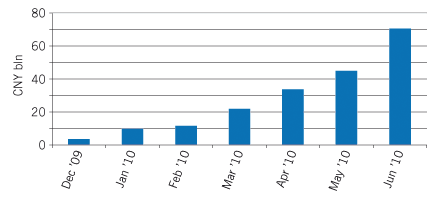
Cumulative CNY settlement trade volumes since the launch |
 |
|
Source: PBOC, Standard Chartered Research |
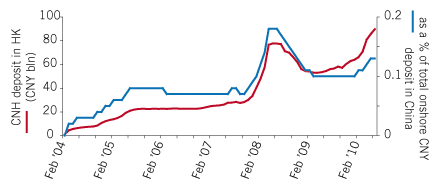
“We see trade volumes growing much faster this year than last because of the general acceptance to settle trade in RMB as well as China’s expansion of companies that are eligible to participate in the scheme,” says Justin Chan, deputy head of global markets, Asia-Pacific, and head of Hong Kong trading, at HSBC. Trade settlement numbers are already transformed: according to the PBOC, half-yearly offshore trade settlement volumes have grown from Rmb3.6 billion in the second half of 2009, when the pilot scheme kicked off, to Rmb70.6 billion in the first half of 2010. “And that’s still a very small percentage,” says Scharff-Hansen. “China is the world’s biggest trading country – in excess of $2 trillion a year. It’s reasonable to expect more and more volume being remitted in RMB as opposed to dollars.” In particular, he notes that many transactions involving Asian currencies are settled in dollars even when there’s no US component to the trade. “If the RMB really starts to open up for that purpose, we are going to see huge volumes coming to our markets.” Thinking like this prompted Julia Leung, Hong Kong’s undersecretary for financial services, to predict a “dramatic expansion” in renminbi circulating outside China. Momentum has been very rapid since the most recent cluster of liberalization measures, although clearly compared with the onshore industry it’s a drop in the ocean. In a variety of metrics offshore volumes come to about 0.1% to 0.2% of the onshore equivalent, according to Standard Chartered research published in late August: $12.5 billion equivalent in renminbi deposits in the Hong Kong banking system compared with $10 trillion in China’s onshore deposits; $30 million to $50 million of offshore spot FX transactions in renminbi per day compared with $20 billion onshore; and $4 billion in offshore renminbi bonds compared with $2.9 trillion onshore. (Even in the month since that report, numbers have started to increase: Chan at HSBC says volumes in the offshore markets, combining general FX, spot and forwards, have already hit $200 million to $300 million a day, and notes that since many banks are probably matching trades internally rather than going to the interbank market, they are probably much higher.)
This gulf between the onshore and offshore market tells us two things: that China will be confident the market can be allowed to develop further without having a big impact on the onshore system; and that the offshore market is set for rapid growth.
HK set for big deposit growth
This has big implications for Hong Kong. For example if offshore renminbi deposits grew to 4% of China’s onshore base, this would double Hong Kong’s total local-currency deposits. “In the early 1960s, when the Eurodollar market started to emerge, the ratio of offshore to onshore US dollar deposit bases grew by about one percentage point per year,” says Standard Chartered. “If the same speed were to be repeated in the CNH market [the standard abbreviation for offshore renminbi], Hong Kong’s bank deposit base could double within five to 10 years.” Similarly, Scharff-Hansen says that if 10% of China’s trade were to be settled in renminbi in Hong Kong, that would equate to up to $2 billion of daily turnover. “I think that’s going to happen pretty quickly,” he says. “All the knowledge is there; all the professionals in the interbank community have that knowledge in Hong Kong in the offshore market. It’s just a question of applying that.”
|
Set to rise |
|
CNH deposits in Hong Kong vs. onshore deposit base |
 |
|
Source: Bloomberg, Standard Chartered Research |
One impediment to development is liquidity relative to demand, although again, the volumes are increasing quickly. Scharff-Hansen calculates a total of Rmb103 billion within the offshore market in Hong Kong today, and notes that will have to grow substantially to be enough to support demand. But Deutsche reckons that through a combination of trade finance and tourism, the total liquidity base will reach Rmb500 billion by the end of 2011, and Rmb1 trillion a year later. It is irresistible to see these latest measures as part of a trend towards full convertibility of the currency. Every move like this is a step closer; it seems only a question of time.
But Rees argues that the issues involved for China doing that are big, far bigger than just FX or even export considerations. He points to growing cost and wage pressure in China, and suggests that these will make China particularly cautious about allowing the renminbi to rise. “The impacts on margins have already been significant,” he says. “If they let the renminbi appreciate, wage pressure will quickly turn into unemployment. That’s a very different scenario. This market will develop based on how China reads the sustainability of its domestic economy.”
see also: