|
Greece will suffer, |
Markets are pricing Greek sovereign debt as though the government will default, or will be forced to leave the eurozone, or be expelled from it. But none of those things will happen. Whatever difficulties the Greeks have in getting their huge budget deficit down to acceptable levels, the country won’t leave the euro or be expelled and it won’t default. The Greeks have promised many things since they became full members of the EU in 1981. They vowed to catch up with the rest of Europe but didn’t. They promised to eliminate corruption but it got worse. They claimed that Cyprus’s membership of the EU would not prevent Europe from dealing with Turkey; exactly the opposite has happened. They imposed economic sanctions on Serbia during the Balkan wars of the 1990s but acted as the main conduit for smuggling. And they claimed that they met all the criteria for adopting the euro but did so by massaging the statistics.
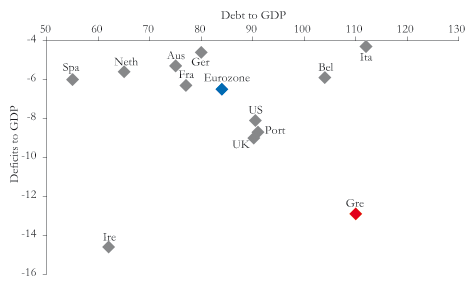
So when the Greek government pledges to reduce its deficit from the present 12.7% to reach the EMU limit of 3% by 2012 it is no wonder that markets are sceptical.
But we can be sure about three things that will not happen. First, Greece won’t default on its government bonds. It won’t repeat Argentina’s irresponsible behaviour in 2001. After all, such a move would hit European banks (particularly those in Germany) that hold a large chunk of Greek debt. And well before Greece finds itself unable to service its debt, it will turn to the EU for additional government credit.
|
Greece out on a limb! |
|
Government deficits and debt (% of GDP), 2010 |
 |
|
Source: ECB, IMF, Independent Strategy |
The EU can easily provide financial assistance. The EU does not want to encourage the Greeks into believing that they can rely on a bailout. But it is in nobody’s interest to have a full-blown euro crisis, which would be the outcome of a Greek default. Second, Greece won’t leave the euro bloc. There are plenty of historical examples of countries in Europe leaving monetary unions. But it was always the country that underpinned the monetary union that decided to leave the arrangement. It was Prussia that left the German financial union and in 1918 it was Austria. Without exception, the smaller states in a monetary union do not leave, because the financial benefits of leaving are not evident. EMU would only collapse if and when Germany itself became tired of the arrangement, and there is no sign of that happening.
Those who raise the possibility of the Greeks leaving the EU argue that if Greece had the ability to debase the value of its currency, it would be able to compensate for its current lack of competitiveness. But this pales into insignificance in comparison with other deleterious effects. The value of any new Greek drachma would sink like a stone before the banknotes had left the printing presses.
And it is not just the economics. To break with the EU would be tantamount to political suicide for the Greeks. They would be on their own in an unstable Balkan region, facing the problem of a divided Cyprus and a Turkey growing in geopolitical importance and military might. The Greeks are inefficient and disorganized but they are not mad. They will cling to EU membership, regardless of the restrictions or the punishments meted upon them.
Third, Greece won’t be expelled from the EU, for the simple reason that there is nothing in any of the treaties founding the EU that provides for expulsion. The recently ratified Lisbon Treaty opens up the theoretical possibility of a country voluntarily leaving the EU. But there is no legal procedure for expelling a member state.
The Greek government might not be able to stick to the commitments that it has made to the EU to make public spending cuts and tax increases and get its deficits and debt down over the next few years.
But Europe can afford to pillory Greece partly because the country has few remaining friends on the continent and partly because it is sufficiently small to be made an example of. Greece will suffer, it will squirm, it will squeal and it might fail to do what is demanded of it. But it will not default, it will not leave the EU and it will not be kicked out.
David Roche is president of Independent Strategy Ltd, a London-based research firm. www.instrategy.com


