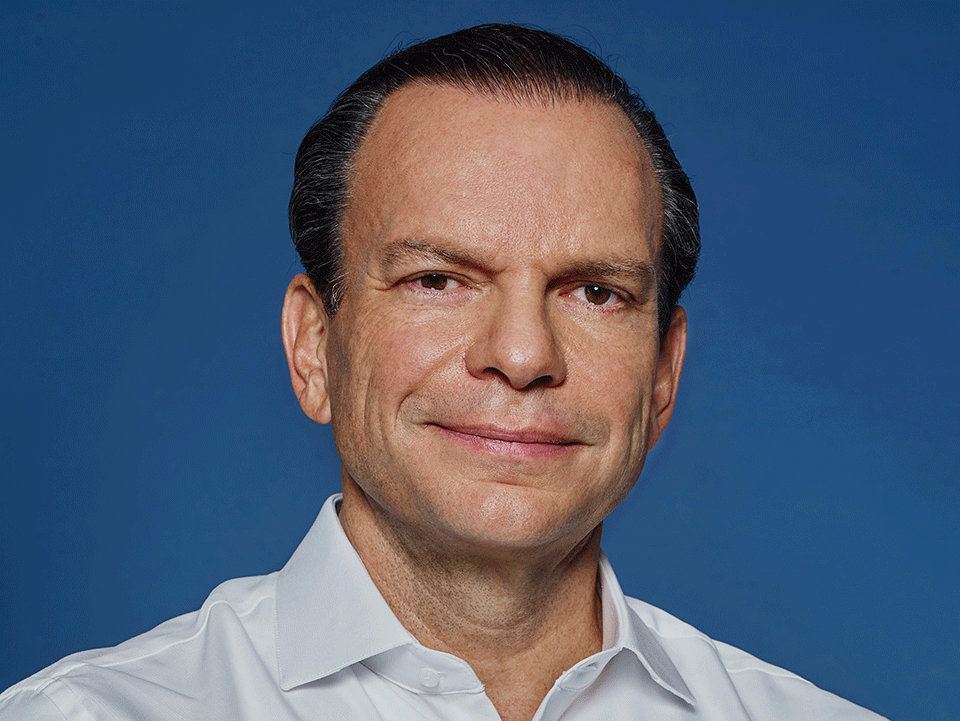
| Martin Ebner | ||||||
When a slight man with white hair, pinched cheeks, a smile playing around his lips and a bow tie stepped onto the podium at the early March AGM of Swiss/Swedish engineering company ABB, the hubbub of bored shareholders calmed and the hall rapidly fell silent.
They all knew that Martin Ebner was an investor on the inside of the catastrophic events at ABB and that he was worth listening to. They also knew he was a major loser as a result of the collapsing share price, and they were on his side in his battle with ABB’s former managers.
So when Ebner, an ABB director, lambasted the two fat-cat executives (Percy Barnevik and Goran Lindahl) who had just taken tax-free, lump-sum pension payments of $87 million and $50 million respectively, the shareholders whistled. When he told them how he had arranged for them to pay half of the money back to the company, they cheered. “The deal I made was not just,” said Ebner, “but it was pragmatic.”
No shareholder would argue with that. Hans Jacob Heitz, the chairman of a shareholders’ protection group, said Ebner and his members, who are small shareholders, were “rowing in the same boat. Ebner is an investor and he wants to earn money. He doesn’t want to lose money. Ebner said that if the board wasn’t transparent about Barnevik and Lindahl, he would take the matter to the courts.”
Ebner’s Stillhalter Vision fund, part of his BZ Group, which held its 11% stake in ABB, is reputedly nursing losses of SFr1 billion ($600 million) as a result of a fall in the price of ABB’s ADRs from a high of $19 in the summer of 2001 to the February 2002 price of $8. ABB’s share price has also fallen precipitately, from a high of SFr54.50 in February 2000 to a low of SFr9 in October 2001. These losses, Ebner says, “hurt a lot”.
Now Heitz, whose members have also lost out, says he has reported the pensions payments to the Zurich legal authorities. “I have sent the case to the prosecutor’s office in Zurich and asked for a criminal investigation,” he says. “They have to decide if there is any suspicion of a criminal act. There is a strong suspicion that they did it against the rules. The prosecutor is seeking information from ABB and they can be required to open the books.”
ABB’s decline has opened up wounds, not just with the executives who were responsible in part for bringing the company low but also with the shareholders and investors who oversaw the decline. Ebner has targeted the Wallenbergs whose family-controlled company, Investor. has a 5% stake in ABB. The head of the family, Peter Wallenberg, was one of only two ABB directors who approved the formula for the controversial pension payments. The rest of the board were left in the dark, on the grounds, say sources close to Wallenberg, that this was in accord with Swiss governance standards prevailing at the time.
The size of the schism between Ebner and the Wallenbergs was fully revealed at ABB’s February board meeting when Ebner demanded that Peter’s son, Jacob Wallenberg, an ABB director, quit the meeting, arguing that he had a conflict of interest. Wallenberg sought to resist the demand, saying that he had not been involved with the company 10 years earlier when the pension formula had been agreed. He declared that Ebner’s demand was unconstitutional but the board overruled him.
Once Wallenberg had left the room, Ebner revealed to the board the size of the pensions payments, and pushed for full disclosure in a press release. This was duly issued, and it asserted that the matter would be settled with the two former managers “amiably”. A source close to Jacob Wallenberg was scathing about this decision. “It was the most unusual thing I have ever seen. The press release said the company looks for an amicable solution, then it kills off such a possibility instantly by revealing the amounts of the pension payment and saying that the board feels there are potential irregularities. If that is the way you try to reach amicable solutions, I wonder how they act when they are looking for aggressive solutions.”
The ABB fracas is the latest eruption of bitterness between Ebner and the Wallenbergs. The feud began with Ebner buying into Investor, the Wallenberg company, where BZ’s Spezialitaeten Vision fund now holds 12%. Sources close to Wallenberg attack Ebner in a highly personal vein. “The only interest the publication of the pensions payments served was Ebner’s,” says one. “If you prioritize your own reputation above everything else, you need a scapegoat, then publication serves your purposes.”
The company was deluged by negative publicity as a result of Ebner’s revelation. Sweden’s prime minister, Goran Persson, and European politicians, such as EC internal market commissioner Frits Bolkestein, lambasted the pension payments.
Wallenberg had to eat humble pie about the way his family had managed the company, saying: “There should have been more transparency, and we take our share of the blame. We claim to be active shareholders but in this case our activities were not enough. We should have checked on our own chairman, that’s our fault. I don’t spend too much time looking over the shoulders of my chairman.”
Zurich-based analysts wonder whether the pensions scandal will persuade the Wallenbergs to divest their ABB stake.
As the furore abated, Ebner said he behaved appropriately. “We are long-term investors and hopefully add to the performance of a company by being good owners. That is the difference between the portfolio investor like BZ, and the small investor.” ABB’s former chairman, Robert Jecker, supported Ebner. “His stakes are so big that you have to have a long term view, and he has a long-term view. He can’t afford to be opportunistic.”
When Ebner bought shares in ABB four years ago, the company looked like a bet on the new economy. But in the past two years it has been hit by a double whammy: the collapse of the internet revolution and a disastrous investment in a US company with high exposure to asbestos claims. Together, they crippled the ABB share price.
A source close to the Wallenbergs says: “Ebner has made a bad investment here, he hasn’t done his homework properly and he has been taken for a ride. He had unrealistic expectations but it all comes back to his judgement and no-one else’s. He has made a bad call. He should take the criticism on the chin.”
At the end of March ABB was desperately trying to renegotiate its bank lines amid a run of downgrades by the credit rating agencies.