 |
CHINA’S FUND MANAGEMENT industry has grown rapidly over the past six years to amass $20 billion in assets under management. And foreign fund managers are enthralled by the domestic market’s vast potential.
But Sino-foreign joint venture fund management firms are having a tough time of it. Last year, several funds for domestic investors were launched but quickly lost up to half of their assets under management because of speedy redemptions.
ABN Amro Asset Management was the first foreign firm to enter China’s domestic fund management industry when it bought into an existing local fund manager, Xiangcai Hefeng. In April 2003 the firm completed the public offering for its first mutual fund in China, raising Rmb2.63 billion ($318 million).
But by the end of December the umbrella fund had lost nearly 50% of its assets to reach Rmb1.43 billion. Its growth sub fund suffered the largest percentage drop in terms of assets between launch date and the end of 2003 (60%). The stable sub fund lost 47% of its assets over the same period, and the cyclical sub fund lost 20%.
In December 2002, ING Investment Management became the first foreign firm to succeed in setting up a greenfield joint venture fund management operation in China. It joined forces with local securities house China Merchants Securities Company and in March 2003 created China Merchants Fund Management. At launch its first open-ended mutual fund attracted Rmb4.5 billion in assets. But by the end of December 2003 this had dropped by 26%.
Several other joint venture funds attracted more than Rmb3.5 billion each when launched but all have seen sizeable redemptions. For example, in October, GTJA Allianz Fund Management attracted Rmb3.7 billion. By the end of the year this had dropped by 24%. In August, Fortis Haitong Investment Management, a joint venture between Fortis Investment Management and Haitong Securities, launched a fund raising Rmb3.7 billion and by the end of the year it had lost 44% of its initial assets.
To the consternation of the fund managers, Chinese investors have taken to diving in and out of mutual funds like American day-traders punting internet IPO stocks. Denis Lefranc, deputy general manager of Fortune SGAM, says Chinese investors’ approach to mutual funds “is a big challenge for everyone. Everyone is seeing a big proportion of redemptions after the IPO of a fund.”
Funds are seeing such large redemptions because investors take a short-term, speculative view of them. Bonn Liu, principal in financial services at KPMG in Hong Kong, says: “The major challenge is educating investors. Punters are not aware of the point of these investment funds. The retail market is seeing it as access to the stock market, taking a short-term view.”
Stuart Leckie, chairman of The Hong Kong Retirement Schemes Association and investment actuary at Stirling Finance, says this is typical of emerging markets. “Investors tend to treat new open-ended funds priced at net asset value as an IPO,” he says.
The poor performance of many domestic listed companies has not impressed buyers in a volatile market. Alain Le Couédic, a manager at the Boston Consulting Group in Hong Kong, says: “They [local investors] view the stock market as being closer to a casino than a vehicle for long-term investment.” And they view mutual funds in much the same way.
Hot new money moving so swiftly out of existing funds and into new ones raises questions about the overall size and stability of the market. One fund manager speculates that “in order to get the right result, hot money was dumped in by, for example, the shareholders, and in one case in less than a month the hot money had been taken out. So it’s not genuine money.”
Industry players also ascribe some of the failure to retain assets to the lack of post-sales marketing. There is no incentive for distributors to encourage investors to keep their money in particular funds, and fund managers face the challenge of direct sales with limited sales teams in a large country.
Peter Alexander, an independent China fund management consultant and long-time China watcher, says: “Distributors get 100% of front-end and back-end loading so there is little incentive for them to keep assets in the funds.” The distributor has a strong interest in selling the maximum number of units when a mutual fund is launched and also benefits when investors make redemptions.
An incentive scheme that works Fund managers believe that distributors need to do more marketing and that their employees need to be better trained.
“Distributors should take the view that if investors take a short-term view and get their fingers burnt then they won’t invest. That is, that it’s in their interest that investors are properly educated,” says KPMG’s Liu. However, Alexander says: “Fault also lies with the fund managers. They spend considerable time launching new funds but allocate little resources to post-launch marketing and sales.”
Fortune SGAM’s Lefranc says his firm, like other fund managers, is making efforts to train branch managers at the distributing banks and its direct sales team tells investors that it’s only worth investing in a mutual fund if they take a long-term view.
It would appear that Fortune SGAM is doing something right as it has suffered relatively low redemptions. The firm launched its first fund in July last year and initially raised Rmb3.9 billion. By the end of 2003, the fund had lost only 12.8% to reach Rmb3.4 billion.
Fortune SGAM has an incentive scheme in place with its primary distributor, China Construction Bank. “It’s very basic at the moment,” he says. “In China, remuneration of the distributor is based on custodian fees and there’s not much rebate in terms of management fees.” Distributing banks do not yet receive a percentage of the fee for managing the funds. The exact details of the custodian fee are also at the discretion of the fund manager.
Perhaps the relatively high retention of assets in Fortune SGAM’s fund can be attributed, in part, to the fact that the firm gives its custodian a fee based on the size of the fund. Therefore, it is in the bank’s interest financially to keep the size of the Fortune SGAM fund up. Lefranc also attributes the fund’s low redemptions to the fact that the its investor base is balanced 50/50 between institutional and retail investors.
Fund managers may be required to give a larger part of their management fees to the local bank distributors.
Several foreign fund managers have been caught out in their eagerness to get into China. Many initially formed technical advisory agreements with local fund managers before formal partnerships were allowed by the China Securities Regulatory Commission (CSRC). This meant that foreign firms spent much time and many resources in sharing technical expertise with their Chinese counterparts without any formal agreement in place to ensure they could form a joint venture with the local party once the regulator allowed it.
Firms that made such technical agreements that didn’t evolve into joint ventures include HSBC Asset Management and China Southern Fund Management, Invesco and Penghua Fund Management, and JPMorgan Fleming Asset Management and Huaan Fund Management. Similarly, foreign firms that haven’t already formally agreed to increase their stakes from 33% to 49% by the end of the year with a set price mechanism could get their fingers burnt.
Fund managers in China are also having trouble trying to make a dent in the $1.2 trillion held in savings deposits. Even highly educated and intelligent locals shy away from mutual funds. Ian Jenkins, CEO of First State Investments, says: “We interviewed an educated 40-year-old woman for the position of CFO. She had experience in property – broader financial markets – and we asked her if she would invest in mutual funds. She said ‘no’ because she doesn’t trust them.”
|
China’s industry Fund management size (Yuan bn) |
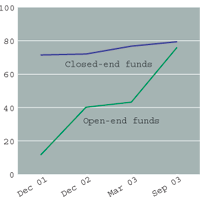 |
| Source: KPMG |
Institutions will dominate Institutional investors are set to shape the future of fund management in China. Industry players surmise that institutional investors are the largest domestic investors in China with non-insurance companies making up around 40% to 50%, followed by insurance companies at 29% of assets and retail investors making up the remainder.
Fund management firms face the risk that insurance companies will move money out of existing mutual funds and invest less in them in future.
In mid-2003 China Insurance Regulatory Commission (CIRC) gave its approval for two insurance firms to set up their own investment arms. For now, China Life and People’s Insurance Company of China, are only allowed to manage their own assets. Insurance companies, by law, are not able to invest directly in the securities markets but solely via investment funds.
Developments here could have a huge impact on fund management houses as insurance assets at $5.43 billion accounted for 29% of total industry assets under management in October 2003, according to independent consultant Alexander. And this is only the tip of the iceberg. Total insurance company assets are around $100 billion and are expected to grow by about 30% a year, according to Leckie.
Only 5.5% of the maximum of 15% that insurance companies are permitted to invest is actually invested. In addition, says Leckie: “Ultimately they will want to compete for investment fund business.” And insurance companies are plentiful – there are half a dozen national domestic insurance companies and about 20 life insurers. There are also several Sino-foreign joint venture insurance companies lining up for a piece of the action.
Asset managers across the board will all be competing for the potential windfall of pension fund assets in China. The World Bank estimates that pension fund assets could reach $1.8 trillion by 2030, according to a report by KPMG and the Economist Corporate Network.
Although China doesn’t currently have an ageing population problem, the increase in life expectancy and a one-child policy means the situation is deteriorating rapidly. The World Bank estimates that China’s pension system will have an annual shortfall of $8 billion in 2005 and Taikang Life Insurance estimates that it will see a Rmb1.8 trillion pension funding gap over the next 25 years, according to independent research house Matrix Services. “They realize they need to address the pension fund industry. There’s a huge shortfall,” says KPMG’s Bonn Liu.
During the 1990s, the government moved to a three-pillar contribution system. The government has now decreased state contributions and is encouraging employees to contribute 6%, while employers pay around 20%.
The government also established the National Council of Social Securities Fund in 2000 and at the end of 2003 its fund – which covers pensions, unemployment benefits and healthcare services – had Rmb133 billion in assets , according to Matrix. In December 2002, the council chose six local independent fund managers to invest a total of $1.7 billion and these managers began to invest this money in June 2003.
Hope for access to assets Fund managers hope that, if the council is satisfied with the pilot and the managers can achieve consistent and strong fund performance, it will begin to allocate mandates to other fund managers from its $16 billion pool of assets. Weimeng Lin, CEO and president of ABN Amro Xiangcai Fund Management, says: “The NCSSF money has been in the market for about a year so maybe this will happen this year.”
Unfortunately, the performance of investment funds has been weak over the past few years. In 2002, three-quarters of the 66 funds listed made losses, according to the joint KPMG/Economist Corporate Network report. The Shanghai and Shenzhen indices were also down 17% and 18% respectively.
However, the stock markets picked up in the fourth quarter of 2003 and equity funds have fared better than the Shanghai and Shenzhen A-share indices on average over the past year. First State’s Jenkins says: “Most fund managers outperformed the benchmark, which is a tremendous result for the industry. There’s more credibility around it.”
For the full year ending January 31 2004, the A-share indices for the Shanghai and Shenzhen stock exchanges were up 6.34% and down 6.47% respectively. Open-ended funds did relatively well, with an average return of 11.14%. The FTSE/Xinhua China A200 index had a strong year and was up by 11.8%.
Despite the pick-up in performance, fund managers are finding it difficult to distinguish themselves from their peers. There is little to differentiate the style of funds offered by different managers because of restrictions on the kinds of products they are able to offer imposed by CSRC regulation.
All investment funds are mutual funds and can be invested only in local assets. The CSRC requires all equity funds to be at least 20% invested in fixed income. And the equity markets free float is small. The market cap for the two exchanges is $470 billion but two-thirds of listed stocks are owned by the government and not traded. “The domestic stock market is made up of about 1,200 shares and, in reality, there’s only about 400 to 500 that you’d dream of investing in,” says First State’s Jenkins.
Bond funds are primarily a government bond market play. “The corporate bond market is tiny,” says Charles Lo, senior portfolio manager at Allianz Dresdner Asset Management. “Only the 100 largest companies, under the State Council, are allowed to issue corporate bonds.” BCG’s Le Couédic says: “Most bonds are government bonds issued to sustain China’s spectacular growth, and these funds are directed to infrastructure and SOE improvement.”
Products lack variety Essentially, the same products are offered to both retail and institutional investors. “There’s a lack of uniqueness to products. These are very plain vanilla funds,” says Alexander. “Unfortunately, product differentiation is constrained by the development of the capital markets,” he adds.
Chris Ryan, CEO of ING Investment Management Asia Pacific, says: “One restriction is the availability of third-party information services such as third-party stock research and indices.”
The CSRC has taken a responsible and measured approach. And, slowly but surely it is authorizing fund managers to launch different types of funds. In December last year the regulator allowed firms to develop money market funds. As a result, Boshi Fund Management, Huaan Fund Management and China Merchants were the first to launch money markets funds. These vehicles proved to be popular with investors. China Merchants, for example, raised Rmb4.6 billion.
Boshi Fund Management created the first All-China Index fund in July last year. The fund is an open-ended index-tracker that uses the FTSE/Xinhua A 200 Composite Index as its benchmark. This index is composed of 25% from the FTSE/Xinhua China Government Bond Index and 75% from the FTSE/Xinhua China A 200 Index. Boshi’s fund is the first to cover stocks and bonds listed on both the Shenzhen and Shanghai stock exchanges.
Local fund management firm China Southern Fund Management offered the first capital guaranteed mutual fund last year, despite the fact that there is no derivatives market in China. Where fund managers offering capital guaranteed funds would usually invest most of the fund in bonds and a smaller amount in highly leveraged options, Southern China’s fund invests partly in bonds and puts the rest in equities. It offers a full guarantee only after three years.
Market watchers and fund managers alike believe that fund launches will come thick and fast over the coming year even though distributors have capacity constraints and, as Alexander puts it, “around 75% to 85% of assets raised are done through only a handful of distributors”.
In an attempt to slow the pace of new funds being launched, the CSRC has placed a restriction on umbrella funds. Only a single sub-fund may be initially launched under an umbrella structure. “Any additional [sub]funds to be added must follow the same application and approval process set by the CSRC,” says Alexander. “Given the time involved this suggests that fund companies can only apply for a new fund every six months.”
Fund managers hope that the qualified foreign institutional investor scheme (QFII) introduced by the government in December 2002 will help to stabilize mutual fund assets. “We’re keen to develop it because foreign investors tend to take a longer-term view,” says Lawrence Lo at BNP Paribas Asset Management in Hong Kong.
The snag is that the QFII scheme has yet to enthuse foreign investors wary of misconduct and poor performance in the domestic share markets. ING’s recent decision to forgo half of its $100 million allotment is telling.
Further opportunities for fund management firms to develop their products in China would be provided if the much discussed qualified domestic institutional investor scheme (QDII) was approved.
One of the main reasons it hasn’t materialized is because of the high valuations of stocks in China. “The valuations of shares in Hong Kong are only half that of those in China so who would buy domestic shares if they open up?” says Allianz Dresdner’s Lo.
Signs of valuation convergence
There have been some encouraging signs that valuations are slowly beginning to converge. Richard Wong, associate director of equities at HSBC Asset Management in Hong Kong, says: “Market talks of allowing local mainland Chinese to invest overseas through a scheme known as QDII have helped to narrow the share price discount of H shares [stocks of Chinese companies listed in Hong Kong] to A shares from an average of over 70% at the beginning of 2003 to around 50% by the end of the year.” He adds: “We expect this gap to continue to narrow going into 2004.” In fact, the fourth quarter last year saw some H shares trading higher than A shares for the first time, notably those of Tsingtao Brewery and Anhui Conch Cement.
China’s large foreign exchange reserve is another reason market watchers believe the government will allow investment in foreign assets. HSBC’s Wong says: “They’re a bit more relaxed about capital control. The foreign exchange reserve was at $403 billion at the end of 2003.”
Allowing Chinese investors to invest in foreign assets would help them diversify and improve performance. “China would like to boost investment returns for pension funds and insurance companies, so will eventually allow investment [in foreign markets],” says HSBC AM’s Wong. Most believe the first step will be to allow investors to invest in Hong Kong assets. Fortune SGAM’s Lefranc says: “I hope to see this happen this year.”




