 |
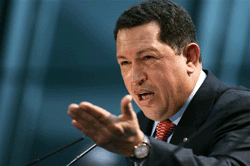
| Chávez: not making the neo-liberal mistake of separating the economy from society |
President Hugo Chávez wants the private sector to invest $19.8 billion in Venezuela’s oil industry over the next six years as part of his government’s strategy to boost oil production. The sum requested is part of the $74 billion that Venezuela plans to invest in drilling and refining projects by 2012. The bulk of the funds will come from state-owned oil firm PDVSA, as Venezuela seeks to ease production pressures. The world’s fifth-biggest oil exporter has just signed a $2 billion deal to buy 100,000 barrels a day of crude oil from Russia until the end of the year as it faces a shortfall in production.
The investment will also be vital in helping to ease supply pressures in the world’s energy markets, although Chávez is downbeat about the prospects in the short term. “The world is going to enter an energy crisis,” he said during a two-hour speech in London last month. He added that the days of oil at $20 a barrel are long gone; instead he expects the price to continue to rise. “The Opec countries can’t lower the price as we don’t have any reserves,” he says. “We’re trying to cover market needs but we won’t be able to in the short term.”
Chávez says international oil companies should not be nervous about pumping money into Venezuela. Although he has imposed tougher operating terms and retrospective tax increases, he says his government is a supporter of the oil majors. “Venezuela will always have its arms open to international private investors and to national private investors,” he says. He warns, though, “that nobody can come to crush Venezuelans like in the past”.
Chávez also used the occasion to defend his policies, rattling off statistics to demonstrate that Venezuela had made great strides since he came to power in 1999. He says the poverty level is below 40% from nearly 50%; inflation is on track to being in single figures this year, compared with more than 100% in the mid-1990s; and that the economy has just recorded its 10th consecutive quarter of growth. He adds that the non-oil sector of the economy is growing the fastest. Chávez says these figures prove that his socialist model is working. “The economic model we’re developing shows vigorous signs of growth. At the same time, social variables are showing vigorous growth.
“One of the major mistakes that has been made in different development models has been to separate social and economic affairs,” he says. “It’s like separating hydrogen from oxygen – if you did you would have no water. Economic and social affairs are like that. They are so closely linked. Neo-liberal theses make that terrible mistake – they try to separate the economy from society.”
He adds that nothing will deter his government from continuing along its path. “We are victims of campaigns that aim to distort reality,” he says, pointing the finger at the US government. “They are trying to satanize our model.” But Chávez is unrepentant. “We’re not just trying to put sticky plaster on things,” he says. “What we’re trying to do is search for the roots of social problems in Venezuela.”