The Squadra Azzura won the World Cup last month after a shaky start and by steadily improving their performance. It’s a stark contrast to the development of the Italian hedge fund industry. Italy rode the wave of hedge fund expansion by introducing regulation as early as 1999. As a result, growth has been strong. Italian funds now manage €18.3 billion, more than 5% of total hedge fund assets invested in Europe.
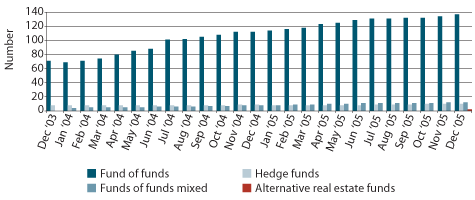
But there is cause for concern. As a survey published in July by the Alternative Investment Management Association and law firm Simmons & Simmons points out, pure hedge funds manage only 3% of the market, with funds of hedge funds claiming the rest. And the bulk of the funds in the collateral are based outside Italy. This means that the notion that there is a burgeoning domestic hedge fund industry in Italy is wrong.
The survey claims to represent the opinions of fund managers holding a combined 82% market share of funds managed in Italy. They list problems and suggested solutions.
| FOFs v hedge funds in Italy |
| The discrepancy between funds |
 |
| Source: MondoHedge |
The most prominent of these is the need for legislation to differentiate between hedge funds and funds of funds In addition, the image of the latter needs to be improved. An obvious start would be to rename the fondi speculativi – a term used for both single-manager hedge funds and funds of hedge funds. Although the existing regulations for the funds are deemed to be a solid basis on which to bring the industry forward, there are calls for abolition of the prohibition on marketing funds and of the restriction in the number of participants in a fund to 200, and for hedge funds to be allowed to split into separate accounts. These proposals should improve the conditions for domestic single-manager hedge funds. Romeo Battigaglia, partner in charge for financial services and derivatives at Simmons & Simmons, who coordinated the drafting of the survey, says the survey was well received by the Bank of Italy. He explains that the Italian regulator is looking to amend the regulations, it is hoped by mid-2007, as a medium-term measure before common EU legislation on hedge funds.
Ultimately, though, success for domestic alternative investment management depends on more fundamental reform. “Small amendments to the system could lead to significant progress,” says Battigaglia. But the scope of reform needs to widen. “Most importantly,” he says, “we need a reform of the labour and tax laws.”
Battigaglia’s worry is the dire shortage of talent able to master the complex task of setting up and managing a hedge fund strategy. Experts such as asset managers are not attracted to a country with tax levels as high as Italy’s. Battigaglia also points out that the problem extends to the service infrastructure: “There is a lack of ancillary service providers such as prime brokers or independent custodians with recognized expertise on NAV calculation, which have to be outsourced abroad.”
The fate of the industry here is intertwined with the more general question of Italy’s international competitiveness. Regardless of Euromoney’s investment banking World Cup, comparisons between football and finance can prove to be tenuous.