
|
| © 2019 Euromoney |
| Regional awards |
| View full 2019 results |
Latin America

Best Investment Bank

Best Investment Bank

Best Investment Bank

Best Investment Bank

Best Investment Bank

Best Investment Bank

Best Investment Bank

Best Investment Bank

Best Investment Bank

Best Investment Bank
Central America and Caribbean

Best Investment Bank

Best Investment Bank

Best Investment Bank

Best Investment Bank

Best Investment Bank

Best Investment Bank

Best Investment Bank
Latin America
 |
Argentina
|
The excitement that surrounded Argentina’s banking system in 2016 is now just a bittersweet memory. Remember those equity issuances? Banco Supervielle ploughing a banking IPO furrow in New York and others topping up equity capital and cheap international debt to finance the expansion of their operations and pursue consolidation of the sector?
The future was so bright – the administration of president Mauricio Macri had removed FX controls, re-accessed the international markets and promised to roll back prescriptive banking regulation and normalise the country’s tax system to incentivize investment and growth of productive sectors.
But doubts about the fiscal adjustment and debt sustainability were to weigh down more quickly than the economy could be transformed. The IMF had to return to the country and build buffers, damaging confidence and returning the banking sector to treading water in a period of high inflation, high interest and recession.
The promise is still there, claim bankers, who still eye the low credit penetration (15% of GDP) as a space to be filled – and point to the swift blossoming of mortgage financing in the country while that fragile Argentine financial sprint lasted as proof of what could have been and could still be.
Bankers say their growth plans have been shelved, not binned. But more dust will gather on those papers before they are revisited. Confusion about this year’s presidential election – and the likely paths of monetary and fiscal policy – condemns the financial system to more inactivity.
It’s in this mournful stasis that the banks hang on. Banco Galicia is faring best – able to pivot back to a business model that generates strong income from government securities. The bank, ably led by chief executive Fabián Kon, grew its deposits by 14% year on year, and channelled these to short-term Leliq notes, increasing its position in central bank paper to 17.5% of assets, up from 13.7% in fourth quarter of 2018.
Net income declined 60% in the first quarter of 2019 (from Q4 ’18) due to higher funding costs, but income from government securities climbed 88%. The bank managed to raise net income by 58% year on year, above both costs (42%) and inflation (probably). The bank’s earnings per share trebled when compared with the first quarter of 2018, driven by a one-off gain of an astutely timed sale of Prisma, its payment processing company.
The country’s crumbling economy impacted the financial system’s asset quality and Galicia was no exception: the bank’s non-performing loan ratio jumped 107 basis points in the first quarter to 3.9% – a high figure in a country that has typically had low rates due to the devaluation of repayments by high inflation. The bank hopes the economy has bottomed out and that the elections will bring normalization and growth.
The investment banking sector is similarly moribund, though there have been deals – even good deals. Despite the frustrating lack of foreign direct investment there have been some big M&A transactions – such as the Prisma sale (the first large M&A deal to follow the IMF standby agreement in May 2018).
Goldman Sachs won more than its fair share of prestige deals – and fees (the bank pulled in most fees in both M&A and ECM, according to Dealogic, with 32.6% and 47.6% market share of each respectively).
Goldman’s team in Argentina, led by Matias Rotella, also led on arguably the country’s standout strategic financing for Mercardo Libre, which consisted of a mix of M&A from PayPal and Dragoneer and a subsequent $1.15 billion follow-on to reposition the capital structure of one of the region’s leading tech companies.
Goldman was also lead left bookrunner and stabilization agent of Globant’s $348 million follow-on, which priced in June 2018 (at a 52-week all-time high).
 |
Bolivia
|
Luis Arce, Bolivia’s finance minister, recently floated the idea of extending the tenor of the country’s next international bond deal. The success of previous 10-year deals suggests demand could be there, despite regional difficulties and questions more genuinely around smaller emerging market sovereign credits.
|
|
|
Alberto Valdés |

Banco Mercantil Santa Cruz takes a similarly long-term view about its business – and that has paid off in recent years.
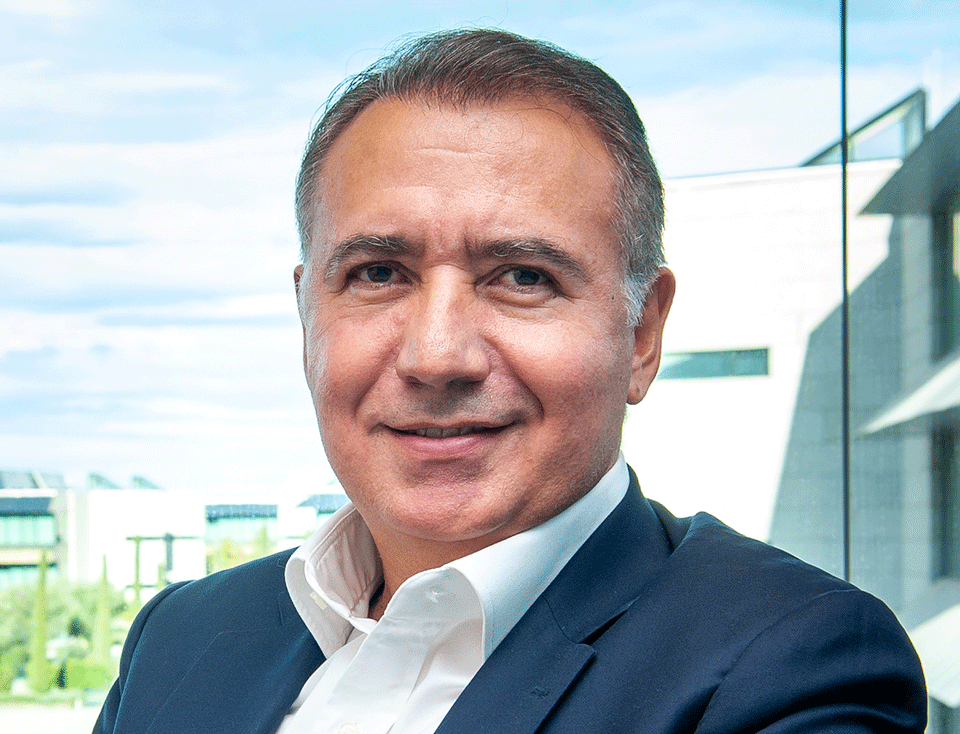
The bank, under the leadership of chief executive Alberto Valdés Andreatta, has a $3.6 billion loan portfolio – equal to a market share of 15.6% and just slightly below the level of its deposits ($4.4 billion and a 17.1% market share). Continued growth has ensured Mercantil retains its status as the biggest and best bank in the country.
Specifically, it has delivered this growth though niche acquisitions that broaden services, most recently in regards to small and medium-sized enterprises (the bank credits its 2017 acquisition of Banco Los Andes ProCredit as instrumental to the segment).
Other initiatives are organic: in 2018 the bank targeted young people, which directly led to a 25% increase in accounts and a 13% increase in loans.
 |
Brazil
|
Who would have thought that Banco Santander Brasil, the perennial underachiever of the Brazilian banking system, could break the duopoly of the country’s big two of Itaú and Bradesco – at least in terms of that headline banking metric, return on equity?
In 2017, Euromoney chose Santander Brasil as the region’s best bank transformation and highlighted that return on equity had jumped from 12.6% to 15.9%, the most eye-catching of a host of improving metrics.
However, even we have been surprised how quickly the bank, led by chief executive Sergio Rial, has continued that momentum and made light of the received wisdom that the sheer scale of Itaú and Bradesco created a natural barrier to the locally listed, Spanish-headquartered Santander challenging either of them.
However, in the first quarter of 2019 that breakthrough came. Sandwiched between Itaú’s 23.6% return on equity and Bradesco’s 20.5%, Santander produced a ROE of 21%.
The ability to sustain its push, even amid disappointing macroeconomic growth, gave the bank the momentum to crash the party at the top of Brazilian banking.
Now come the doubts: some analysts believe earnings momentum has peaked. Partly that’s just a fact of gravity as the last two years have seen a compound annual growth rate of 25% in earnings, and partly it’s a fact that the positive effect from falling costs of equity are not likely to be compensated by macroeconomic growth as Brazil’s economic forecasts are constantly revised down.
Signs of a mild slowdown are already apparent, with the bank’s loan book growing at an annual rate of 10.8% in the first quarter of 2019, down from 12% year on year in the fourth quarter of 2018. However, the portfolio continues to be slanted to higher margin business, as credit to individuals grew 19.4% year on year in the first quarter of this year, while lower-cost, securitized lending grew at a more modest rate – payroll loans grew 5.5% – which suggests the bank’s risk appetite is not diminishing.
Ironically, having forced its way into the top tier of Brazilian banking, it may be the smaller, digital upstarts that have the biggest competitive impact on Santander Brasil’s results in the future.
Itaú and Bradesco have little to gain from responding to Santander’s newfound swagger with a price war but the central bank has been carefully fostering a tech-friendly regulatory environment in the hope that new digital entrants will lead to greater competition. Santander Brasil will need to be looking down, not up, if it is to maintain its lead.
While Brazil’s best bank recognises an institution reaching the summit for the first time, the award for the country’s best investment bank goes to BTG Pactual, which returns to the top of its field.
Its stumble on key-man risk, with the arrest of former chief executive André Esteves, prompted a liquidity crisis – and an existential one – that shook the bank to its core. The bank survived – it allowed redemptions across its many areas to maintain its market reputation. Now under the leadership of CEO Roberto Sallouti, BTG Pactual re-scaled, refocused and has returned.
After the election of president Jair Bolsonaro, who swept to power promising a swathe of economic liberalization, the market salivated at the prospect of a flood of investment banking activity. To date, activity has been more muted than it had been hoped; nonetheless, volumes in all segments are improving and the momentum is building.
Local investors have driven the majority of demand for risk assets so far this year. While international investors have largely been standing on the sidelines, locals, private bank clients and even retail investors have been seeking to add risk to portfolios that have seen Selic-linked investment returns shrink. This has led to a boom in local debenture issuance: by the end of May there had been 228 local issues in Brazil worth R$65 billion ($17 billion), compared with 78 worth just R$6.5 billion in 2018.
This dynamic has put international banks at a disadvantage – while some heads of Brazil for the global investment banks say they would like to develop local debt market capability, it’s a near-impossible sell to headquarters as a good use of precious bank capital.
BTG has enjoyed a strong year in the product, coming third in fee generation, despite pursuing more of a distributional model than other local players, which often hold on to these credits within the bank.
For a largely non-balance sheet-driven bank, BTG Pactual also had a very strong year in international DCM, claiming third spot in fee generation (11.2% share) from 48 deals worth a combined volume of $2.8 billion (a 9.44% market share)
In M&A, BTG Pactual claimed second spot with a market share of 31.3% behind Itaú (32.2%) in terms of deal volume (first in number of deals).
It also continued to attract mandates from outside the region. BTG Pactual was the sole financial adviser to New Steel and its shareholder the Lorentzen Group in its sale to Vale. It also advised Enel on the public takeover of Eletropaulo – evidence that the bank’s reputation as a Brazilian expert is developing prospects for more non-domestic M&A mandates.
In ECM, BTG managed to perform, despite the trend of global banks sweeping in to take the country’s best tech companies to New York for IPOs. The bank got between Morgan Stanley and Goldman Sachs, at the centre of this trend, coming second in the league table after Morgan Stanley’s 16.9% market share from nine deals worth a combined $1.5 billion. BTG registered 10 deals worth $1.1 billion for a 12.3% market share, pipping Goldman’s $1.0 billion (12% market share) from four deals.
BTG Pactual’s momentum has been improving since the end of the qualification period for these awards (March 31, 2019) and next year the bank could take the ECM crown in Brazil: it has been the left bookrunner and/or global co-ordinator in 11 out of the 17 completed or live deals.
 |
Chile
|
In June, Chile’s central bank surprised the market with a 50-basis point cut in interest rates to 2.5%, saying the economy could grow much faster than in the first quarter of the year (1.6%) without sparking inflation.
The slack in the economy has led to tepid growth in the financial sector – both for retail and consumer portfolios. With headline growth muted, the focus has been on margin optimization; that has favoured the biggest – and still the best – bank in the country: Banco Santander Chile.
The bank has market shares in loans and deposits of 19% and 17.7% respectively and, importantly for profitability, the most digital retail customers (with a 32% market share of all digital transactions).
Under the leadership of Claudio Melandri, president and country head, Santander Chile has been investing in its digital proposition: a $380 million investment plan up to 2021 announced this year shows that it is serious. As part of this plan it will look to enter the payments business in 2020, targeting the country’s under-represented small and medium-sized enterprise segment – the bank estimates that 70% of small businesses do not have a point of sale terminal. It will also launch Superdigital, a prepaid card to target the country’s unbanked population.
The bank blends scale and efficiency. Its cost-to-income ratio is a sector best at 40%. It also leads the industry in its net interest margin (tied first place with Banco do Chile at 4.4%) and has the highest return on equity (19.2%).
|
|
|
Juan Guillermo |
Last year saw moderate activity in capital markets from Chilean issuers. In terms of league table, there was no dominant player, but BTG Pactual wins the award for best investment bank due to a blend of volume and prestige. The Brazilian bank, which bought Celfin in Chile in 2012, had a strong performance outside its domestic market in Latin America this year, with Peru and Colombia producing record numbers for the firm. But Chile remains its second biggest market.
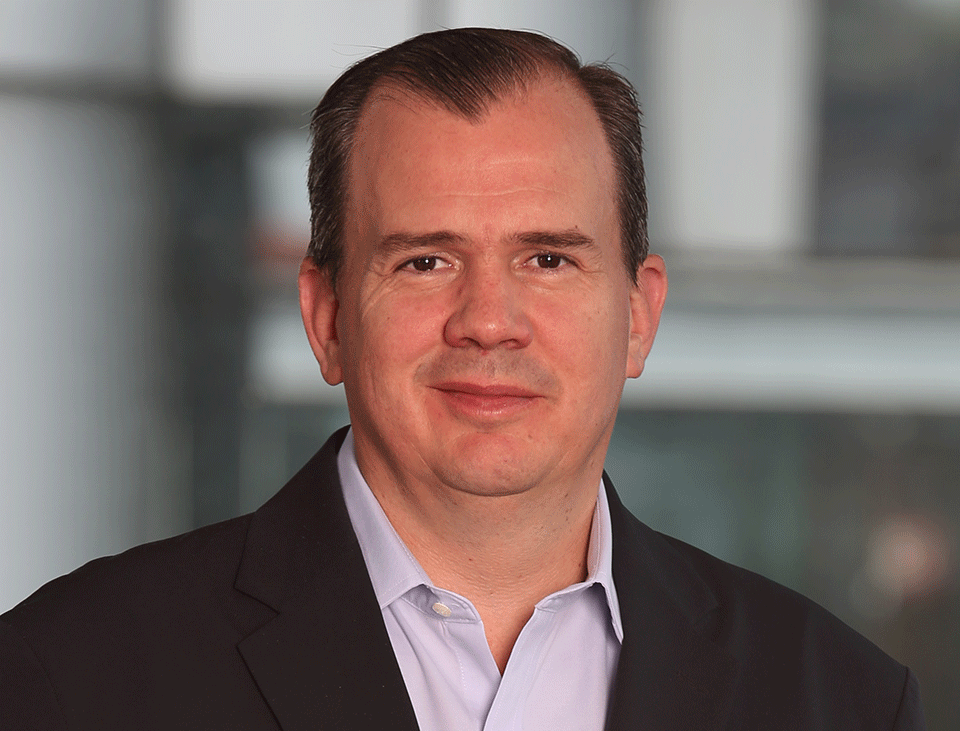
Led by country chief executive Juan Guillermo Agüero, the bank worked on four equity deals, for a combined volume of $430 million and a market share of 13%, including the $530 million IPO of Mall Plaza (the largest ever Chilean IPO and the largest Latin America real estate IPO since 2014) and the $70 million IPO of Inmobiliaria Manquehue. It was also sole bookrunner on a $76 million accelerated book-build for Hortifrut.
BTG’s Chile office also closed five M&A transactions, including acting as sole financial adviser to AES Gener in the sale of 100% of its regulated transmission assets to Chilquinta Energia for $220 million. This was the first deal in Chile’s transmission industry following 2016’s regulatory and tax reforms.
BTG was also sole financial adviser to Zurich Insurance Group in its $153 million acquisition of EuroAmerica’s Life Insurance and Asset Management business.
 |
Colombia
|
The Colombian economy is gradually gaining momentum, with a broad-based recovery in most sectors. GDP grew by 2.6% in 2018 (up from 1.4% in 2017), driven by a boost in domestic demand (in large part due to the inflow of migrants from Venezuela) and investment has been recovering.
The financial industry grew at 5.5% in the first quarter as assets continue to outpace an annualized rate of 2.8% GDP growth. The ratio of credit to GDP in the system now stands at 68% (from 50% in 2010).
|
|
|
Alejandro Figueroa |

In a concentrated banking system (the four largest banking groups by assets hold 73% of total assets), Banco de Bogotá had the best performance of the large Colombian banks. The bank, led by chief executive Alejandro Figueroa, claimed a leading market figure in net income, with 29.2%, despite only having 14.6% of assets, 12.2% of loans and 13.8% of deposits.
The success in 2018 of the bank’s digital strategy has been largely responsible for its strong margin performance: it grew savings in its digital accounts by a compound monthly rate of 37% over the year, while digital credit card sales had a compound monthly growth rate of 53% and a monthly average of 8,000 digital credit card orders placed.
The bank’s return on equity is 17.1%, comfortably ahead of Bancolombia’s 11.5% and Davivienda’s 12.9%, and its return on assets is also the best in Colombia, at 2.1%.
The bank grew net income by 53.9% in 2018, to $904 million.
In investment banking, Credit Suisse’s team fought its way onto the most important mandates and took a leading market share of 17.2%, advising Spain’s Gas Natural on its $388 million disposal of its gas distribution in Colombia to Brooksfield.
The bank was also involved in arguably the deal of the year: the Republic of Colombia’s $2 billion dual tranche bond issue in October 2018 that also featured an intra-day cash/tender switch. Credit Suisse helped the sovereign maximize the deal by taking advantage of higher oil prices and strong secondary performance of Colombian paper to generate an order book of $8 billion (the biggest ever for the issuer in terms of volumes and number of orders) and the bank was able to tighten it by an impressive 25 basis points from initial price thoughts.
The tender element was also a success, with the market accepting $1 billion of tender offers for the first switch offered by the Republic.
 |
Ecuador
|
While low oil prices are a boon for much of Latin America, they are definitely bad news for Ecuador. In June the Ecuadorian central bank said it expects the economy to slide into a mild recession (-0.2% GDP growth) in 2019.
Despite macroeconomic headwinds, Banco Pichincha enjoyed a remarkably strong performance. It increased net profits by 68.2%, or $48.5 million, thanks to better risk controls (non-performing loans fell to 3.2% from 3.5%) on revenue growth of 8%. This operational leverage has been achieved thanks to a strong focus on efficiency. In the last year alone, the bank managed to cut its cost-to-income ratio by 5.3 percentage points to 64.6%.
At the end of 2018 the bank had $10.6 billion in assets – or a 26% market share. It has developed a well-diversified business: 41% of its loan portfolio is commercial, 33% to individuals, 13% are home loans and 13% to the micro credit segment.
One of Pichincha’s strengths is its management’s conservative approach to liquidity management: cash and savings deposits represent 32% and 38.3% of liabilities respectively, while 23% of liabilities are concentrated in term deposits and 6.4% in other deposits. Should the country’s coming recession prove deeper than expected, the bank is well positioned to outlast any downturn.
 |
Mexico
|
The markets’ surprisingly positive reaction to the election of Andrés Manuel López Obrador (Amlo) last July proved to be based on false confidence regarding his likely economic orthodoxy.
However, since he has taken power some erratic decisions, notably regarding airports and energy, have compounded global headwinds, not least those caused by US president Donald Trump. Investors are less sanguine today about Mexico’s prospects than they were a year ago.
To be fair to the new government, these revised expectations of GDP growth, at around 1.5% for this year, sit within the long-term (albeit underperforming) trend of Mexican growth.
Despite this continuing frustration with headline economic growth, the banking industry remains sound. It is well-regulated, well-capitalised and highly competitive, while the low level of debt (loans are just 34% of GDP) offers considerable potential. And there is more to be found as more banks try to build scale (Scotiabank and Citibank are pursuing aggressive growth) by optimizing digital investments.
|
|
|
Nuno Matos |
The leading banks have to be very good – and HSBC Mexico has been the best of a strong group in recent years. Last year, Euromoney recognised its turnaround story, awarding it best banking transformation in the region. This year that momentum has propelled the bank to be the worthy and standalone winner of the best bank in Mexico.
Under the leadership of chief executive Nuno Matos since 2015, HSBC Mexico boosted pre-tax profit by 77% (to $507 million) in 2018 through increasing revenues (up 12% to $2.3 billion), strict cost control (expenses fell by 5%) and improving its risk performance (non-performing loans, which were for a long time a weakness, are now down to 1.9%, below the industry average of 2.1%).
The bank grew its loan portfolio by 19.8% (10.5 percentage points above the industry), which boosted market share to 7.3% from 6.7% – a big step towards Matos’ target of double digits. That aim of a market share of more than 10% is helped by deposits, where the bank grew 14.5% in 2018 and took market share to 8%.
Management says the bank’s continued rapid growth is down to a number of factors, including new products and better digital interfaces, but perhaps all these contribute to the improvement in retail service recognised by the National Commission for the Protection and Defense of the Users of Financial Services: HSBC came top.
Retail banking competition in Mexico is set to get ever-fiercer as the established banks respond and the smaller players fight for scale.
BBVA Bancomer will be a strong competitor for those retail banks in Mexico and is also the leading investment banking franchise. Álvaro Vaqueiro, head of BBVA corporate and investment banking in Mexico, has been successful in translating the bank’s corporate and wholesale relationships into investment banking mandates.
|
|
|
Álvaro Vaqueiro |

The bank’s undoubted strength is in fixed income financing – Bancomer dominates the highly liquid and cost-effective local debt market. It recorded a 31.2% share of this market, according to Dealogic, with $2.7 billion of volume generated from 26 deals. Second-place Santander claimed a market share of 17.5%.
In loans, BBVA also has twice the market share at 28% of second-placed Citi’s 14%.
BBVA is also one of the country’s leading providers of project finance structuring and capital.
In a quiet year for international finance for Mexican companies, BBVA claimed fourth spot in the DCM league table. Meanwhile, it completed six M&A deals (HSBC and Citi both claimed two mandates), coming third in volume terms, behind JPMorgan and Evercore, which were joint top, thanks to their respective roles on Countour Global’s $801 million acquisition of Cogeneración.
According to Dealogic, the bank failed to land any ECM mandates during the qualification period – not a critical weakness, given that only five equity deals came to market – but the bank will need to add capability and credibility to these more strategic advisory investment banking services if it is not to lose market share to the investment banking powerhouses, once economic growth sparks a new round of investment and capital markets activity in the country.
 |
Paraguay
|
Paraguay has been the standout sovereign growth story in Latin America for many years. Its ability to disconnect its GDP performance (between 2013 and 2018 the average annual GDP growth rate has been 5%) from the negative growth of its large neighbouring economies of Argentina and Brazil has been impressive, and has led to strong appetite for its frequent trips to the international debt capital markets.
Now Paraguay is brushing off a bad drought that has affected the country’s large agriculture sector. Thanks to economic diversification, the country’s GDP rate is set to be only 50 basis points lower than previously expected, at around 3%. Not too long ago bad agricultural yields (the country’s soy crop is expected to fall 12% this year) could spell recession in Paraguay. Now this is just a small bump on the long road to the investment-grade rating that the country craves.
One of the biggest factors in that pursuit is a very stable and solid banking system. A new player has emerged though: Banco Basa, which is timing its expansion to meet a deeper and more diversified financial system.
The bank’s president Eduardo Campos is aiming to make it a full-service bank within Paraguay and in 2018 launched Basa Capital ( Basa Casa de Bolsa) a brokerage and investment bank. It also launched an asset management subsidiary to manage investment and mutual funds for local and international investors.
Meanwhile the bank continues its rapid and profitable growth (return on equity was 42.2% in 2018) and it passed $1 billion in assets in 2018 and grew its loan portfolio by 28%, more than three times the financial sector’s growth. Basa’s market share has tripled in the last five years, but this has not affected asset quality, with non-performing loans of 2% below the sector average of 2.4%.
 |
Peru
|
Peru’s economy continues to perform well. While it has been seeking to diversify in recent years, the strong, double-digit growth in core mining industries has buoyed GDP growth. In the first quarter of 2019, annualized growth hit 2.5% and the IMF expects the year to reach about 3.3%.
The outlook is mixed, with the country exposed to fallouts in commodity prices if trade tensions between China and the US dampen global growth. The country’s largest bank clearly thinks it’s time to hit the accelerator. In 2018 Banco de Crédito del Peru oversaw a big increase in its loan portfolio, of 9.3% on an aggregate basis and with higher growth rates in higher margin credit. Middle-market corporate loans rose by 17.9% and consumer loans grew 10.1%.
The bank’s management team, led by chief executive Gianfranco Ferrari since April 2018, clearly think it is time to add risk and has done so effectively: its risk-adjusted net income margin improved to 4.48% (from 4.31%) in the first quarter of 2019, thanks largely to an improved cost of risk (the bank’s non-performing loans remained static).
The bank increased net earnings by 11.4% and return on equity stayed at an impressive 20.3%, with return on assets at 2.5%. The efficiency ratio nudged up, to 41.8% from 41.3%, due to slight expenses growth, but the bank remains well run with a strict risk-adjusted returns focus.
JPMorgan wins the award for best investment bank in Peru. It led on Peruvian M&A and executed highly complex and large transactions, such as Unacem’s reverse merger with its controlling holdings, InRetail’s acquisition of Quicorp and Alicorp’s acquisition of Fino and SAO.
The bank also got a perfect score in international debt capital market transactions (four out of four) from Peruvian issuers (a dual tranche for InRetail, one for Hunt Oil Company and the sovereign’s $3 billion trade in November 2018) and led liability management exercises (such as Pacasmayo). JPMorgan also led local market deals to help companies finance acquisitions (such as Inkia’s 25% October 2018 acquisition of Kallpa Generación).
 |
Uruguay
|
Uruguay’s economy is gradually slowing down. After years of defying the gravitational pull of the Argentine and Brazilian economies (this will be Uruguay’s 16th straight year of positive economic growth), it is starting to run out of steam. Consensus forecasts project this year’s figure will be below 1%.
Meanwhile, inflation remains high (8.2% in April) and rising – an economic wrinkle has not been helped by looser monetary policy from the central bank. It is little wonder the currency has been slipping.
So this makes for a complicated operating environment for the country’s banks, but this year’s best, Itaú Uruguay, has been the clear market leader under general manager Horacio Vilaró. It achieved the sector’s highest return on equity (29%) and grew its total net income by 438% to $124 million (equal to 47% of total net income by the private banks) on the back of a 4% increase in loans (total loans in the sector shrank by 1%).
The bank’s drive to digital has been effective – more than 70% of transactions are now made through its digital platform – and has helped it deliver a seven percentage point improvement in its efficiency ratio to 56%, the best of the private banks.
Central America and Caribbean
 |
Costa Rica
|
The rebranded BAC subsidiary in Costa Rica (previously called BAC San José) continued its impressive growth: last year BAC Credomatic Costa Rica increased its share of system assets by 1.3 percentage points to 14.1% and deposits from 13.5% to 15.3%.
The bank, led by country manager Federico Odio, already the largest private retail bank in the country, grew total assets to $6.3 billion and total loans to $4.3 billion. It contributed $115 million to the regional bank’s total $405 million net profit.
The Costa Rican bank may be about to create headaches for its group’s risk management team: it represents 28% of BIB’s regional loan portfolio (the self- prescribed limit for a single country) and 27% of its deposits.
It is also making swift progress in building its business banking franchise in the country (which now accounts for 33% of the bank’s total portfolio) with a focus on commercial lending, transaction services and trade finance.
In the last three years, the bank has grown its market shares in receivables by 140 basis points to 14.9%, to a total of $4.3 billion in 2018.
 |
Dominican Republic
|
The Dominican Republic continues to set the pace for economic growth for the region, growing 7% in 2018; this year’s expectation is of 5%, putting it at the top of the leader board again.
The strong economic performance of recent years – the government has demonstrated fiscal discipline and enacted export-orientated growth policies to deliver consistent growth – has had an impressive financial impact. The country has finally been able to build an investor base to execute its long-held desire to issue international bonds in its local currency – a demonstration of the stability the island economy enjoys.
Banco Popular Dominicano took full advantage of this stability (inflation was 1.17% at the end of 2018). The bank, which recently appointed Christopher Paniagua as chief executive, saw a positive risk environment and grew its loan portfolio by 14.4%, increased assets by 11.1% and deposits by 10.2% – well above the financial system’s growth of 7.1%.
The bank’s digital push also helped growth (app users grew by 21% compared with 2017, while 77.8% of its transactions are now made online).
Digitalization helped costs, too; the bank’s efficiency rating improved by 6.4 percentage points in the year (to 74.3%) and net profitability grew by 33.9% in local currency and by 28.5% in dollars (to $173 million).
The bank achieved a return on equity of 19.9%, up from 17%, and return on assets hit 2.1% from 1.8% a year earlier.
 |
El Salvador
|
Being a banker in El Salvador has not been easy in recent years. A drought in the country in 2018 damaged its key coffee exports sector and exacerbated problems for a small financial system weighed down by high poverty rates. That is not only feeding emigration (and tensions with the US) but has made the banks focus on small, low-risk areas.
However, change could be coming. In June this year the country’s new president, Nayib Bukele, vowed to cure the “sick child” of the region, planning investment to deepen and broaden the financial sector. And with a debt-to-GDP of just 24%, the government would seem to have the fiscal space to invest for growth without upsetting any rating agencies.
Banco Cuscatlán has been making rapid progress and is well placed to take advantage of any improvements: Jose Eduardo Luna, chief executive, has been implementing a long-term vision that is having near-term impact.
Cuscatlán effectively relaunched in June 2016 (and continued the overhaul with the introduction of its digital renovation programme in 2018) that has improved revenues, costs and margins. The bank has an industry-best net margin of 11% and has improved its efficiency rating better than peers – with a cost-to-income ratio of 57.4%. The bank certainly has momentum and has thrown down a gauntlet to the competition.
 |
Guatemala
|
At first glance, the Guatemalan economy seems in decent shape: growth of 3% last year and expectations of up to 3.8% next year aren’t bad. But given its nominal size, it is not good, either, and it is hobbled by a very patchy performance.
In Guatemala City, GDP per capita is around $10,000, but in the western highlands that shrinks to an impoverished $1,500.
Guatemala will elect its new president in August and the leader will have a challenge to deepen financial inclusion and grow the economy.
BAC Credomatic Guatemala, which carved out the best performance of the last 12 months, will greet whatever is to come (an infrastructure bill being debated in Congress would help) with the best momentum among its peer group.
Led by country manager Eric Campos, the bank grew its market share of assets to 8.2% in 2018 (from 7.9% in 2017 and 7.6% in 2016) and deposits to 8.1% (from 7.4% in 2017).
Given the size of the country, the bank’s earnings were eye-catching – with net income of $101 million generating returns on equity of 20.6% and on assets of 2.7% – both much higher than the industry’s average of 15.1% and 1.5% respectively.
 |
Honduras
|
Honduras has experienced a year of political upheaval and violence but its economy has pressed ahead. However, it is also true that the economy has benefited from an increase in remittances as migration surged, reaching an all-time high in 2018. Remittances now account for around 20% of Honduran GDP (which grew 3.1% in 2018).
Under its president Camilo Atala, Banco Ficohsa Honduras maintained its outperformance in the financial sector over the last year. The bank has made light work of integrating Citi’s retail unit in the country and continues to improve its key metrics: it grew its loan portfolio by 12.6% in 2018, total assets by 11.4%. It now represents 20% of the entire banking system in the country.
Deposits nudged up 2.3% and now equal 55% of the bank’s loan portfolio, giving the bank a funding advantage over most of its private-sector competitors.
 |
Nicaragua
|
Nicaragua’s reputation as a stable Central American country was swept aside last year as mass protests broke out against president Daniel Ortega.
Bankers, long accustomed to being able to brag about the country’s economic performance and stable investment climate, were jolted out of any complacency, as political commentators worried aloud about the possibility of civil war.
Banco Lafise Bancentro responded most effectively. The bank, led by president Roberto Zamora, increased its liquidity levels to withstand stress events: it raised $99 million in senior debt, $52 million in subordinated debt and $132 million in short-term debt (as well as $350 million in repurchase agreements with Nicaragua’s central bank).
The focus on funding saw the bank raise its cash and cash equivalents to 89.4% (while the industry average was 75%).
It also improved its solvency ratio by retaining earnings and subordinated debt; its capital adequacy ratio hit 18.47% at the end of December, well ahead of the average.
Meanwhile, the bank continued to perform, delivering net income growth of 18.5% and delivering returns on equity of 17.6% and on assets of 2.21%, both well ahead of its private-sector peers.
 |
Panama
|
What did the best bank in Panama do in 2018? Perhaps, to the consternation of its competitors, Banco General, led by chief executive Raúl Alemán, developed a new strategic plan through to 2021 to improve client service, pricing models and its use of data to boost revenues, minimise costs and build margins.
Evaluating the plan’s impact may be hard; even before the move was announced, the bank posted impressive annual results: net income rose to $434.2 million.
Last year alone it increased its retail loan portfolio by 7.4% (its market share is now 18.8%, up from 16.8% in 2014). Corporate credits grew a more modest 0.7% in the year, but the bank still enjoys 16% market share.
Costs are already under control: operating efficiency is 35.3%, return on equity stands at 20.2% and return on assets is 2.4%.
The competition was not even close in these key metrics before the bank decided to implement its three-year improvement plan.