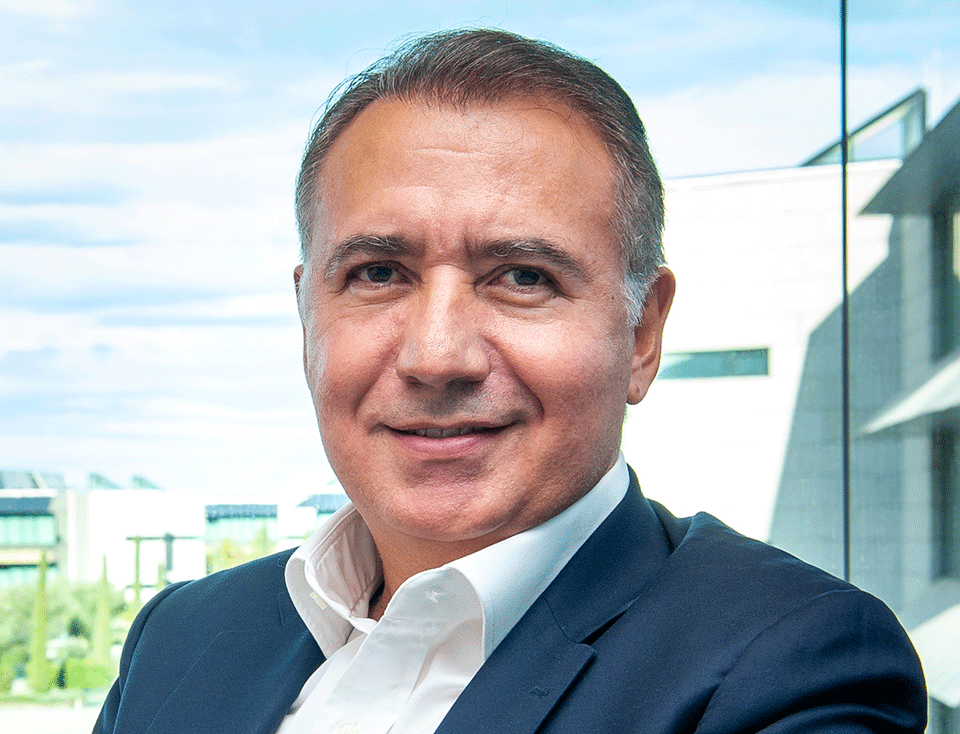
“Sudan is probably the richest country in the region. It has the best commodity in the world: water. It also has oil, minerals, cattle, fertile land and human resources. If it can resolve its problems, Sudan has the potential to be a perfect economy.” Such is the view of Ahmed Abbas, CEO of Liquidity Management Centre, a Bahraini Islamic investment firm. And if the capital markets are anything to go by, says Abbas, the biggest country in Africa might already have begun its recovery.
Liquidity Management Centre has just helped the Sudanese government sell a three-year, €68 million sukuk. It was the first sukuk the Sudanese government has issued. Its 9% coupon was, for Sudan, remarkably tight, according to industry insiders. Investors were almost exclusively Middle Eastern or North African. The deal followed a 9.5%, $130 million sukuk sold in September by Sudan’s Berber Cement Company.
Sudanese financing is re-emerging on the international market. At the same time, the country’s domestic banking sector might be about to take off. Two of the country’s biggest banks are negotiating a merger that will create the ninth-biggest bank in Africa – excluding Egypt and South Africa.
It is perhaps too early to get overly excited about Sudan. Bank of Khartoum, which is swallowing Emirates and Sudan Bank, boasts the most extensive retail network in the country. The oldest bank in Sudan, it has about 50 branches to cover the country’s 39 million people and 2.5 million square kilometres. The pooled corporate clients of Bank of Khartoum and Emirates and Sudan Bank (which does not provide retail services) will also be about 50 (both banks currently serve about 25 corporate customers). The new bank will have $300 million in capital.
Sudan’s total external debt at the end of 2006 was $26.6 billion (including arrears), compared with a GDP at present prices of $42.3 billion, and exports of $6 billion. Sudan’s defaulted London Club commercial debt is estimated at about $4 billion, including unpaid interest. Market sources say some hedge-fund holders of Sudanese debt might bring lawsuits against the country now that the government, by issuing fresh debt, has shown itself to have the resources to pay.
Fresh sanctions imposed by the US government in response to conflict in Darfur might add more gloom to Sudan’s economy. In fact, according to local media, Sudan’s central bank governor has said the sanctions might force the government to sell some of the 10% it was due to hold in the new bank merger.
Nevertheless, in recent years, China’s thirst for Sudanese oil has helped push GDP growth above 11%. Khartoum, in its own way, is a boom town.
With about 30 local and international banks operating in Sudan, the central bank is eager for more consolidation. Banks from Lebanon, Kuwait, Abu Dhabi, and Jordan have all set up shop in Sudan in recent years. Qatar National Bank received a licence in January.