Trichet puts the ECB firmly in the ascendancy
Since becoming governor in 2003, Jean-Claude Trichet has brought the ECB out of the shadow of the US Fed and led the global response to the credit crunch.
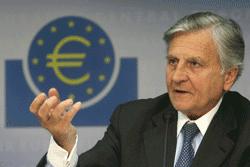 |
|
Jean-Claude Trichet, European Central Bank |
IT IS A little over a year since the European Central Bank injected some €95 billion of liquidity into markets, finally waking the world to the extent of the backwash from the US mortgage crisis, and beginning a fight to maintain stability that still rages. The ECB has been at the centre of that struggle ever since. That prominence reflects, of course, the size of the bad bets placed by European financial institutions on events across the Atlantic. But it also underlines the way in which the ECB has acquired a reputation for sure-footedness it could only have dreamed of when it was founded just over a decade ago.
That achievement is the work of many hands. No one, however, has contributed more than Jean-Claude Trichet, president of the European Central Bank since November 2003. On his watch the Bank has emerged from the shadow of the Federal Reserve, forged its own monetary policy and set the pace in matters of financial stability. In that process, Trichet has arguably made himself the world’s most respected central banker.
It is for those reasons that Trichet is both Euromoney’s central bank governor of the year, as well as being recognized for his outstanding contribution to finance through the course of his stellar career.
Urbane, intellectual and calm, the 65-year-old Trichet is the very model of a French public servant. Educated at the elite École Nationale d’Administration, Trichet rose through the French Treasury to end up as governor of the Banque de France. As architect of the franc fort policy – which tied the French currency to the Deutschemark – he nurtured strong links with the Bundesbank. His patent admiration for an institution widely perceived as the ultimate inflation fighter made him widely admired among the northern European countries centred on Germany.
Those ties lent him crucial support in the battle for the top job at the ECB, although initial doubts about the appointment of a Frenchman meant he had to wait four years. Trichet took over an institution that had struggled to establish its credibility under its first president, Wim Duisenberg, a man more liked than feared, and fatally handicapped by his status as a compromise candidate.
Trichet set himself two main tasks: instilling discipline into the bank’s monetary policymaking and its communication to markets, and pursuing calm but determined efforts to fight off any attempts to undermine the bank’s independence. There have been lapses of discipline – Trichet spooked markets in June this year with comments on inflation; there were hints of dissension over the September decision to hold rates steady – but the ECB has spoken with remarkable clarity for so polyglot an institution.
But perhaps a bigger achievement has been to check those who sought to exert more political control over the bank or to influence monetary policy. Those fights started early. European Union finance ministers set up the Eurogroup in 1995 as a counterweight to the ECB, appointing Luxembourg prime minister Jean-Claude Juncker as the Eurogroup president. New French president Nicolas Sarkozy has been especially vociferous in his demands that the ECB be made more accountable to elected politicians in the eurozone. The French establishment has long believed that Germany reneged on an agreement over political oversight when the ECB was set up.
Trichet’s response to those sallies has been firm and determined, even taking the battle into enemy territory when appropriate. Long a vocal believer in freer markets for labour, Trichet has gone as far as suggesting that, with their public finances in crisis, French politicians should get their own house in order before criticizing the ECB.
Ultimately, that is the central irony of Trichet’s career: the skills he honed at the very top of the French establishment have given him the powers to slip its grip and, in doing so, become a genuine European. That has made him a prophet without honour in his own country.
Trichet will need all his personal powers in coming years. The credit crunch continues to threaten financial institutions in the eurozone and beyond. The economic outlook in Europe is gloomy: even if relentless economic underperformance does not force laggards such as Italy out of the single currency, politicians are certain to turn up the pressure on the ECB to ease monetary policy. And the terms of trade for central banking – the payoff between growth and inflation – have turned against practitioners of that dark art. To paraphrase Bank of England governor Mervyn King – the Nice decade is in the past for Trichet, as for his peers.
Trichet is not yet Paul Volcker – the great US central banker who tamed inflation in the early 1980s. Eurozone inflation has regularly been above the ECB’s target of “at or close to 2%”. But by cementing the reputation of the ECB and by his, largely, deft moves in markets, Jean-Claude Trichet has put himself at the pinnacle of his profession.